Xianbei
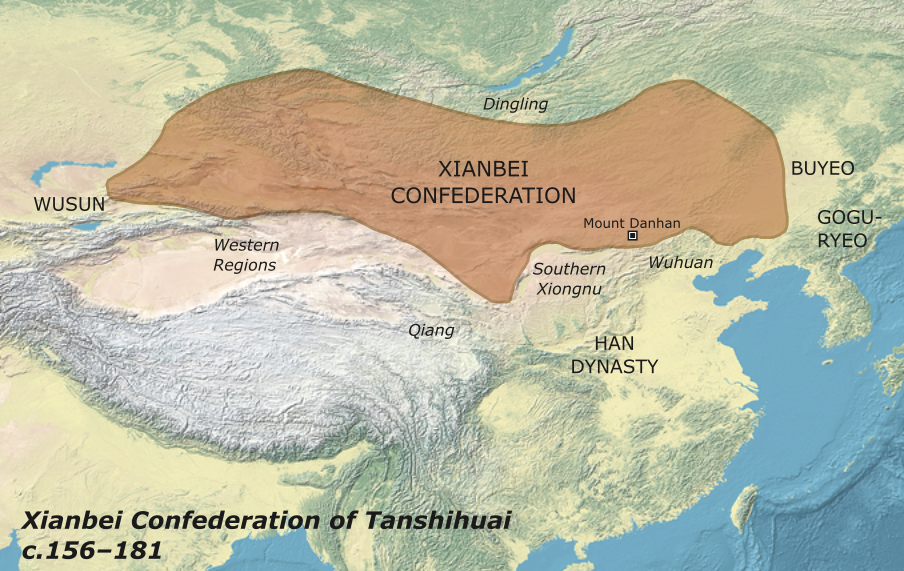
The Xianbei (simplified Chinese: 鲜卑; pinyin: Xiānbēi) were an ancient nomadic people in northern East Asia who developed a distinct cultural and political identity by the first century BC. They inhabited regions spanning parts of present-day northeastern China, Inner Mongolia, and the eastern Eurasian steppe. Several Xianbei groups formed ruling regimes, with early political center around present-day Datong in Shanxi. The Xianbei were likely not of a single ethnicity, but rather a multilingual, multi-ethnic confederation consisting of mainly Proto-Mongols (who spoke either pre-Proto-Mongolic, or Para-Mongolic languages), and, to a minor degree, Tungusic and Turkic peoples. They originated from the Donghu people who splintered into the Wuhuan and Xianbei when they were defeated by the Xiongnu at the end of the third century BC. Following the split, the Xianbei people did not have direct contact with the Han dynasty, residing to the north of the Wuhuan. In the first century BC, the Xianbei began actively engaging in the struggle between the Han and Xiongnu, culminating in the Xianbei replacing the Xiongnu on the Mongolian Plateau.
What You'll Get

Taishang Huang
In Chinese history, a Taishang Huang or Taishang Huangdi is an honorifi…
Silla
Silla was a Korean kingdom that existed between 57 BCE and 935 CE and w…
Taoism
Taoism or Daoism is a philosophical and religious tradition indigenous …
Leshan Giant Buddha
The Leshan Giant Buddha is a 71-meter (233 ft) tall stone statue, built…
Yellow Sea
The Yellow Sea (simplified Chinese: 黄海; pinyin: Huáng Hǎi), also kno…
Huai River
The Huai River, formerly romanized as the Hwai, is a major river in Eas…
Western Turks
The Western Turkic Khaganate (Chinese: 西突厥; pinyin: Xī Tūjué) or O…
Yue Jue Shu
Yuejueshu 越絕書 "End of the kingdom of Yue" is a history of …
Sancai
Sancai (Chinese: 三彩; pinyin: sāncǎi) is a versatile type of decorat…
Yangtze River
The Yangtze River, Yangzi River or Chang Jiang (simplified Chinese: 长江…