Pipa
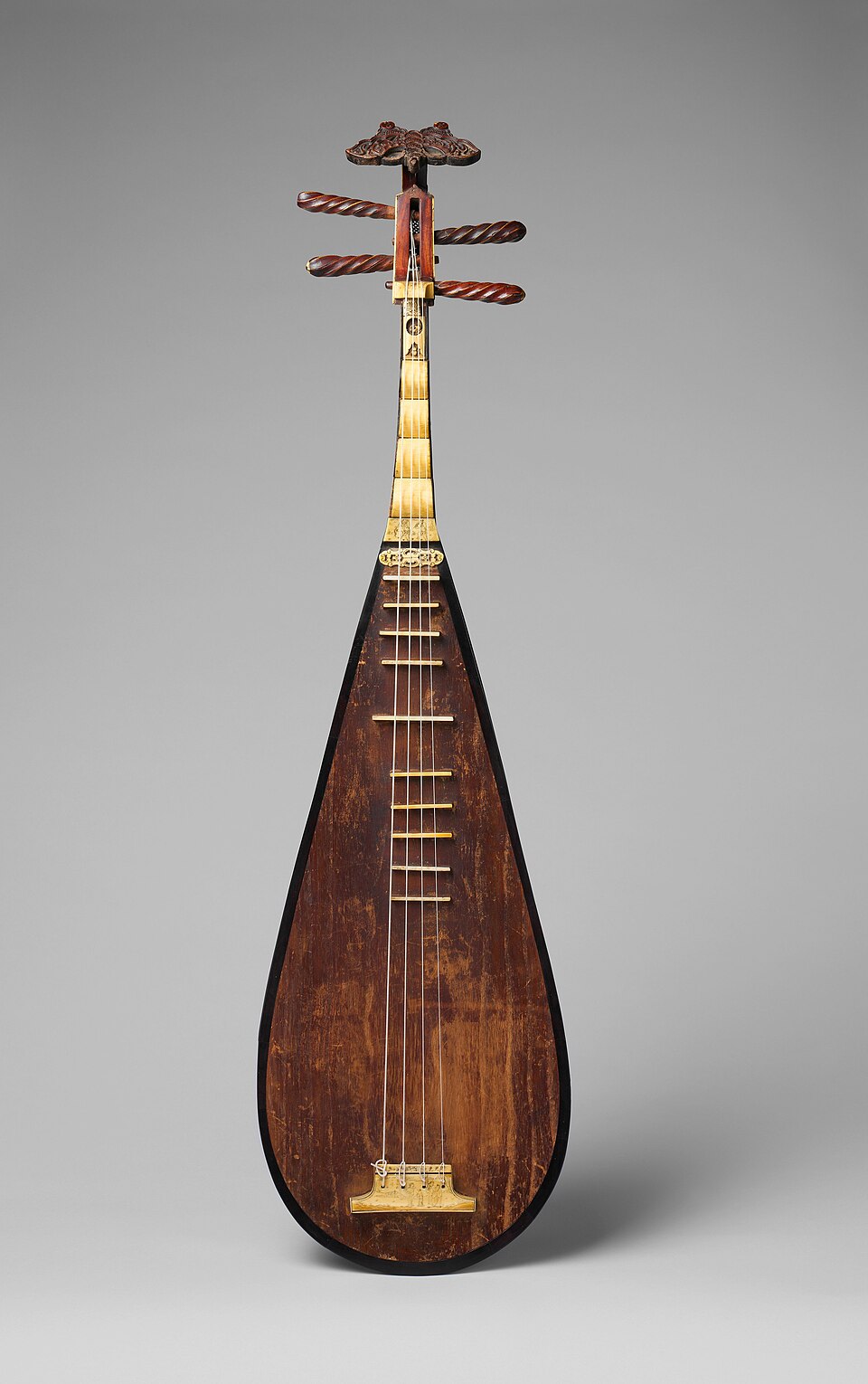
The pipa (Chinese: 琵琶; pinyin: pípá) is a traditional Chinese musical instrument belonging to the plucked category of instruments. Sometimes called the "Chinese lute", the instrument has a pear-shaped wooden body with a varying number of frets ranging from 12 to 31. Another Chinese four-string plucked lute is the liuqin, which looks like a smaller version of the pipa. The pear-shaped instrument may have existed in China as early as the Han dynasty, and although historically the term pipa was once used to refer to a variety of plucked chordophones, its usage since the Song dynasty refers exclusively to the pear-shaped instrument.
The pipa is one of the most popular Chinese instruments and has been played for almost two thousand years in China. Several related instruments are derived from the pipa, including the Japanese biwa and Korean bipa in East Asia, and the Vietnamese đàn tỳ bà in Southeast Asia. The Korean instrument is the only one of the three that is no longer widely used.
What You'll Get

Taishang Huang
In Chinese history, a Taishang Huang or Taishang Huangdi is an honorifi…
Silla
Silla was a Korean kingdom that existed between 57 BCE and 935 CE and w…
Taoism
Taoism or Daoism is a philosophical and religious tradition indigenous …
Leshan Giant Buddha
The Leshan Giant Buddha is a 71-meter (233 ft) tall stone statue, built…
Yellow Sea
The Yellow Sea (simplified Chinese: 黄海; pinyin: Huáng Hǎi), also kno…
Huai River
The Huai River, formerly romanized as the Hwai, is a major river in Eas…
Western Turks
The Western Turkic Khaganate (Chinese: 西突厥; pinyin: Xī Tūjué) or O…
Yue Jue Shu
Yuejueshu 越絕書 "End of the kingdom of Yue" is a history of …
Sancai
Sancai (Chinese: 三彩; pinyin: sāncǎi) is a versatile type of decorat…
Yangtze River
The Yangtze River, Yangzi River or Chang Jiang (simplified Chinese: 长江…