Sancai
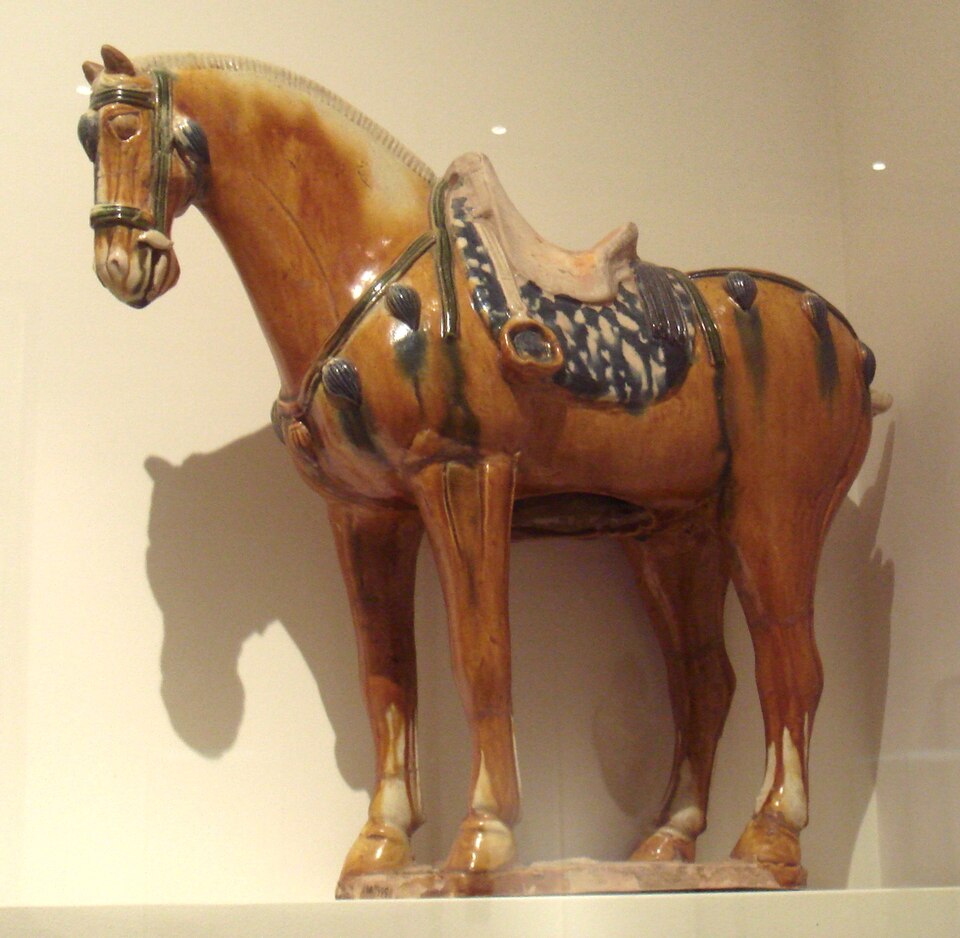
Sancai (Chinese: 三彩; pinyin: sāncǎi) is a versatile type of decoration on Chinese pottery and other painted pieces using glazes or slip, predominantly in the three colours of brown (or amber), green, and a creamy off-white. It is particularly associated with the Tang dynasty (618–907) and its tomb figures, appearing around 700. Therefore, it is commonly referred to as Chinese: 唐三彩 Tang Sancai in Chinese. Tang sancai wares were sometimes referred in China and the West as egg-and-spinach by dealers, for their use of green, yellow, and white, especially when combined with a streaked effect.
The Tang dynasty three-color glazed pottery is the treasure of ancient Chinese ceramic firing techniques. It is a kind of low-temperature glazed pottery popular in the Tang dynasty. The glaze has yellow, green, white, brown, blue, black and other colours. The yellow, green, and white colour-based are predominant, so people call it "Tang Sancai." Because the Tang Sancai was unearthed in Luoyang earliest and is most found in Luoyang, it is also known as "Luoyang Tang Sancai."
It uses lead-glazed earthenware, and although two firings were needed, it was easier and therefore cheaper to make than Chinese porcelain or celadon, and suitable for making large figures, if necessary made up of several moulded sections assembled after a first firing. Vessels, mostly rather small and made for burial, were made in the technique as well as figures. Small plates with three feet, typically about 18–40 cm (7–16 inches) across, called "offering-trays", are a distinctive type, with more carefully controlled decoration than other types of pieces.
The white may come from the natural colour of the fired clay, sometimes coated with a transparent glaze, or there may be a white slip. The brown and green colours came from adding metal oxides to a lead glaze, and in fact blues and blacks are also found. The blue came from adding imported cobalt, and was therefore more expensive and used sparingly, often on smaller pieces.
What You'll Get

Taishang Huang
In Chinese history, a Taishang Huang or Taishang Huangdi is an honorifi…
Silla
Silla was a Korean kingdom that existed between 57 BCE and 935 CE and w…
Taoism
Taoism or Daoism is a philosophical and religious tradition indigenous …
Leshan Giant Buddha
The Leshan Giant Buddha is a 71-meter (233 ft) tall stone statue, built…
Yellow Sea
The Yellow Sea (simplified Chinese: 黄海; pinyin: Huáng Hǎi), also kno…
Huai River
The Huai River, formerly romanized as the Hwai, is a major river in Eas…
Western Turks
The Western Turkic Khaganate (Chinese: 西突厥; pinyin: Xī Tūjué) or O…
Yue Jue Shu
Yuejueshu 越絕書 "End of the kingdom of Yue" is a history of …
Sancai
Sancai (Chinese: 三彩; pinyin: sāncǎi) is a versatile type of decorat…
Yangtze River
The Yangtze River, Yangzi River or Chang Jiang (simplified Chinese: 长江…