Parthian Empire
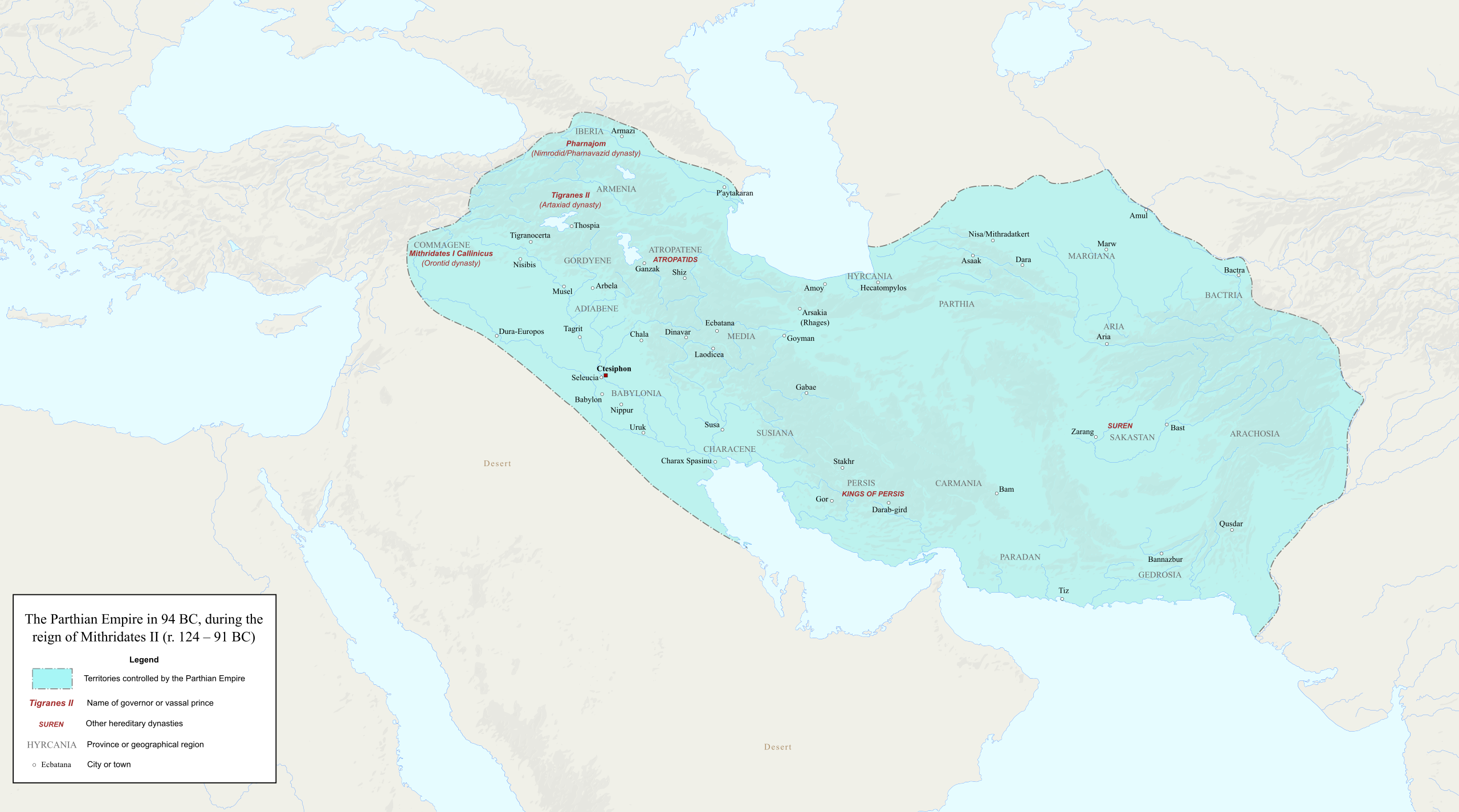
The Parthian Empire, also known as the Arsacid Empire, was a major Iranian political and cultural power centered in ancient Iran from 247 BC to 224 AD. Its latter name comes from its founder, Arsaces I, who led the Parni tribe in conquering the region of Parthia in Iran's northeast, then a satrapy (province) under Andragoras, who was rebelling against the Seleucid Empire. Mithridates I (r. c. 171 – 132 BC) greatly expanded the empire by seizing Media and Mesopotamia from the Seleucids. At its height, the Parthian Empire stretched from the northern reaches of the Euphrates, in what is now central-eastern Turkey, to present-day Afghanistan and western Pakistan. The empire, located on the Silk Road trade route between the Roman Empire in the Mediterranean Basin and the Han dynasty of China, became a center of trade and commerce.
The Parthians largely adopted the art, architecture, religious beliefs, and regalia of their culturally heterogeneous empire, which encompassed Persian, Hellenistic, and regional cultures. The Arsacid court initially adopted elements of Greek culture, though it eventually saw a gradual revival of Iranian cultural traditions. In modern historiography, the Arsacids are considered the first indigenous Iranian dynasty to come to power in the Iranian world after the Achaemenids, in contrast to the Seleucids who represented Hellenistic rule after Alexander the Great. The Arsacid rulers were titled "King of Kings", claiming the inheritance of the Achaemenid Empire; indeed, they accepted many local kings as vassals, though the Achaemenids had centrally appointed, albeit largely autonomous, satraps. The Parthian court appointed a small number of satraps, largely outside Iran, but these satrapies were smaller and less powerful than the Achaemenid potentates. With the expansion of Arsacid power, the seat of central government shifted from Nisa to Ctesiphon along the Tigris (south of Baghdad), although several other sites also served as capitals.
The earliest enemies of the Parthians were the Seleucids in the west and the Scythians in the north. However, as Parthia expanded westward, they came into conflict with the Kingdom of Armenia, and eventually the late Roman Republic. Rome and Parthia competed with each other to establish the kings of Armenia as their tributaries. The Parthians destroyed the army of Marcus Licinius Crassus at the Battle of Carrhae in 53 BC, and in 40–39 BC, Parthian forces captured the whole of the Levant except Tyre from the Romans; Mark Antony led a Roman counterattack. Several Roman emperors invaded Mesopotamia in the Roman–Parthian Wars of the next few centuries, capturing the cities of Seleucia and Ctesiphon. Frequent civil wars between Parthian contenders to the throne proved more dangerous to the Empire's stability than foreign invasion, and Parthian power evaporated when Ardashir I, ruler of Istakhr in Persis, revolted against the Arsacids and killed their last ruler, Artabanus IV, in 224 AD. Ardashir established the Sasanian Empire, which ruled Iran and much of the Near East until the Muslim conquests of the 7th century AD, although the Arsacid dynasty lived on through branches of the family that ruled Armenia, Caucasian Iberia, and Caucasian Albania.
Native Parthian sources, written in Parthian, Greek and other languages, are scarce when compared to Sasanian and even earlier Achaemenid sources. Aside from scattered cuneiform tablets, fragmentary ostraca, rock inscriptions, drachma coins, and the chance survival of some parchment documents, much of Parthian history is only known through external sources. These include mainly Greek and Roman histories, but also Chinese histories, prompted by the Han Chinese desire to form alliances against the Xiongnu. Parthian artwork is a means of understanding aspects of society and culture that are otherwise absent in textual sources.
What You'll Get

Western Liang
Liang, known in historiography as the Western Liang (simplified Chinese…
Parthian Empire
The Parthian Empire, also known as the Arsacid Empire, was a major Iran…
Han dynasty
The Han dynasty was an imperial dynasty of China (202 BC – 9 AD, 25–2…
Five Dynasties and Ten Kingdoms…
The Five Dynasties and Ten Kingdoms period (Chinese: 五代十國) was an e…
Sui dynasty
The Sui dynasty was a Chinese imperial dynasty that ruled from 581 to 6…
Jiedushi
The jiedushi or jiedu was a regional military governor in imperial Chin…
An Lushan rebellion
The An Lushan rebellion was a civil war in China that lasted from 755 t…
Xuanwu Gate Incident
The Xuanwu Gate Incident was a palace coup for the throne of the Tang d…