Han dynasty
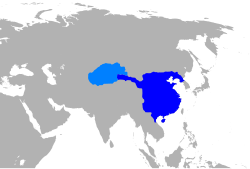
The Han dynasty was an imperial dynasty of China (202 BC – 9 AD, 25–220 AD) established by Liu Bang and ruled by the House of Liu. The dynasty was preceded by the short-lived Qin dynasty (221–206 BC) and a warring interregnum known as the Chu–Han Contention (206–202 BC), and it was succeeded by the Three Kingdoms period (220–280 AD). The dynasty was briefly interrupted by the Xin dynasty (9–23 AD) established by the usurping regent Wang Mang, and is thus separated into two periods—the Western Han (202 BC – 9 AD) and the Eastern Han (25–220 AD). Spanning over four centuries, the Han dynasty is considered a golden age in Chinese history, and had a permanent impact on Chinese identity in later periods. The majority ethnic group of modern China refer to themselves as the "Han people" or "Han Chinese". The spoken Chinese and written Chinese are referred to respectively as the "Han language" and "Han characters".
What You'll Get

Western Liang
Liang, known in historiography as the Western Liang (simplified Chinese…
Parthian Empire
The Parthian Empire, also known as the Arsacid Empire, was a major Iran…
Han dynasty
The Han dynasty was an imperial dynasty of China (202 BC – 9 AD, 25–2…
Five Dynasties and Ten Kingdoms…
The Five Dynasties and Ten Kingdoms period (Chinese: 五代十國) was an e…
Sui dynasty
The Sui dynasty was a Chinese imperial dynasty that ruled from 581 to 6…
Jiedushi
The jiedushi or jiedu was a regional military governor in imperial Chin…
An Lushan rebellion
The An Lushan rebellion was a civil war in China that lasted from 755 t…
Xuanwu Gate Incident
The Xuanwu Gate Incident was a palace coup for the throne of the Tang d…