An Lushan rebellion
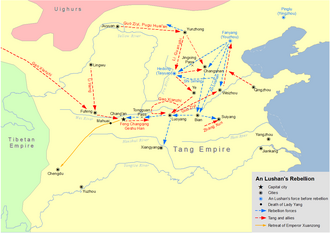
The An Lushan rebellion was a civil war in China that lasted from 755 to 763, at the approximate midpoint of the Tang dynasty (618–907). It began as a commandery rebellion attempting to overthrow and replace the Tang government with the rogue Yan dynasty. The rebels succeeded in capturing the imperial capital Chang'an after the emperor had fled to Sichuan, but eventually succumbed to internal divisions and counterattacks by the Tang and their allies. The rebellion spanned the reigns of three Tang emperors: Xuanzong, Suzong, and Daizong.
On 16 December 755, An Lushan, the jiedushi of the Taiyuan Commandery, mobilized his army and marched to Fanyang. An Lushan led the rebellion for two years before he was assassinated by his son An Qingxu. Two years after An Qingxu's ascension, Shi Siming, the governor of Pinglu Commandery and a close ally of An Lushan, killed An Qingxu and usurped the leadership. Shi Siming ruled for two years, but was in turn killed by his own son Shi Chaoyi, who ruled for another two years until the Yan dynasty fell to Tang forces on 17 February 763. There were also other anti-Tang rebel forces, especially those in An Lushan's base area in Hebei, as well as Sogdian forces and other opportunist parties who took advantages of the chaos.
The rebellion was an important turning point in the history of medieval China, as the military activities and associated casualties caused significant depopulation from famine, displacement, and large-scale infrastructure destruction, significantly weakening the Tang dynasty and leading to the permanent loss of the Western Regions. Even though the rebellion was ultimately suppressed by a large-scale alliance between the imperial dynasty and various participants, including local militias and foreign support, the dynasty did not overall change the structure of the military committee, but only followed the old principles of establishing territory. It was a direct cause of the dynasty's decline, and led to rampant secessionism among regional warlords during the latter half of the dynasty that continued into the Five Dynasties and Ten Kingdoms period for decades after the ultimate demise of the Tang. The fear of repeating Tang's commandery secessionism also led the Song dynasty that followed to distrust and oppress prominent military commanders even when invaded by hostile foreign states such as Liao, Western Xia and Jin. It also triggered the long-term decline of the Guanzhong region, which had been a political and economic heartland of China at least since the Han dynasty, and a shift of the economic center of China towards the Jiangnan region.
What You'll Get

Western Liang
Liang, known in historiography as the Western Liang (simplified Chinese…
Parthian Empire
The Parthian Empire, also known as the Arsacid Empire, was a major Iran…
Han dynasty
The Han dynasty was an imperial dynasty of China (202 BC – 9 AD, 25–2…
Five Dynasties and Ten Kingdoms…
The Five Dynasties and Ten Kingdoms period (Chinese: 五代十國) was an e…
Sui dynasty
The Sui dynasty was a Chinese imperial dynasty that ruled from 581 to 6…
Jiedushi
The jiedushi or jiedu was a regional military governor in imperial Chin…
An Lushan rebellion
The An Lushan rebellion was a civil war in China that lasted from 755 t…
Xuanwu Gate Incident
The Xuanwu Gate Incident was a palace coup for the throne of the Tang d…