Han Gan
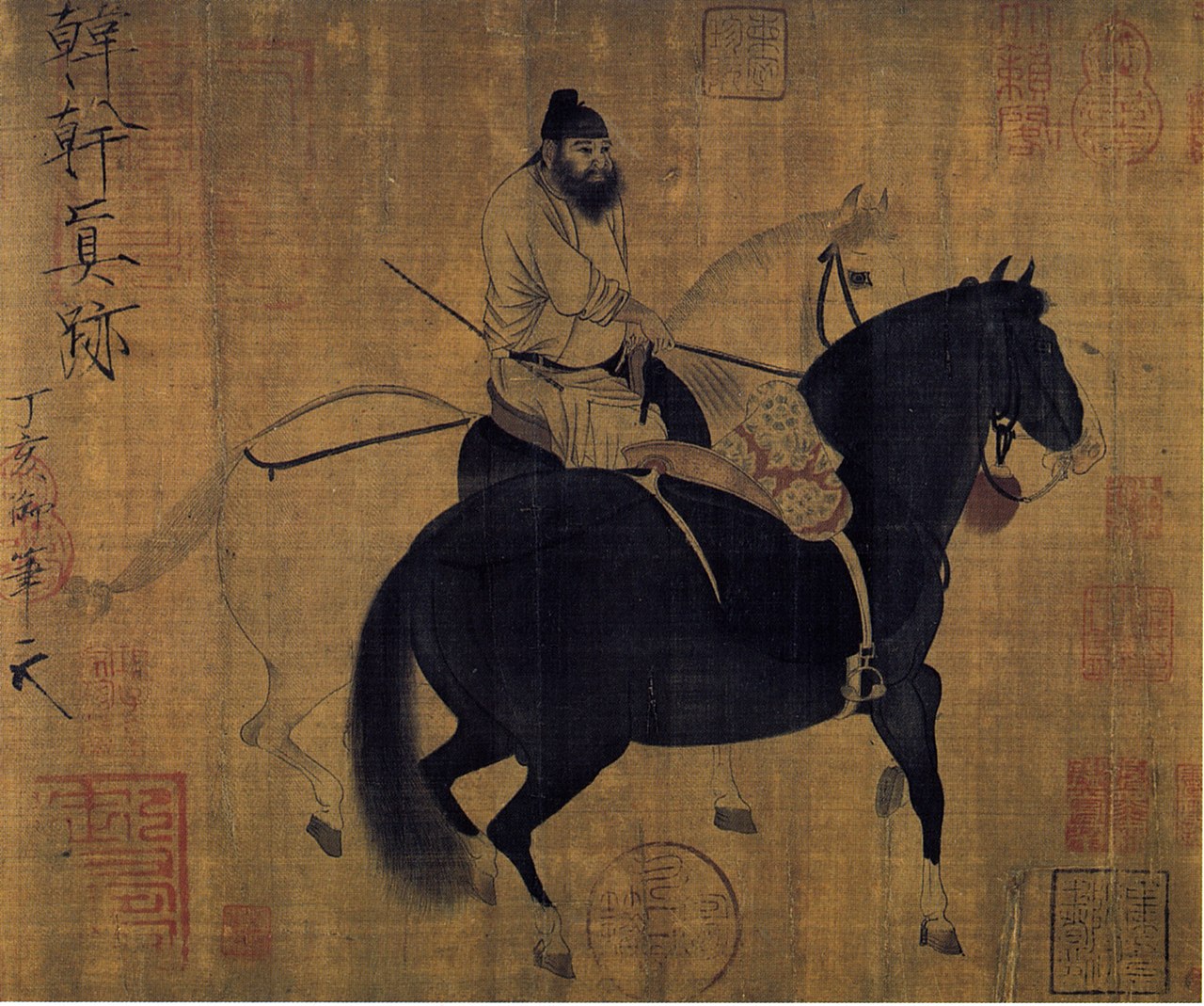
Han Gan (simplified Chinese: 韩干) (c. 706–783) was a Chinese painter during the Tang dynasty.
He came from a poor family in either Chang'an, modern-day Xi'an, Shaanxi; Lantian, modern-day Shaanxi; or Daliang, modern-day Kaifeng, Henan. As a young man, Han Gan was recognized by Wang Wei, a prominent poet, who sponsored Han in learning arts. Han became a student of Cao Ba, a court painter. After his studies, Han became a painter in the Tang court.
Han painted many portraits with Buddhist and Daoist themes during his career; however, he is most widely remembered for his paintings of horses. He was reputed to have "learned from the horses in the imperial stables" and to be able to not only portray the physical body of the horse, but also its spirit. His reputation rose and surpassed that of his teacher. Horse painters of later generations studied Han.
What You'll Get

Shi Siming
Shi Siming (Chinese: 史思明) (19th day of the 1st month, 703? – 18 Apr…
Laozi
Laozi (Chinese: 老子; pinyin: Lǎozǐ) was a legendary Chinese philosop…
Li Jing
Li Jing (571 – July 2, 649, courtesy name Yaoshi, posthumous name Duke…
Gao Xianzhi
Gao Xianzhi or Ko Sŏnji (died January 24, 756) was a Tang dynasty gene…
Jia Dan
Jia Dan (simplified Chinese: 贾耽; pinyin: Jiǎ Dān, 730 – 805), cour…
Sulaiman al-Tajir
Sulaymān al-Tājir (Arabic: سليمان التاجر, lit. 'Solomon …
Zhu Wen
Emperor Taizu of Later Liang (後梁太祖), personal name Zhu Quanzhong (朱…
Huang Chao
Huang Chao (835 – July 13, 884) was a wealthy Chinese salt trader and …
Jianzhen
Jianzhen (688–763), also known by his Japanese name Ganjin, was a Tang…
Xuanzang
Xuanzang (Chinese: 玄奘; 6 April 602 – 5 February 664), born Chen Hui …