Leisure in the Tang Dynasty
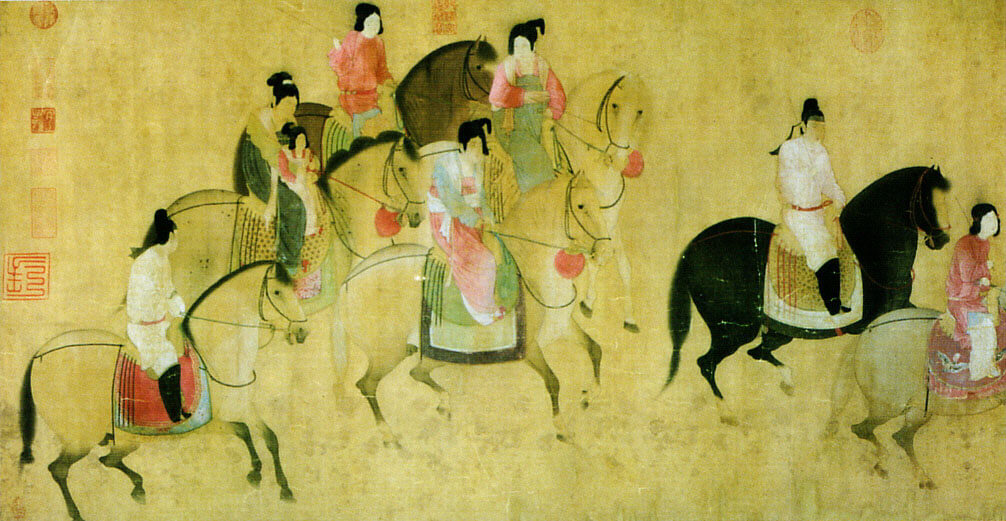
The Tang played as hard as it governed. Polo thundered across the grounds of the imperial palace; courtesans sang the new songs of the pleasure quarters in the capitals' wine-shops; poets wandered the mountains in search of waterfalls and enlightenment; festival crowds packed the temple fairs; and the empire's aristocrats hunted, hawked, gambled, and feasted through the seasons of the year. Tang leisure was not the residue of work — it was one of the dynasty's great arts, and its record in poetry and painting is among the richest of any civilization.
Polo: The Game of Empire
Nothing symbolized Tang aristocratic life like polo — the chagan of the Turks, imported from the steppe with the dynasty’s very blood. Played on horseback with long mallets and a wooden ball, it was the cavalryman’s game and the court’s obsession: emperors played it (Zhongzong, Xuanzong, and the tragic Jingzong, whose devotion to the game reportedly cost him his life when assassins struck during a night match), princes organized palace leagues, and the tomb murals and figurines of the era show the players bent low at full gallop, mallets swinging. Women’s polo — the ladies of the court riding sidesaddle at the game — appears in the paintings and scandalized the moralists in equal measure. The sport spread with the dynasty’s prestige: it took root in Japan and Persia alike, and the Chinese name for the mallet passed into the vocabulary of half of Asia. When the later poet wrote of the dynasty’s golden age, the polo ground was one of his first images.
The Pleasure Quarters
The urban entertainment culture of the Tang reached its apex in the northern ward of Chang’an and its counterparts in Luoyang and Yangzhou — the licensed pleasure districts where the courtesans, musicians, dancers, and actors of the empire were registered and ranked. Here the dynasty’s greatest poets spent their evenings and much of their verse: Bai Juyi and Yuan Zhen immortalized the singers of the Pingkang ward, Li Bai drank through the wine-shops of both capitals, and the examination candidates lodged nearby made the quarter their second academy, polishing their poems on the walls of the wine-shops as on a public notice board. The courtesans themselves were artists of the first rank — singers who premiered the new ballads, poets whose verses survive in the anthologies, chess-players and calligraphers who matched the scholars at their own games. The quarter was a licensed zone of pleasure and a commercial machine, taxed and regulated by the city, and its economics ran from the imperial examinations (whose pass lists made and broke singing careers) to the tourist trade of the canal cities.
Festivals and the Calendar of Play
Tang leisure ran on the festival calendar, and the calendar was full. The New Year brought the greatest sequence — court audiences, family feasts, the lantern festival of the fifteenth night, when the curfew lifted and the capitals’ wards filled with lantern displays, music, and crowds until dawn. The Pure Brightness festival sent the city outing to the tombs and the spring countryside; the Dragon Boat festival raced boats and exchanged the herb-bundles against the summer’s pests; the Double Seventh celebrated the lovers’ stars; the Mid-Autumn moon filled the gardens with viewing parties. The emperor’s birthdays — Xuanzong’s Qiqiong festival among them — became imperial holidays with their own performances and amnesties. The temple fairs of the Buddhist and Taoist establishments ran the commercial calendar between the festivals: markets, wrestlers, acrobats, storytellers, and the shadow-play and puppet shows that were the age’s popular theater.
The Scholar’s Leisure
For the educated man, leisure was an art form with its own canon. The excursion to the mountains — the yaji gathering of friends at a famous site, with wine, poetry, and painting — was the scholar’s highest recreation, sanctified by Wang Xizhi’s fourth-century Orchid Pavilion gathering and practiced by every Tang man of letters: the poets Du Fu and Li Bai and the painters Wang Wei made the landscape excursion the emblem of the cultivated life. Chess (weiqi) and the lute (qin) were the scholarly games, gardening and flower-appreciation the scholarly crafts, and collecting — of rocks, of bronzes, of calligraphy — the scholarly vice. The wilder aristocratic recreations — hunting with hawks and hounds, gambling with dice and cards, the boat excursions and night revels of the canal cities — filled the other end of the spectrum, deplored by the moralists and immortalized by the poets in about equal measure.
Historical Assessment
Tang leisure left a legacy out of proportion to its seeming frivolity. The poetry of the pleasure quarters became the canon of Chinese verse; the polo stick and the courtesan’s song entered the iconography of the golden age; the festival customs of the Tang — the lanterns, the boats, the moon-viewing — became the festival customs of China forever after. And the record itself is a historical source of the first rank: the paintings of the outings and the games, the poems of the wine-shops and the singing girls, the foreign accounts of the capitals’ night life, together preserve a civilization at play with a fullness matched by few ages before the modern world. The Tang that conquered the steppe and wrote the law codes also knew, and recorded, how to spend an evening.
References & Historical Sources
- Quantangshi, the festival and pleasure-quarter poems of Li Bai, Bai Juyi, Du Fu, and Yuan Zhen.
- Old Book of Tang and New Book of Tang, treatise on ritual, on the festival calendar.
- Tang huiyao, on the licensing of the pleasure quarters and the market regulations.
- The tomb murals of Prince Zhanghuai and Princess Yongtai, for polo, hunting, and excursion scenes.
- Edward H. Schafer, “Hunting Parks and Animal Enclosures in Ancient China” and The Golden Peaches of Samarkand.