Fashion in the Tang Dynasty
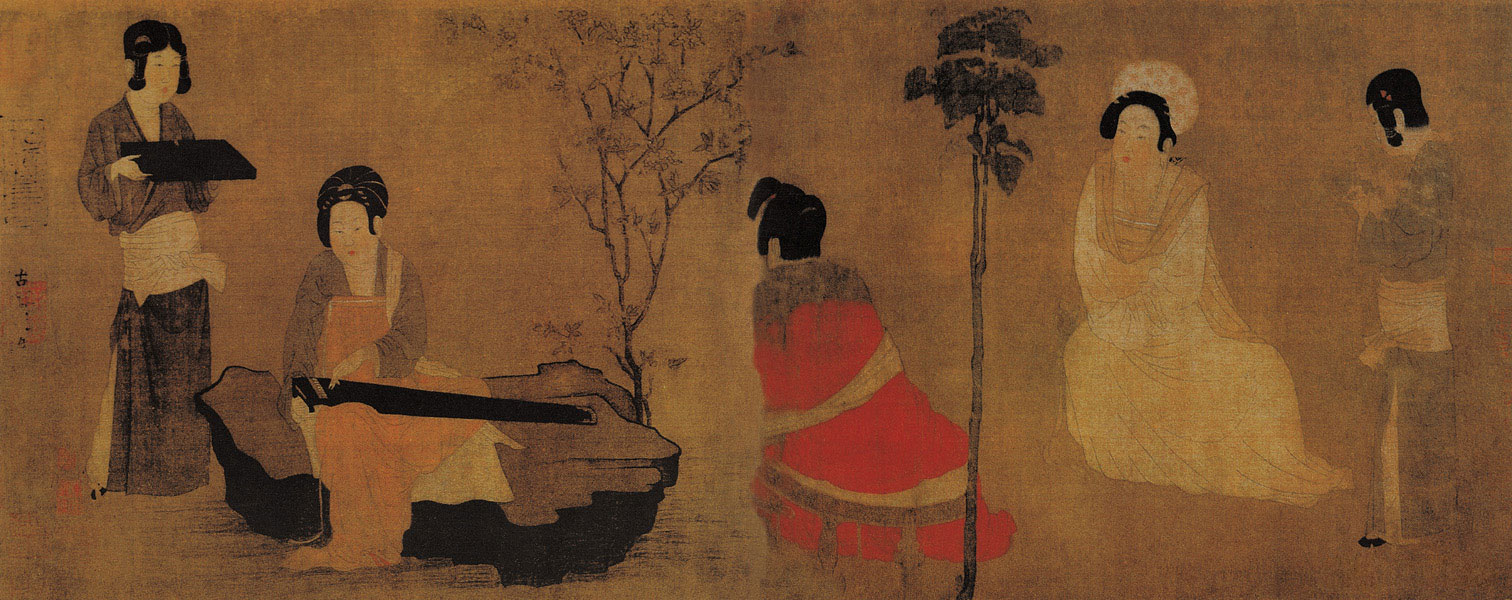
Tang fashion was the most cosmopolitan costume in the medieval world — silk from China's own looms cut in steppe silhouettes, Persian roundels woven into Sogdian-style gowns, Korean waistlines and Central Asian boots, all regulated by sumptuary law and all in constant motion. From the narrow-sleeved riding dress of the founding aristocracy to the high-waisted, wide-sleeved splendor of Xuanzong's court and the exotic fashions the silk road delivered to the wardrobes of Chang'an, the dynasty's dress records the story of its openness — and its confidence.
The Law of Dress
Tang dress was regulated down to the detail, and the regulations themselves are historical documents. The sumptuary codes, elaborated from Gaozu’s reign onward and revised through the dynasty, assigned colors and ornaments by rank: purple and crimson for the high officials of the third rank and above, green and blue for the middle ranks, and yellow — the imperial color, forbidden to subjects after Xuanzong’s reign — reserved to the throne. Official robes carried the rank badges of the age: the ornamental belt plaques of gold, silver, and jade that identified their wearer’s grade in the bureaucratic order, and the symbolic patterns — the twelve ornaments of the emperor’s regalia, inherited from the deepest antiquity — that wrapped the sovereign in cosmological meaning. Court ladies’ dress followed its own hierarchy of rank insignia, with the empress’s ceremonial robes, in dark blue and hung with pendants, standing at the head of a graduated system that the palace regulations minutely specified.
Women’s Dress: The Tang Silhouette
Women’s fashion was the dynasty’s great sartorial story, and it changed with the dynasty’s fortunes. The early Tang favored the steppe style of the founding aristocracy — narrow sleeves, fitted bodices, long skirts, and the riding dress of split skirts and boots in which palace women hunted and played polo, often with men’s hats and men’s deportment, to the scandal of the moralists. As the dynasty prospered, the silhouette swelled: by the High Tang the fashion ran to high-waisted gowns with full skirts gathered above the bust, enormous transparent sleeves of silk gauze, long scarves (pibo) that streamed behind the wearer, and hair built into towers of loops and ornaments. The painters preserve the progression — Zhang Xuan’s and Zhou Fang’s ladies, with their layered gauze and jeweled coiffures, show the style at its zenith — and the tomb murals and figurines of the era let historians date the changes almost decade by decade. Cosmetics completed the look: white lead foundation, rouge, the painted dimples and the flower ornaments (huadian) pasted between the brows, and the eyebrows plucked and repainted in the season’s shape, from the narrow “moth brows” of the early dynasty to the full “eight-character” brows of its decline.
Men’s Dress and Foreign Fashions
Men’s formal dress was the costume of office: the round-collared robe (yuanling pao) with its rank-colored silk, the black gauze cap with its stiff wings, the leather belt with its graded plaques — the dress uniform of the bureaucratic state, worn at court and on ceremonial occasions from one end of the empire to the other. Informal and military dress was another matter, and it was here that the foreign influences flowed most freely. The silk road brought the Sogdian tunic and the pointed cap, the Persian-style roundel-patterned silks that the excavated tomb finds show in glorious color, the Central Asian boots and the leather gear of the caravan world; Korea contributed the narrow sleeves and high waistbands of the early period; and the emperor’s own Turkish connections made steppe dress — the fur-trimmed riding coat, the felt hat — an accepted part of aristocratic casual wear. Xuanzong’s era saw the apogee of exotic taste: courtiers competed in the wearing of foreign dress, foreign music accompanied the fashion, and the poet Li Bai’s wandering years in steppe costume were a fashion statement as much as a life choice.
Textiles and the Silk Economy
None of it was possible without the silk industry, and the industry was the economy’s crown. The Tang state ran its own weaving and dyeing directorates — the Directorate for Imperial Manufactories supplying the court, the great private workshops of the Yangzi delta and the north supplying everyone else — and the surviving fragments of Tang silk, preserved in the dry tombs of the northwest and the hoards of the Silk Road, show a technical brilliance that justified the fabric’s role as world currency: twills and damasks, gauzes and brocades, printed and resist-dyed patterns, weft-faced compound weaves carrying hunting scenes and pearl roundels in Sasanian style. Dress and textile were one economic system: the court’s sumptuary consumption set the fashion, the workshops met it, the foreign trade exported it, and the tax system took its share in cloth as readily as in grain. When the dynasty’s troubles came, the textile record registered them too — the late-Tang tomb figurines show the gauze grown heavier, the colors darker, the foreign patterns rarer, as the silk road closed and the great houses economized.
References & Historical Sources
- Tang Code and the Tang huiyao (Collected Statutes), sumptuary regulations.
- Zhang Yanyuan, Lidai Minghua Ji; Zhou Fang’s and Zhang Xuan’s paintings in Song copies.
- Dunhuang and Astana tomb silks, in the collections of the British Museum, Musée Guimet, and the Xinjiang Museum.
- Edward H. Schafer, “The T’ang Imperial Concubines” and The Golden Peaches of Samarkand.
- Zhao Feng, “The Evolution of Textiles along the Silk Road” (in The Silk Road: Trade, Travel, War and Faith, 2004).