Central & Local Administration
The Tang government was a pyramid: three departments and six ministries in the capital, ten (later more) inspection circuits in the …
THE TANG ENCYCLOPEDIA
Knowledge Base on China Tang Dynasty
Chinese culture flourished and further matured during the Tang era. Historians generally regard the Tang as a high point in Chinese civilisation, and a golden age of cosmopolitan culture.
ARCHIVE DIRECTORY
No matching scrolls found
Try searching with broader historical terms, dynasties, or figures.
The Tang government was a pyramid: three departments and six ministries in the capital, ten (later more) inspection circuits in the …
The Tang chancellorship was not a single office but a circle of trust at the top of government — the senior men of the Secretariat, …
Chang'an was the principal capital of the Tang dynasty and, at its height, the largest, richest and most cosmopolitan city on earth. …
Dou Jiande (573 – 3 August 621) was the most admired of the rebel leaders who rose against the collapsing Sui dynasty. A farmer-soldier …
Lady Dugu (544 – c. 590s), Duchess of Tang and posthumously Empress Yuanzhen, never saw the dynasty her descendants founded. As wife of …
The early Tang (626–712) carried the dynasty from its bloody founding to the threshold of its golden age. It opens with a palace coup — …
The Tang economy grew from a restored agrarian order into the most commercialized economy in the world, then broke apart and …
The Tang imperial family produced not only twenty emperors but a remarkable supporting cast: crown princes who never reigned, …
Empress Wei (died 21 July 710) was the second wife of Emperor Zhongzong of Tang and, for the five years of his restored reign …
The Tang dynasty's destiny was settled in a handful of battles — sudden, violent encounters where the empire's future turned on a …
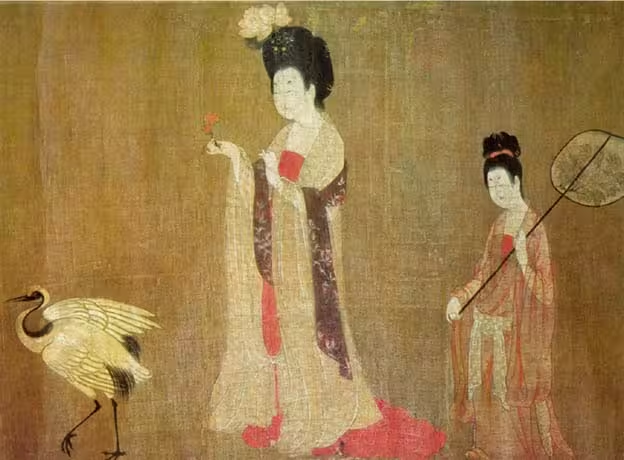
Tang fashion was the most cosmopolitan costume in the medieval world — silk from China's own looms cut in steppe silhouettes, Persian …
Tang strategy was made at the edges of the map. For three centuries the dynasty measured itself against the peoples of the steppe, the …
Gao Xianzhi (died 24 January 756), known in Korean sources as Ko Sŏnji, was the greatest conqueror of the Tang's western expansion — a …
The Tang table was the most diverse in the pre-modern world. Wheat and millet in the north, rice and fish in the south, mutton and …
The Tang empire was won by generals, saved by generals, and finally destroyed by the soldiers it could not demobilize. This page …
The Tang empire stretched from the Korean frontier to the Pamirs, from the Mongolian steppe to the Annamite mountains. Its geography — …
Guo Ziyi (697 – 9 July 781), posthumously Prince Zhongwu of Fenyang, was the general who saved the Tang dynasty — and the rarest figure …
Han Gan (c. 706–783) was the supreme horse painter of the Tang dynasty — the stable-hand prodigy whom Wang Wei discovered and the …
The High Tang (712–755) was the summit — the Kaiyuan golden age, the most celebrated four decades in all of Chinese history. Under …
Hou Junji (died April 29, 643) was a general of the early Tang who rose with the dynasty, conquered Gaochang and campaigned against the …