The Tibetan Empire
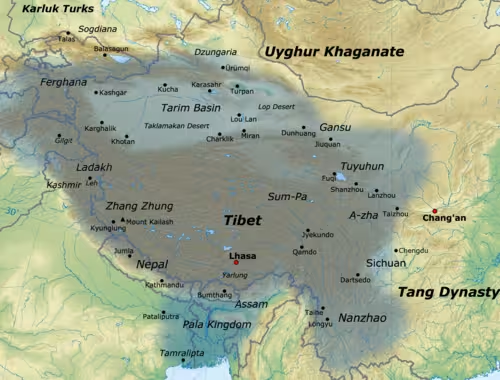
The Tibetan Empire (Tufan, c. 618–842) was the Tang dynasty's most dangerous and most underrated adversary — the highland rival that took the Tang's best general prisoner, occupied its western garrisons, and in 763 stormed and held Chang'an itself. Unified by Songtsen Gampo and armed with armored plateau cavalry, Tibet fought the Tang to a standstill across two centuries of war over the oases of the Tarim and the horse-lands of Qinghai, then collapsed from within after the assassination of its last emperor in 842. The truce inscription the two empires set up at Lhasa in 822 still stands — the oldest surviving treaty text between two great powers in Asia.
The Unification of the Plateau
The Tibetan state that faced the Tang emerged with startling speed. Around 618 — the very year the Tang itself was founded — the chieftain Songtsen Gampo, a young ruler of the Yarlung valley in southern Tibet, began the conquest of the plateau’s quarreling tribes, and within a generation his house ruled from the Himalayas to the edge of the Tarim. The new state’s institutions were built by design: a written script, devised by the minister Thonmi Sambhota after study in India; a law code; a standing army of armored cavalry, for which the plateau was famous — Tibetan heavy horse, man and mount both mailed, was reckoned the best in Asia by contemporaries who had met it. Songtsen Gampo moved his capital to Lhasa and, in the diplomacy that shaped the empire’s opening century, looked outward in both directions at once: he married a princess of Nepal, and in 641 he married a princess of the Tang imperial clan, Princess Wencheng, in the most famous marriage alliance of the age.
The histories record the embassy and the marriage as a peace; the peace was real but brief. Within a decade of Songtsen’s death in 649, the two empires were at war along their whole frontier, and the war lasted, with interruptions, for two hundred years.
The Wars for the West
The strategic prize was the road between the two empires: the Qinghai horse-country of the Tuyuhun kingdom and, beyond it, the oasis cities of the Tarim Basin, whose trade the Tang held through the Four Garrisons and whose allegiance Tibet contested. The first great collision came in 670 at the Dafei River, where a Tang army under Xue Rengui — one of the dynasty’s best commanders — was surrounded and destroyed by the Tibetan minister Gar Trinring’s field army. The defeat cost the Tang the Tuyuhun kingdom, opened Qinghai to Tibet, and began a two-generation struggle for the Tarim itself, in which the two empires and the advancing Arabs of the caliphate fought a three-cornered war for the oases — the “tripartite struggle” that modern historians consider one of the great geopolitical contests of the early Middle Ages. The tide turned under the Empress Wu and her successors: in 692 the general Wang Xiaojie recovered the Four Garrisons and re-established the Anxi Protectorate, and for the next two generations the frontier held, with the Tibetan court repeatedly pressing the Tarim while Tang armies repeatedly burned their way toward Lhasa.
The war’s character is worth noting, because both empires’ records of it are remarkably parallel. Each treated the other as its principal military problem; each raised enormous expeditionary armies — through altitudes that stopped most campaigns cold; each fielded mixed armies of Chinese, Turks, and plateau peoples; and each learned the other’s warfare so thoroughly that captured generals changed sides and served new masters with distinction. The Tibetan commander Lun Qinling (the Gar Trinring of the Tibetan records) fought Xue Rengui and his successors for thirty years without a major defeat, and was finally destroyed not in battle but by his own court’s suspicion of his powerful family — a fate the Tang, reading its enemy’s annals, would have recognized from its own history.
Chang’an, 763
The Tibetan high water mark came in the aftermath of the An Lushan rebellion. With the Tang’s western armies recalled to fight the rebels, Tibet absorbed the Tang’s garrisons in the Gansu corridor one by one through the 750s and 760s, cutting the protectorate off from China proper, and in the winter of 763 struck the capital itself. A Tang government in panic and confusion — the eunuch regime that had just murdered its own chancellor — fled; the Tibetan army entered Chang’an, occupied the city for fifteen days, and withdrew only when it judged the position untenable, setting up a puppet imperial kinsman on the throne before leaving. It was the only foreign occupation of a unified China’s capital between the Han and the Mongols seven centuries later, and it entered Tibetan historical memory — as it entered Chinese — as proof of what the plateau army could do.
The recovery was slow and never complete. Tibet held the Gansu corridor and besieged the isolated garrisons of the Tarim — Anxi and Beiting — whose garrisons, by the chronicles’ nearly incredible account, held out for decades after contact with the court had been severed, until the last of them fell around the turn of the ninth century. The Tang retaliated in kind: through the late eighth century the great western commander Wei Gao, based in Sichuan, fought a long, methodical war of attrition along the eastern Tibetan frontier, defeating Tibetan armies in the field and building the network of alliances with the southern tribes that would eventually crack the empire’s southern flank.
The Peace of Equals
The end of the great war came from exhaustion on both sides, and its form was remarkable. In 821–822 the two courts negotiated a formal treaty between equals — no tributary language, no subordination, a boundary settlement and a mutual renunciation of aggression, sealed by oath and inscribed on stone in both capitals. The Lhasa pillar, erected before the Jokhang temple in 823, survives in place to this day: the text styles the Tang emperor and the Tibetan btsan-po as uncle and nephew, the fictive kinship descending from the marriage of Wencheng, and describes the two sovereigns as having “become as one” in friendship. It is the oldest surviving treaty monument between two Asian great powers, and its language of scrupulous equality reflects two centuries of war that had taught each empire the exact measure of the other.
Fifty years later the Tibetan empire itself was gone. In 842 the emperor Langdarma was assassinated — the event Tibetan tradition links to the beginnings of organized Buddhism’s revival on the plateau — and the empire shattered in a succession war among his descendants, dissolving into regional regimes from which, centuries later, a reformed Tibetan Buddhism would emerge. The Tang fell to its own soldiers in 907, sixty-five years after its most dangerous enemy had already ceased to exist.
References & Historical Sources
- Old Book of Tang and New Book of Tang, monograph and annals on Tibet (Tufan zhuan).
- Zizhi Tongjian, volumes 195–201 (the wars of 670–692) and 223–236 (the eighth-century wars, 763, and the 821 treaty).
- The Lhasa treaty inscription of 823, surviving text.
- Christopher I. Beckwith, The Tibetan Empire in Central Asia (1987).
- The later Tibetan historical tradition, used with caution alongside the Chinese record.