The Parthian Empire (247 BC – 224 AD)
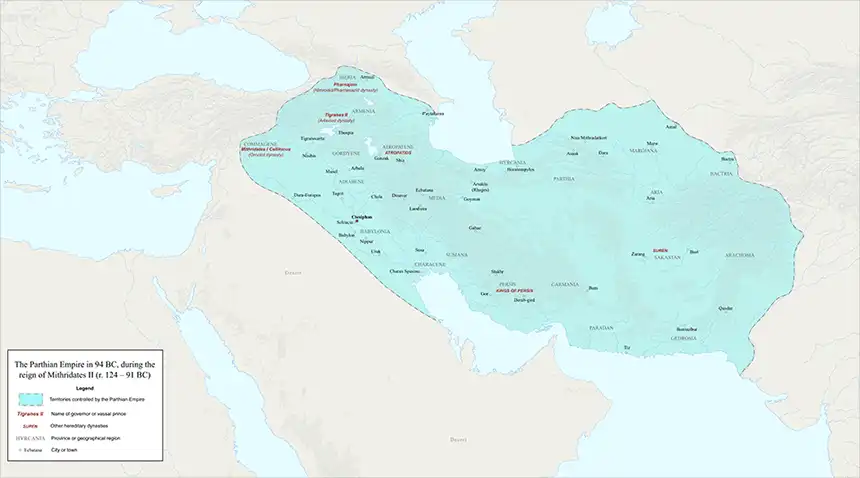
The Parthian Empire — the Arsacid kingdom of Iran, Rome's great eastern rival for four centuries — stood on the Silk Road between the Han dynasty of China and the Mediterranean world, and was the first great Iranian empire the Chinese court ever knew. Though it had fallen three and a half centuries before the Tang was founded, the Parthian inheritance shaped the world the Tang inherited: its roads, its trade, its successor empires, and the very name 'Anxi' by which Chinese geographers knew the Iranian west.
The Arsacid Empire
The empire was founded in 247 BC when Arsaces I, chief of the Parni — a nomadic tribe of the steppe fringe — seized Parthia in northeastern Iran from its rebellious Seleucid satrap. For a century the Arsacids consolidated the Iranian plateau; then Mithridates I (r. c. 171–132 BC) tore Media and Mesopotamia from the decaying Seleucid Empire, and his grandson Mithridates II extended the dominion to its greatest extent — from the Euphrates in central-eastern Turkey to Afghanistan and the Indus approaches. The Arsacid kings ruled as “King of Kings,” heirs by claim of the Achaemenids, over a deliberately loose federation of subject kingdoms, tributary princes, and semi-autonomous cities; their court, after early Hellenizing phases, gradually revived Iranian dress, titulature, and custom. The seat of government settled at Ctesiphon on the Tigris, south of modern Baghdad, where the Arsacid palace became one of the wonders of the ancient world.
Rome’s Eastern Rival
The Parthians destroyed three Roman armies in the age of the Republic — the annihilation of Crassus at Carrhae in 53 BC being the most famous — and for three centuries the Euphrates was the negotiated border of the two superpowers, with Armenia as their perennially contested buffer. The wars were episodic but the rivalry was structural: Rome’s legions against Parthia’s armored horse-archers and cataphracts, two systems of war that each found the other nearly unbeatable on its own ground. Internally, the empire’s greater danger was its own constitution — the Arsacid practice of parceling the realm among royal kinsmen guaranteed a supply of rival kings, and civil wars among contenders consumed the dynasty’s last century. In 224 AD Ardashir, prince of Istakhr in Persis, defeated and killed the last Arsacid, Artabanus IV, and founded the Sasanian Empire, which inherited the Parthian lands, wars, and title.
China and Anxi
To Han China the Parthian Empire was Anxi 安息 — a transcription of “Arsaces” — and the two empires met, indirectly, at the height of the Silk Road’s first age. Zhang Qian’s mission of the second century BC had reported the land of Anxi west of the Pamirs; by 115 BC Han envoys were reaching the Arsacid court, and Parthian embassies traveled to China — the Book of Han records the presentation of “large birds’ eggs and conjurers” (ostrich eggs and illusionists) as tribute in the first years of the common era. The Parthians were the indispensable middlemen of the silk trade, passing Chinese silk westward to Roman markets — where, by the first century AD, it was draining the empire’s silver, to the moralists’ despair — and carrying western glassware, silver, wool, and horses eastward. Chinese silk has been found in Parthian graves; Parthian and Roman glass reached the Han capitals. The contact was commercial and diplomatic rather than military — the two empires never shared a border — but it established the template of Sino-Iranian relations that would run through the Sasanians to the Tang.
The Tang Inheritance
When the Tang looked west three and a half centuries after the Arsacids fell, they found the Parthian world twice transformed but recognizably continuous: the Sasanian Empire had preserved the Arsacid borders, capital, and wars, and when the Arabs destroyed the Sasanians in the 650s, their last king Yazdegerd III fled east — to Tang China, where the court received his son Peroz and settled Sasanian refugee communities in the western provinces. Tang geography still organized the west by the old names: Anxi was now the memory behind the “Anxi Protectorate,” the very title the Tang gave its own western garrison command at Qiuci. The Parthian legacy to the Tang was thus double: the Silk Road, which the Tang would police and tax to its great profit, and the precedent of Iranian-Chinese diplomacy, which taught the Tang court to treat the empires of the west — Sasanian or Abbasid — as peers in a single world.
References & Historical Sources
- Sima Qian, Records of the Grand Historian, “Account of Dayuan” (Ferghana), for the first Chinese reports of Anxi.
- Ban Gu, Book of Han, monograph on the Western Regions (Xiyu zhuan).
- Old Book of Tang and New Book of Tang, monographs on Persia (Bosi zhuan) and the Western Regions.
- Plutarch, Life of Crassus, and the Roman historians, for the wars of Carrhae.
- Vesta Sarkhosh Curtis and Sarah Stewart (eds.), The Age of the Parthians (2007).