Jiedushi: The Military Governor
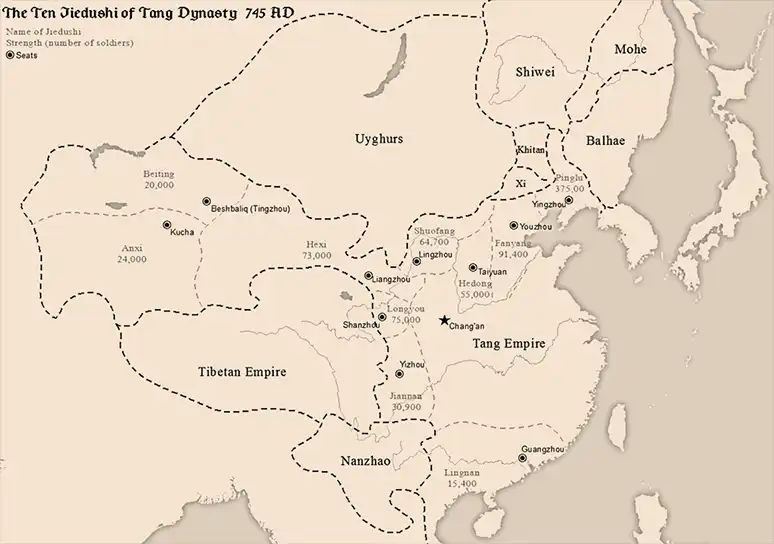
The jiedushi (節度使), the Tang military governor, was the most consequential military office in Chinese history. Created in 711 to coordinate frontier defense, it accumulated over a century until its holders — An Lushan above all — commanded armies, revenues, and appointments that the court could no longer control. The jiedushi destroyed the High Tang, ruled the Late Tang, and became the warlord regimes of the Five Dynasties; understanding the title is understanding how the Tang fell.
Origins: The Frontier Fix
The office was born of an administrative puzzle. By the first decade of the eighth century the Tang frontier ran thousands of li through desert, steppe, and mountain, guarded by scattered garrisons under a bewildering stack of temporary commands — area commands, defense commissions, pacification offices, each with overlapping authority and no power to act beyond its own walls. In 711 the court rationalized the tangle with a single solution: the jiedushi, a military commissioner delegated the “full authority of the tally” (jiedu) over a defense zone often spanning several prefectures, empowered to move troops, requisition supplies, coordinate the garrisons, and report directly to the throne. The early jiedushi were instruments of the golden age’s expansion — the men who held the Anxi garrisons, built the western cavalry, and kept the northeast watch. They served at the court’s pleasure, rotated among commands, and answered through the normal channels of memorial and inspection.
The Accumulation of Power
Over the next four decades the office absorbed the functions around it. To provision standing armies in regions where the land tax reached thin, the jiedushi were given revenue powers; to staff their growing bureaucracies, appointment powers over their subordinate officers; to stabilize the border populations, gradually the civil administration itself. By the 740s the great military provinces were states in embryo: the governor commanded from 20,000 to 90,000 professional troops, drew the local revenues to pay them, appointed his own staff — and, crucially, built the personal loyalty of armies that served him, not the distant court. The court’s own policy accelerated the drift: the chancellor Li Linfu’s promotion of non-Han professional soldiers to the great commands, on the theory that men without Chinese clan connections would owe everything to the throne, instead produced commanders whose armies owed everything to their commander. In 751 An Lushan held three of the ten great commands — Pinglu, Fanyang, Hedong — controlling the entire northeast and perhaps a fifth of the empire’s military manpower.
Rebellion and Heredity
The An Lushan rebellion (755–763) revealed the institution’s transformation in the starkest possible way: the rebels were not bandits but the dynasty’s own frontier army, and the loyalist resistance had to be built on other jiedushi — Guo Ziyi, Li Guangbi, Pugu Huai’en — whose power the rebellion then ratified. The settlement of 763 made the logic permanent: to end the war, the court confirmed the surrendered rebel generals as jiedushi of their own territories. The result was the fanzhen system — autonomous military provinces, of which the Three Fanzhen of Hebei (Weibo, Chengde, Lulong) were the model: commands passed from father to adopted son to nephew without reference to Chang’an, taxes stayed home, and the court’s writ stopped at the circuit border. The late Tang emperors spent a century fighting, buying, and outlasting the fanzhen — sometimes successfully, as when Xianzong’s campaigns of 805–820 briefly broke the northeast, always temporarily. In the provinces, the jiedushi had become hereditary princes in everything but title.
The Afterlife: From Jiedushi to Warlord to Dynasty
The institution’s final act came with the Huang Chao rebellion (875–884), which destroyed the court’s own military capacity and left survival to the jiedushi. The victors took their payment in power: Zhu Wen of Xuanwu, whose base at Kaifeng commanded the Grand Canal, became the master of the capital itself; Li Keyong of Hedong ruled Shanxi as a Shatuo-Turkish kingdom-in-waiting. In 907 Zhu Wen took the throne and founded the Later Liang — the first of the Five Dynasties, every one of them founded by a jiedushi or his son, ruling by the jiedushi method of army, revenue, and appointment. The Song founders who ended the era in 979 understood exactly what they were abolishing: no provincial governor would again hold military, fiscal, and civil power in one hand, and the jiedushi title survived, emptied into a sinecure, into the Yuan dynasty. Few offices in world history have carried so much consequence in a single word: the tally of authority that built the Tang’s frontier became the charter of its destruction.
References & Historical Sources
- Old Book of Tang and New Book of Tang, treatise on the army (Bingzhi); biographies of An Lushan and the Hebei governors.
- Zizhi Tongjian, volumes on the An Lushan settlement (220–222) and the late-Tang fanzhen.
- Denis Twitchett, Cambridge History of China, vol. 3, “The T’ang Military Governorship.”
- Chen Yinke, Tangdai zhengzhi shi shulun gao (1943).