Frontier Campaigns & Adversaries
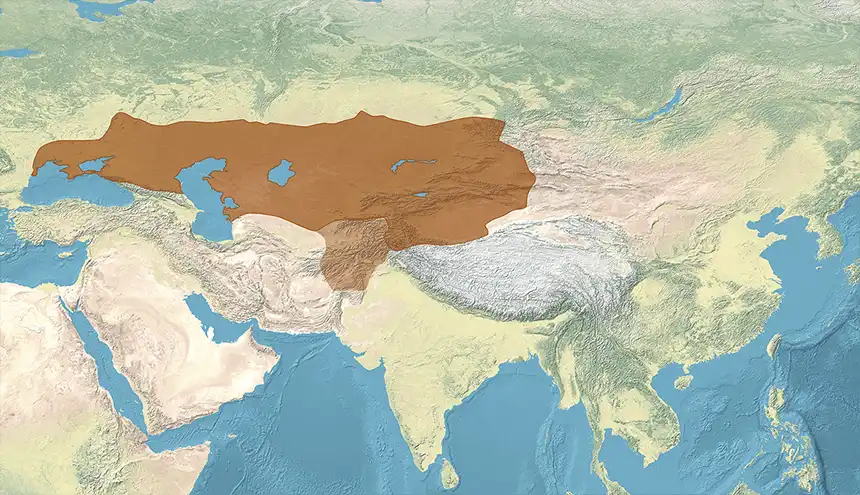
Tang strategy was made at the edges of the map. For three centuries the dynasty measured itself against the peoples of the steppe, the plateau, and the peninsula — the Turkic khaganates, the Xianbei military aristocracy from which its own elite sprang, the Korean kingdoms that fought the longest wars of the age, and the distant empires of Iran and the caliphate whose horizons bounded the world the Tang knew. This page surveys the adversaries who shaped the dynasty's wars and the frontier system those wars built.
The Steppe Adversaries
The defining strategic fact of the early Tang was the Turkic Khaganate, the steppe empire that had dominated northern China before the founding and whose riders could reach the Wei River in days. Taizong broke the Eastern Turks in 630 — the campaign that made the Tang’s reputation — but the western half of the khaganate, the Onoq or “Ten Arrows” confederation centered on Suyab in the Chui valley, survived another generation on the far side of the Pamirs. Su Dingfang’s winter campaign of 657 crossed the deserts west of the Tarim, scattered the Western Turkic army on the Irtysh, and took their khagan to Chang’an; the western khaganate dissolved into a patchwork of tribal fragments, some absorbed as Tang auxiliaries, one fragment drifting west to become, across the steppe, the Khazar empire. The steppe frontier never again threatened the dynasty’s existence — but its lessons, above all the need for loyal steppe cavalry, became permanent features of Tang military policy.
The Xianbei Inheritance
Less an adversary than an ancestor, the Xianbei were the nomadic confederation of the northeastern steppe that had provided the ruling peoples of the Northern dynasties — including the Tuoba aristocracy from which the Tang elite itself descended. By the Tang period the Xianbei as a distinct people had dissolved into the populations of the north, but their military tradition — horse-archery, the aristocratic command structure, the very grammar of steppe warfare — flowed directly into the Tang army, whose founding generals and whose fubing garrisons were largely men of the old Xianbei-Tuoba military society. The dynasty’s ability to fight the steppe was, at bottom, a family inheritance: the Tang understood the Turks because the Tang court was, in large part, Turkic in its habits, its blood, and its sport.
Korea: The Longest War
No adversary cost the Tang more than Goguryeo, the hard, fortress-studded kingdom of the northern peninsula and southern Manchuria that had broken the Sui’s three invasions. Taizong’s campaign of 645 came within a hair of taking Ansi fortress and cost the emperor personally the flower of his guard; his son Gaozong persisted, and in 660 the Tang fleet and army destroyed Baekje on the peninsula’s southwest coast, then in 668, with Silla as ally, stormed Pyongyang itself. The settlement was unstable from the start: Silla, having used Tang power to unify the peninsula, turned on its ally within five years and expelled Tang garrisons from the south by 676. The Tang retained the old Goguryeo lands north of the Taedong as the Protectorate-General of the Andong, but the peninsula itself passed beyond direct Chinese control forever after — the limits of Tang arms drawn in the Han River valley.
The Western Horizons
Beyond the Pamirs, Tang strategy faced a different kind of frontier: not one adversary but a succession of world empires. The Parthian Empire — the Arsacid “King of Kings” of Iran, Rome’s eastern rival for four centuries — had been the power the Han knew as Anxi, and its memory and trade routes still structured the Tang’s western geography long after Ardashir’s Sasanian house and then the Arab caliphate had inherited its lands. The Tang’s true western adversary was the last of these: the Abbasid Caliphate, whose armies met Gao Xianzhi’s at the Talas River in 751. After that single battle the two empires never fought again — each had measured the other’s reach and turned to its own affairs. The frontier Tang built against that western world — the Four Garrisons of Kucha, Khotan, Kashgar, and Karashahr, the Anxi Protectorate’s desert line — held for a century against Tibetans, Arabs, and Karluks alike, one of the most remarkable military occupations in Chinese history.
References & Historical Sources
- Old Book of Tang and New Book of Tang, monographs on the Turks (Tujue), Korea (Gaoli), and the Western Regions (Xiyu).
- Zizhi Tongjian, volumes 191–201.
- Christopher I. Beckwith, The Tibetan Empire in Central Asia (1987).
- Edwin G. Pulleyblank, “A Sogdian Colony in Inner Mongolia” (1952).