Battle of Hulao
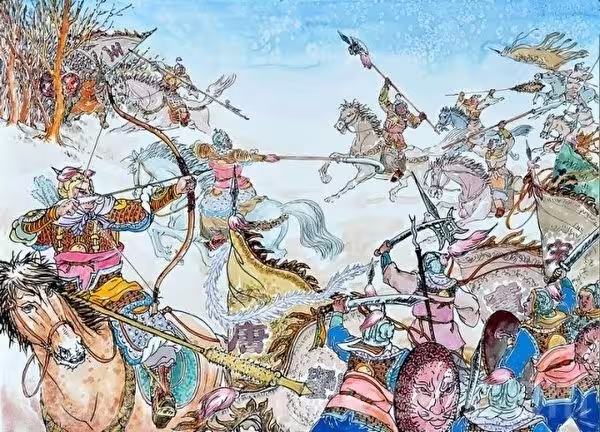
The Battle of Hulao, fought on 28 May 621 at Hulao Pass in Henan, was the single most decisive engagement of the wars that founded the Tang dynasty. There Li Shimin, the future Emperor Taizong, at twenty-two years old and commanding a fraction of his enemies' strength, destroyed in one afternoon the combined armies of the two strongest rivals to Tang rule — Dou Jiande's Xia and Wang Shichong's Zheng. No other battle of the age carried such consequences: after Hulao, the unification of China under the Tang was a matter of time, not of chance.
The Strategic Situation
By the spring of 621, four years after the Taiyuan uprising, the civil wars had resolved into a three-cornered struggle. The Tang held the northwest and the old Sui capitals; Wang Shichong, a former Sui general, had seized the eastern capital Luoyang and proclaimed the Zheng dynasty; and Dou Jiande, a peasant leader from Hebei of enormous personal authority, had built the Xia state across the northeast, respected even by his enemies for his honesty and frugality. The Tang struck first at the center. In the autumn of 620, Li Shimin — the second son of Emperor Gaozu and the dynasty’s best general — advanced on Luoyang with the main Tang army, reduced Wang’s outlying strongholds one by one through the winter, and by early 621 had Wang bottled inside the besieged city, his armies beaten in the field and his food running out.
Dou Jiande understood what the loss of Luoyang meant. Gathering his own host — the traditional accounts give figures of a hundred thousand or more, certainly several times Li Shimin’s strength — he marched west along the Yellow River to raise the siege. Between Dou and Luoyang stood Hulao Pass: the fortified choke point where the road from the east climbs out of the plains toward the river crossing, a position the histories describe as a place where “a thousand men could hold against ten thousand.” Li Shimin made the decision that defined the campaign. Leaving the bulk of the army to maintain the siege of Luoyang under his brother Li Yuanjing, he took a force built around roughly 3,500 picked cavalry and infantry — the precise numbers vary by source, but all agree he was heavily outnumbered — and threw himself into the pass ahead of Dou’s arrival.
The Waiting Game
What followed was not a battle but a siege of nerves, and it is the phase of Hulao that military writers studied most closely afterward. Li Shimin refused to be drawn. His troops held the pass’s fortifications; his cavalry ranged across the Si River south of the walls, cutting Dou’s forage parties and probing his camp. Weeks passed, and the summer worked on the Xia host: a great army camped in the heat, its supplies eaten down, its levied farmers muttering about the unmown fields at home. Dou’s advisers split — some urging the march straight on Luoyang regardless of the Tang blocking force, others caution. Dou hesitated, and the histories credit Li Shimin’s intelligence service with reading his indecision exactly. To provoke the enemy into standing still, Li’s men took their horses across the river each day within sight of the Xia camp, as if water-fattening mounts that would soon be useless — a deception meant to convince Dou that the Tang were in no condition to attack and that time favored him.
It did not. In late May, with Dou’s army camped south of the Si River and grown careless in the long inaction, Li Shimin struck.
The Afternoon of 28 May
The Tang plan rested on two exploitations: the enemy’s fatigue at midday and the broken ground that broke his army. Li Shimin held his own men behind the river through the morning while the Xia host stood to arms and waited for an attack that did not come; then, as the summer heat peaked and Dou’s formations broke up to eat and rest, the Tang crossed the Si River and fell on them. The Xia army, a mass of levies stiffened around Dou’s personal core, never formed properly. Li Shimin led the cavalry charge at its head — he was always that kind of general, and his standard drew the enemy’s best troops like a magnet — while the Tang foot struck the flank and the river cut off retreat northward. Dou Jiande, wounded by a lance and unhorsed, was taken at the mouth of the Ox Horn ravine as he fled; the capture of the king broke what was left of the host, and the field collapsed into rout within hours.
The sequel was as swift as the battle. Li Shimin brought his captive before the walls of Luoyang and showed him to the garrison. Wang Shichong, whose army was starving and whose last ally was now a prisoner, surrendered the city days later. The Xia and Zheng states, the two strongest obstacles between the Tang and the rule of China, had been extinguished in a single stroke, and the traditional chronicles do not exaggerate when they treat 621 as the year the dynasty’s victory became certain. Dou was sent to Chang’an and executed; the remnants of his movement in Hebei would flare up once more under Liu Heita, but as rebellion against a nearly unified empire, not as a rival for it.
Why Hulao Matters
Hulao’s afterlife is a story about Chinese military thought. Taizong, as Li Shimin became in 626, talked about the campaign in his own writings and conversations, and the pattern the battle fixed — refuse battle against a stronger enemy, let time and supply erode him, deceive him into passivity, then attack at the moment of maximum advantage with a small, fresh, well-handled force — became the canonical illustration of the indirect approach in the Chinese strategic tradition. Later military writers from the Song onward cited it the way Western writers cite Cannae, and its logic runs straight through the dynasty’s later triumphs, from Li Jing’s steppe campaigns to the suppression of the eastern rebellions. For the Tang itself the consequences were immediate and permanent: the dynasty acquired the eastern capital intact, the heartland of the Sui state, and a reputation for invincibility that itself became an instrument of power — half the remaining warlords of the south submitted without a fight when their turn came. Hulao made the Tang, and it made Taizong: the twenty-two-year-old who won it never lost another battle.
References & Historical Sources
- Zizhi Tongjian, volume 189 (the campaign of 620–621 and the battle of 28 May).
- Old Book of Tang and New Book of Tang, annals of Emperor Gaozu and the biography of Li Shimin (Emperor Taizong).
- Old Book of Tang, biographies of Dou Jiande and Wang Shichong.
- Du You, Tongdian, and later military compendia citing the battle as the model of the indirect approach.