
Famous Battles
The Tang dynasty's destiny was settled in a handful of battles — sudden, violent …
The Tang dynasty was made by war and unmade by soldiers. In three centuries it fielded armies that conquered the steppe, crossed the Pamirs, stormed the capitals of rival states, and twice saved the dynasty from destruction — and it ended as a federation of military governors whose armies answered to no one. This section covers the dynasty's military world: its institutions from the fubing militia to the jiedushi warlords, its most famous battles, the weapons and armor of its soldiers, and the adversaries — Turks, Tibetans, Koreans, and the empires beyond — that defined its strategy.
Tang military history divides into three acts. The first, from 618 to about 660, was conquest: the fubing garrison-militia system gave the founding emperors cheap, disciplined armies that destroyed the Eastern Turks in 630, reduced the Tuyuhun, planted garrisons across the Western Regions, and fought the three great wars against Goguryeo. The second, from the 660s to 755, was the age of the professional frontier army: the fubing decayed, the border was entrusted to permanent area commands, and Tang power reached its farthest extent — the Talas River in the west, the Korean peninsula in the east — under generals of every ethnicity of the empire. The third act was catastrophe and aftermath: the jiedushi rebellion of 755, a century of civil war, and the slow transformation of the military governor from an imperial officer into a hereditary prince, ending only with the dynasty’s own soldiers delivering it to Zhu Wen in 907.
In no other great dynasty was the army so central to every phase of political life. The Tang was founded by a military coup; its greatest emperor took the throne by killing his rival at a palace gate; its examinations included military degrees; its most honored subjects were soldiers (Li Jing, Guo Ziyi); its worst catastrophes were made by soldiers (An Lushan, Huang Chao, Zhu Wen). The fiscal system existed largely to feed and pay the armies — the Grand Canal was, at bottom, a military supply line — and the fate of every late-Tang reform, from the salt monopoly to the two-tax system, was decided by whether it could fund the soldiers the dynasty could no longer fully control.
The pages that follow cover four dimensions of this military world. Military Systems traces the institutional evolution from the fubing militia through the frontier commands to the jiedushi whose autonomy consumed the dynasty. Famous Battles examines the engagements that decided the dynasty’s fate: Hulao, the Iron Mountain, the Yalu, the Talas River, Tong Pass. Weapons & Armor describes the material reality of the Tang soldier — the horse, the bow, the crossbow, the long saber, and the lamellar armor of the frontier garrisons. And Frontier Campaigns & Adversaries looks outward at the neighbors who shaped Tang strategy: the Turkic khaganates, the Xianbei inheritance, the Korean kingdoms, and the empires of the western horizon, from the Parthians to the caliphate, whose armies met Tang armies at the edges of the known world.
The Tang dynasty's destiny was settled in a handful of battles — sudden, violent …

Tang strategy was made at the edges of the map. For three centuries the dynasty …
The jiedushi (節度使), the Tang military governor, was the most consequential military …
The Tang dynasty ran three successive military systems in three centuries, and the …

Silla (57 BC – 935 AD), the Korean kingdom of the southeast, was the Tang dynasty's …

The Parthian Empire — the Arsacid kingdom of Iran, Rome's great eastern rival for …
The Western Turkic Khaganate — the Onoq, the 'Ten Arrows' — was the western half of …
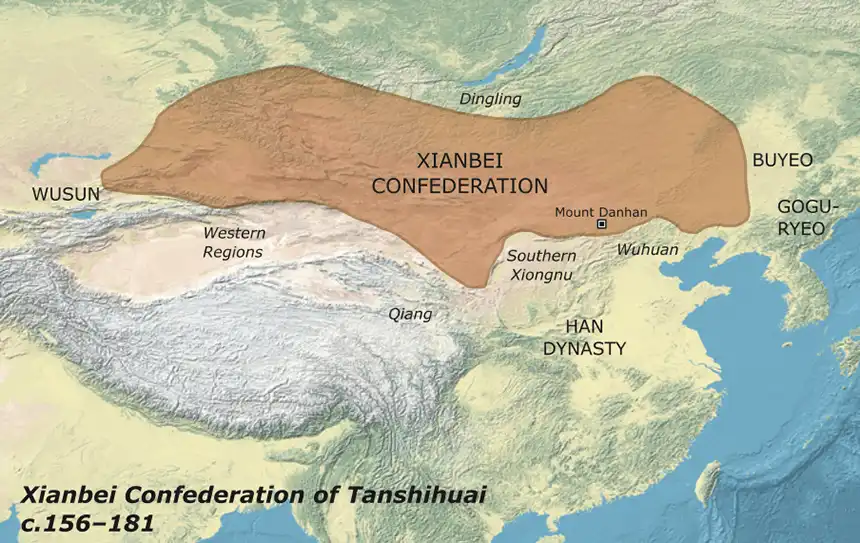
The Xianbei were the great nomadic confederation of the northeastern steppe, heirs of …
The Tang soldier went to war on horseback, behind a laced-lamellar cuirass, with a …

Western Liang was a small dynastic state of the Sixteen Kingdoms period, founded in …