Zhou Fang
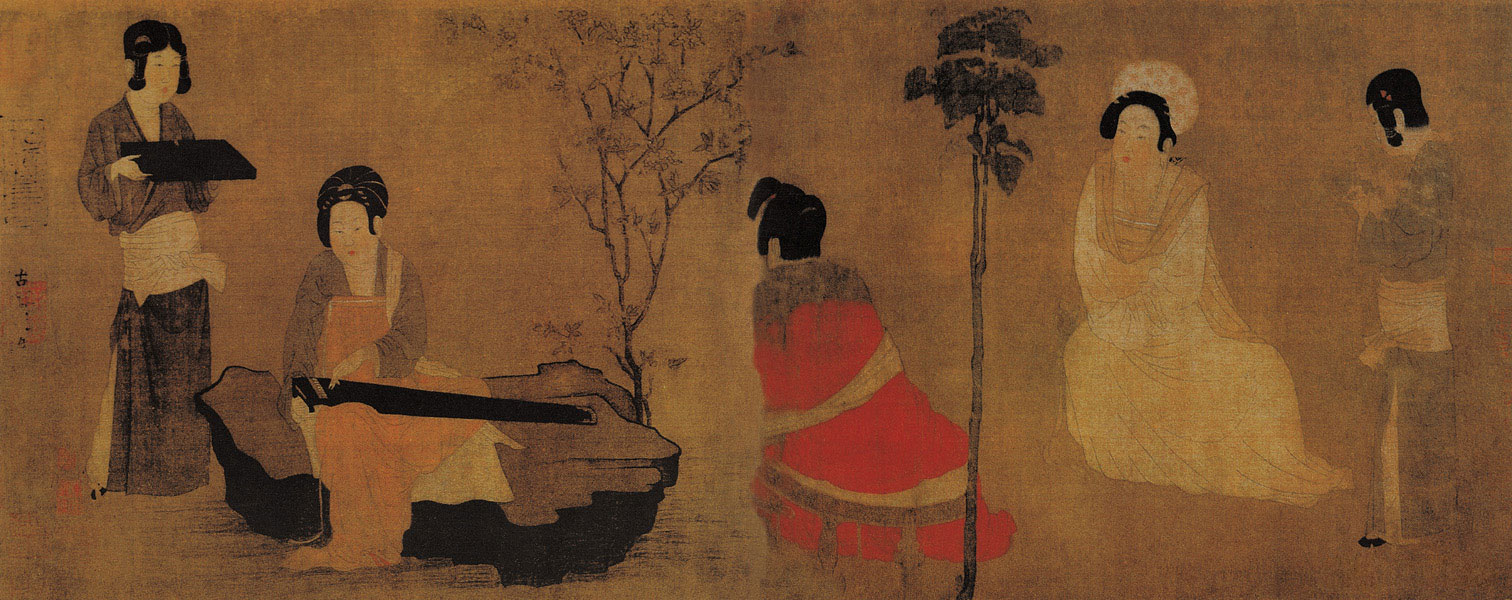
Zhou Fang (c. 730–800), courtesy name Zhonglang, was the painter who perfected the image of Tang beauty — the creator of the plump, serene, silk-draped court lady who became, for all later centuries, the very type of the dynasty's feminine ideal. A great aristocrat who painted the great aristocracy, he served as governor of Yuezhou and Xuanzhou, painted for the emperor and the temples, and was revered in his lifetime as the matchless master of religious and figure painting.
The Aristocrat Painter
Unlike Han Gan, who came from the stables, Zhou Fang came from the class he painted. His family was among the great houses of Chang’an — wealthy, connected, and at ease in the palace world — and he held substantial office: successively prefect of Yuezhou and Xuanzhou, posts that a court painter by trade could never have attained. He painted because his rank and his talent allowed it, and he painted his own world: the ladies of the great families at their music, their toilette, and their leisure. The Tang critics, listing the masters, placed him at the summit of figure painting in the generation after Zhang Xuan, and his religious paintings — Buddhist and Taoist subjects for the great temples — were ranked among the wonders of the age, their gold and mineral colors said to gleam like the gods themselves.
The Zhou Fang Lady
What he added to Chinese art was a type. Zhang Xuan had painted court women vividly; Zhou Fang abstracted them into an ideal — the full face, the small mouth, the heavy coil of hair, the body hidden and revealed in layers of transparent silk, the languid concentration of women at the lute or the mirror. The type is instantly recognizable: it is the Tang beauty of a thousand later copies, the form against which Chinese painters measured female beauty for a millennium, and which even today reads as “Tang” in a single glance. His most famous compositions — Court Ladies Adorning Their Hair with Flowers, Lady with a Fan, the lute-tuning groups — survive in Song and later copies that preserve the composition if not the brushwork, and his influence ran in every direction: to the Five Dynasties court ladies, to the Song academy, and across the sea to the Buddhist painting of Nara-period Japan, where his style was treasured as the very canon of elegance.
Technique and Reputation
His manner was famous for two things: the “iron-wire” outline of unwavering even strength, and color applied in translucent layers so that silk and flesh seemed to glow from within. Critics of the ninth century wrote that his ladies’ skin had the quality of jade and their gauze the quality of mist — praise that became formula precisely because later painters spent centuries trying to reproduce it. His religious work had an equal contemporary fame that posterity could not preserve: the great temple murals of Chang’an were destroyed with the city in the wars after 755 and 880, and Zhou Fang’s Buddhist and Taoist paintings survive only in copies, copies of copies, and the temple traditions of Japan.
Historical Assessment
Zhou Fang’s career spanned the catastrophe — born around 730, he was a mature master when An Lushan rebelled in 755 and lived on into the 790s, painting the diminished court of the restored dynasty. The art he perfected belonged, however, to the world before the fall, and his serene ladies, eternally young and unhurried amid their silk and music, have become for later ages the image of everything the High Tang meant: wealth without anxiety, beauty without tragedy, and a civilization at the height of its confidence. That the confidence lasted only three more years is the knowledge the viewer brings to the painting; the painting itself, true to its maker, never betrays it.
References & Historical Sources
- Zhang Yanyuan, Lidai Minghua Ji; Zhu Jingxuan, Tangchao Minghua Lu.
- Duan Chengshi, Youyang Zazu, for contemporary anecdotes of Zhou Fang’s painting practice.
- Wen C. Fong, Beyond Representation (1992).