Zhang Xuan
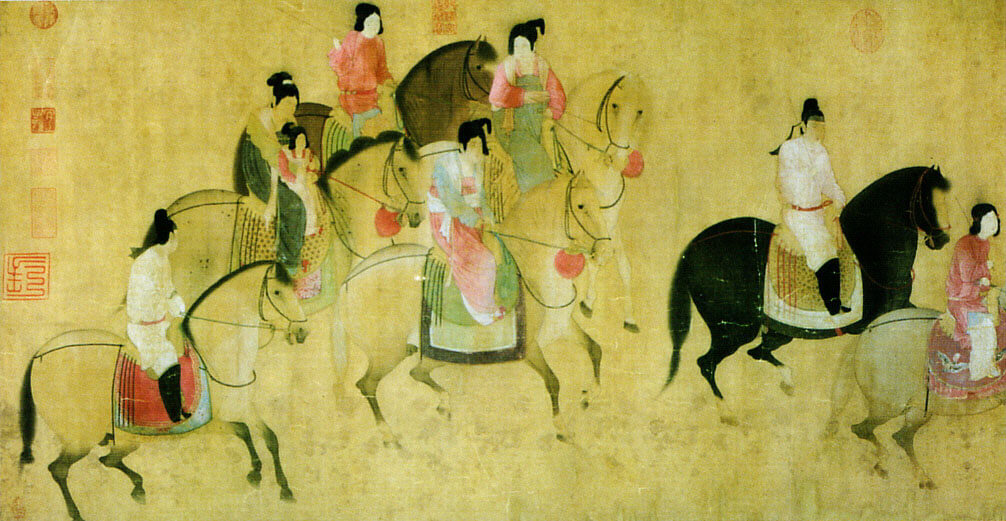
Zhang Xuan (713–755) was the great painter of Tang court ladies — the visual chronicler of the palace world of Emperor Xuanzong's Chang'an in the very years that world stood at its zenith and tottered to its fall. No original by his hand survives, but his two most famous compositions, preserved in close Song-dynasty copies, remain the most vivid windows into the life of the Tang aristocratic woman: the Spring Outing of the Tang Court and the Court Ladies Preparing Newly Woven Silk.
Court Painter at the Summit
Zhang Xuan worked in Chang’an during the Tianbao era (742–755), the extravagant last act of Xuanzong’s reign, painting the emperor’s court, its ladies, its musicians, and its pleasures. The contemporary painting records credit him with a special mastery of the two subjects that defined the court art of the age: women and horses — often, as in the Spring Outing, women on horses, the sight that so struck foreign visitors to the capital. His figures were noted for the roundness of their faces, the richness of their drapery, and above all their lifelikeness: the Tang critics wrote that his ladies seemed to move and breathe. He was, by all the evidence of his fame and his imperial employment, the establishment’s own painter — the man to whom the court turned when it wished to see itself.
The Spring Outing
The Spring Outing of the Tang Court (Youchun tu 遊春圖), in its surviving Song copy, shows the season’s first excursion of the palace women: a procession of mounted ladies in silk and gauze, accompanied by riders and attendants, moving through a landscape of flowering trees and spring water. Every detail documents the era — the sidesaddle riding fashion of the aristocratic woman, the elaborate coiffures, the tiny boots and long skirts, the social ease of women moving through public space in a way later centuries would find remarkable. The painting is a costume piece, a genre scene, and a historical document in one: the closest surviving visual record of how the women of Xuanzong’s court actually looked, dressed, and rode. Its authorship, transmitted through the Song imperial collection, rests on the copy’s own attribution — the original having vanished, like every other Tang painting on silk that was not sealed in a tomb or a cave.
Court Ladies Preparing Silk
His other surviving monument, the Court Ladies Preparing Newly Woven Silk (Dao lian tu 搗練圖), preserved in a close copy attributed to the Song emperor Huizong’s own brush, shows the other half of the silk economy: aristocratic women at the collective work of softening woven silk — pounding it with mallets, stretching it, sewing it — in groups that dissolve the boundary between labor and leisure. The composition, with its interlocking figures and rhythmic repetition of gesture, became one of the most studied works in Chinese art; its individual figures were copied by painters for five centuries. Together with the Spring Outing, it fixes the image of the Tang lady — full-faced, confident, fashionable, real — that later Chinese art could never quite leave behind.
Historical Assessment
Zhang Xuan’s dates (713–755) make him the perfect emblem of the High Tang’s rise and fall: he was born the year Xuanzong’s Kaiyuan era began, and died, by the traditional account, in the year the world ended. Whether his death actually coincided with the An Lushan rebellion is uncertain — the date may be conventional — but the symbolism has attached to him permanently. He painted the court at its brightest, and within three years the court was ashes. Art history’s verdict is simpler and firmer: through two Song copies, the hand of a Tang master still reaches us, and the Tang court — its silks, its horses, its women in the spring light — still lives.
References & Historical Sources
- Zhang Yanyuan, Lidai Minghua Ji, and Zhu Jingxuan, Tangchao Minghua Lu, for the painter’s reputation and subjects.
- The Song copy of Spring Outing of the Tang Court (Youchun tu), transmitted attribution to Zhang Xuan.
- The Court Ladies Preparing Newly Woven Silk (Dao lian tu), copy attributed to Emperor Huizong after Zhang Xuan.
- Wen C. Fong, Beyond Representation (1992).