Yuwen Huaji
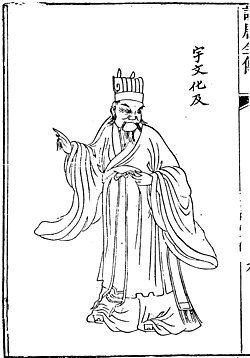
Yuwen Huaji (died 22 March 619) was a Sui dynasty general and court favorite who murdered his own emperor — strangling Emperor Yang of Sui at Jiangdu in 618 — and briefly ruled in his name before proclaiming himself emperor of a doomed state called Xu. His three-act career — favorite, regicide, pretender — spans barely a year, and every power he touched destroyed him within months. He is remembered as the archetype of the dynasty-ending favorite: the man who kills the sovereign he was bred to serve and discovers that the throne, taken that way, cannot be held.
The Favorite
The Yuwen clan had served the Northern Zhou as its ruling house, and Yuwen Huaji grew up in the court of its successor, the Sui, as the younger brother of Emperor Yang’s closest companion, Yuwen Chengdu — the dynasty’s champion general in the romances, its trusted guardsman in the record. The Book of Sui’s portrait of Huaji before 618 is unambiguous: a man elevated by family and favor, repeatedly pardoned for crimes that ranged from corruption to adultery within the palace, greedy, violent, and wholly without the talent that usually excuses such men. He held commands because the emperor liked his brother; he kept his head because the emperor indulged him. When Emperor Yang withdrew to Jiangdu (Yangzhou) in 616 — fleeing, in effect, from the rebellions consuming the north — Huoji went with him, commanding the palace guard.
The Regicide
The court at Jiangdu was a trap. The northern soldiers of the Xiaoguo Army, the emperor’s elite guard, stranded south of the Yangzi while their homes fell to rebels, were mutinous; Emperor Yang refused to return north, speaking instead of moving the capital to the lower Yangzi permanently. In the spring of 618, the guard officers — Sima Dekan, Pei Qiantong, and others — approached Yuwen Huoji as the officer whose family prestige could front the thing. Huoji, terrified when first approached, accepted when the conspirators made refusal the more dangerous course. On 11 April 618, the guard rose; Emperor Yang, hiding in a palace wing, was dragged out, and by the Book of Sui’s account was offered poison, refused it, and was strangled by one of Pei Qiantong’s men — or, in the more lurid version, by Yuwen Huoji himself. The empress and the emperor’s favorite son were killed; the officials who remonstrated were slaughtered in the streets of Jiangdu. It was the first regicide of the dynastic age by the emperor’s own guard, and every rebel and loyalist in China drew the same conclusion: the Sui mandate was dead.
The Pretender and the Reckoning
Huoji’s plan was to take the Xiaoguo Army back north and fight his way to power. He installed a puppet — Yang Hao, a grandson of Emperor Wen — as nominal emperor, and marched. It did not go well. The army, murderers of an emperor, was refused passage, supplies, and allies everywhere; Li Mi’s Wagang army blocked the road through the eastern plain and mauled the Xiaoguo at Liyang; Li Shentong, a Tang prince, struck from the side; and when the battered remnant reached Hebei, it met Dou Jiande — the ablest of the northern rebel leaders, whose statesmanship the histories praise precisely by contrast with Huoji’s. Dou’s army destroyed the Xiaoguo remnant in early 619. Knowing the end was near and refusing the indignity of dying a subject, Yuwen Huoji poisoned his own puppet Yang Hao and declared himself emperor of Xu. It availed him weeks. Dou Jiande took him alive, and — in the gesture that made Dou’s reputation among the Sui-loyal gentry — delivered him to the prisoners of Jiangdu to be executed in their sight. He died on 22 March 619, not yet forty, less than a year after his great crime.
Historical Assessment
The Book of Sui’s verdict on Yuwen Huoji is one of the great sneers of the dynastic histories, and it stuck: he was a man of low talent and great luck, raised by his brother’s shadow, who mistook proximity to power for possession of it. The deeper lesson of 618–619 is structural. The regicide of Jiangdu showed every warlord in China that the throne no longer had a mystic defense — that a guard commander could kill an emperor and the sky would not fall. The Tang’s own founder took the lesson in the same months. And the speed with which the murderers were themselves destroyed — no ally, no city, no legitimacy, ground to pieces between Li Mi, the Tang, and Dou Jiande in a single campaigning season — became the standing argument of the age for why Heaven, though it might permit a dynasty’s fall, had no patience for the men who hurried it.
References & Historical Sources
- Book of Sui, biography of Yuwen Huoji; annals of Emperor Yang.
- Old Book of Tang, annals of Gaozu; biographies of Li Mi and Dou Jiande.
- Zizhi Tongjian, volumes 183–187.