Yang Guifei
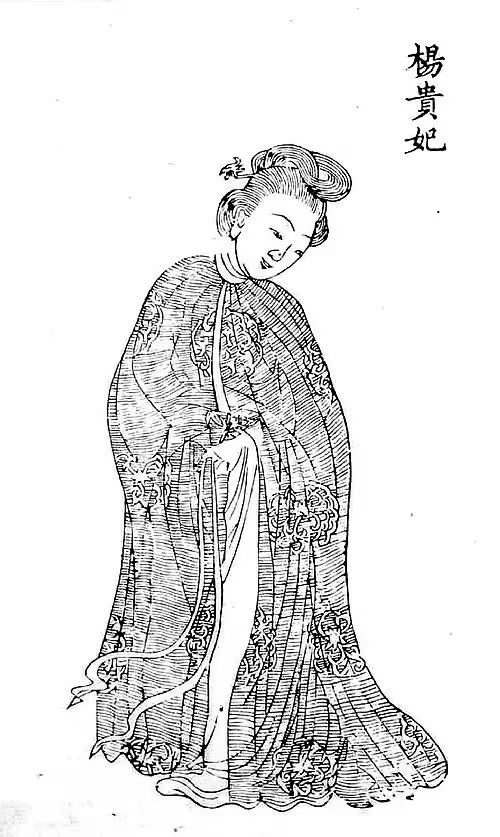
Yang Guifei (719 – 15 July 756), born Yang Yuhuan, was the most famous imperial consort in Chinese history — the beloved of Emperor Xuanzong whose family's rise and fall traced the arc of the High Tang's collapse. Taken into the palace from her position as a Taoist priestess after a first marriage to the emperor's own son, she held the emperor's exclusive devotion for eleven years; her cousin Yang Guozhong's feud with the frontier general An Lushan ignited the rebellion of 755; and at Mawei Station her own soldiers demanded her death as the price of the dynasty's survival. She became the subject of China's greatest love poem, Bai Juyi's Song of Everlasting Regret — and of a thousand-year debate over whether one woman was ever worth the blame of an empire's fall.
From Consort of a Prince to Priestess
She was born Yang Yuhuan in 719 at Yongle, near the Yellow River bend in Shanxi, into the Yang clan of the nearby prefecture — a respectable official family, not one of the great aristocratic houses, though it claimed old pedigree. Her childhood passed in Sichuan, where her father served and died, and she was raised by an uncle in Henan; the histories describe a girl of unusual beauty and a quick, playful intelligence, trained in music and dance, the two courtly arts that opened every door the examinations closed to women. In her late teens she was chosen as consort to Li Mao, the Prince of Shou — the eighteenth son of Emperor Xuanzong. It was, by the standards of the court, a brilliant match for a girl of her rank.
It became, by those same standards, a problem without a precedent. In 737, Xuanzong’s beloved consort Wu — mother of his favored son, the pivot of his middle age — died, and the emperor, in his early fifties, grieved as men do who have never before been refused anything. The most beautiful woman in his dominions, by court consensus, was already inside his own household: his son’s wife. The solution the court devised was characteristically Tang, and characteristically evasive. Yang Yuhuan was induced to take Taoist vows and enter a temple as a priestess with the religious name Taizhen — a device that dissolved her first marriage without scandal and placed her, conveniently, beyond the reach of ordinary propriety. For several years she moved in the emperor’s orbit in this ambiguous sanctity. In 745 the pretense was dropped; she was installed in the palace with the title Guifei — Noble Consort, the rank just below empress — and the emperor’s son was quietly given a new wife. The histories record the transaction with the delicacy of men who found it, even then, a little much.
The Reign of the Yangs
For the next eleven years, Xuanzong’s devotion was total, and the dynasty’s administration bent around it. The emperor had ruled for three decades and, after the exhausting years of the early Kaiyuan era, was visibly tired of governance; under the chancellors Li Linfu and then Yang Guozhong the machine ran on — taxation, frontier commands, court ritual — while the center of the emperor’s attention shrank to a single person. Yang Guifei held no office and issued no edicts; her power was the older and more absolute kind, over one man’s heart, and through it over the appointments, titles, and fortunes that flowed from his favor. Her three elder sisters were granted estates and the rank of state ladies and became fixtures of capital society, whose processions, the chronicles sniff, outshone the imperial princesses’. Her cousin, the minor official Yang Zhao — better known to history by his later name Yang Guozhong — rose from her recommendation to the chancellorship itself in 752, despite a record the histories describe as undistinguished to the point of comedy. The family’s enrichment was open and enormous. The standard anecdotes assembled the full indictment: the consort’s delight in fresh lychees, rushed north by imperial courier from the distant south, at a cost the memorialists never tired of computing; the courtiers and generals who paid court to her sisters as the road to the throne; the aging emperor who watched her performances in the Pear Garden academy and found in them the sum of his remaining ambitions.
The most bizarre entry in the record is An Lushan’s place in it. The enormous, magnetic frontier general — a grown man older than the consort — performed the role of her adopted son at court, joking and capering for the imperial couple, and the histories preserve the scene with the unease of men who knew what it portended: the dynasty’s greatest soldier and its most powerful consort’s family, playing at kinship in a palace where real kinship was the only currency. When An Lushan and Yang Guozhong fell into the feud that split the court after 753, the consort’s family stood at the center of every calculation the emperor refused to make.
Mawei Station
The rebellion came in the winter of 755, and everything the court had neglected came due at once. By the summer of 756 the rebel army had taken Luoyang and broken through Tong Pass; on 14 July the emperor fled the capital at dawn with a few thousand guards, family members, and high officials, heading for Sichuan. A day later, at Mawei Station, the army stopped and would not go on. The soldiers were exhausted, hungry, and furious — at the Yangs, whose cousin’s provocations they blamed for the war, and at the consort whose family the war had enriched. Yang Guozhong was dragged from his horse and hacked to death in the road. That was not enough. The mutinous regiments told the emperor, through his senior general Chen Xuanli, the terms: the root of the calamity was still with him. The record of Xuanzong’s deliberation, as preserved, is one of the most painful scenes in the dynasty’s annals — the old emperor hesitating while Gao Lishi, the chief eunuch who had served him for half a century, stated the situation with the plainness of a man out of time: the troops would not protect a sovereign who kept the woman they held responsible. She was taken to a Buddhist shrine at the edge of the post station and strangled. She was thirty-seven. Xuanzong went on to Sichuan, a retired emperor in everything but name, and the empire was put back together by his son.
The Poem and the Verdict
Her historical afterlife divides in two. The official one — the histories and their long tradition — places her in the line of consorts blamed for dynastic collapse, the proof text of the “beauty ruins the state” doctrine that Chinese political writing applied to every fallen age. It is a verdict that modern historians have decisively complicated: the structural causes of the catastrophe — the jiedushi system, the court’s withdrawal from frontier policy, the fiscal exhaustion — were decades in the making and owed nothing to a woman who held no office and made no appointments. The popular afterlife was more generous and far more durable. In 806, Bai Juyi wrote the Song of Everlasting Regret: the emperor who could not keep her, the priestess of Taizhen, the ever-lasting regret of a love that outlasted an empire. It became instantly the most famous poem in the language, was set to music within the dynasty, and fixed Yang Guifei forever not as a political case but as the image of beauty and loss — the woman for whom, in the poem’s closing vision, a Taoist adept searches the isles of the immortals and finds, at last, her promise and her hairpin. The histories say the empire fell because of her. The poem, which everyone remembers, says only that he loved her.
References & Historical Sources
- Old Book of Tang and New Book of Tang, biographies of the consort Yang (Yang Guifei zhuan).
- Zizhi Tongjian, volumes 215–218 (the installation, the Yangs’ rise, the flight and the Mawei mutiny).
- Bai Juyi, The Song of Everlasting Regret (806), with Chen Hong’s companion prose narrative.
- Poems and memorials of the period, in the Quantangshi.