Xuanzang
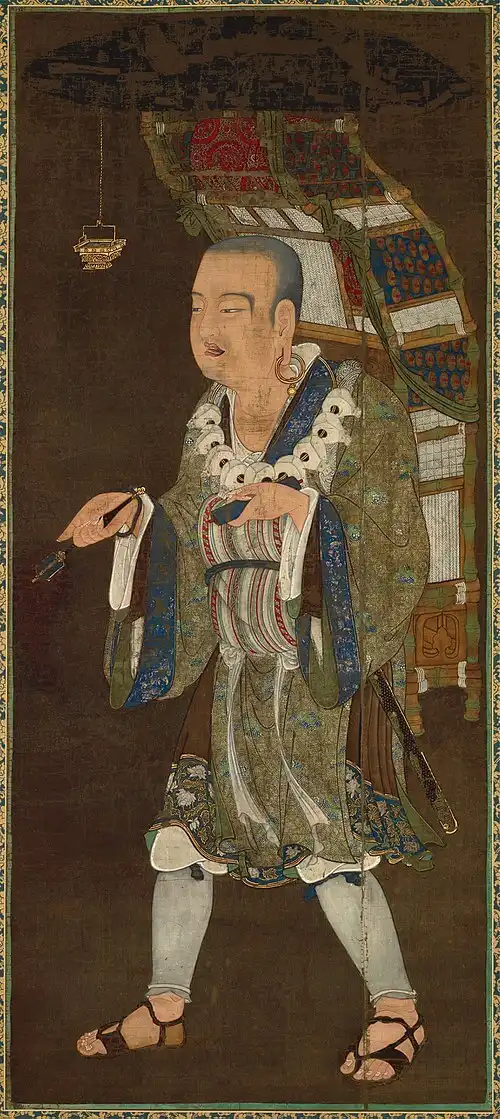
Xuanzang (602 – 5 February 664), born Chen Hui, was the Tang monk whose pilgrimage to India became the foundational journey of Chinese Buddhism. Setting out in defiance of the emperor's prohibition and crossing deserts and the highest passes on earth alone, he reached the great monastic university of Nalanda, studied with the age's foremost masters, and returned after seventeen years with hundreds of Sanskrit texts that he spent the rest of his life translating into Chinese. His travel record mapped medieval Asia for posterity; his fictional shadow, the Tang Monk of the Journey to the West, made his name immortal in every language.
The Forbidden Departure
Xuanzang was born Chen Hui in 602, the youngest of four brothers, in a scholarly family of Henan that had fallen on hard times — orphaned young, he was ordained at thirteen in the Luoyang temples and rose through the Buddhist establishment of the Sui-Tang transition as a prodigy of scriptural learning. His growing fame, however, rested on a crisis: the Buddhist texts available in Chinese were corrupt, truncated, and contradictory, and no authority in China could resolve the great doctrinal questions of the age. The answers lay at the source, in India, and in 629 — with the court’s westward travel ban in force after the recent Turkish wars — Xuanzang joined a caravan out of Liangzhou and slipped beyond the frontier at Guazhou, alone. The pilgrim’s own account, dictated years later, describes the passage of the Lop Nor desert: five days without water, mirages, the bones of earlier travelers, and the near-death from which his horse, inexplicably bolting, led him to an oasis.
India
From Kucha and the oasis cities — where the king of Turfan, impressed, provisioned him against the emperor’s ban — Xuanzang crossed the Pamirs in their winter snows and descended into the Buddhist world of the subcontinent. He spent the core years of his pilgrimage, from about 633, at Nalanda, the great monastic university of Magadha, studying Yogacara philosophy under the master Silabhadra, Sanskrit grammar, and the logical tradition, and traveling the sacred geography of the faith — Kapilavastu, Bodh Gaya, the Deer Park at Sarnath — while noting, with the geographer’s eye that makes his book priceless, the politics, products, and customs of every kingdom from Kamarupa to Sindh. His learning won public vindication: challenged at the court of King Harsha of Kannauj, he defended Mahayana doctrine in debate against all comers, and Harsha’s grand assembly of 643 — thousands of monks, brahmins, and princes — acclaimed the Chinese master’s victory.
The Return and the Translation
He came home in 645 with a caravan of twenty horses loaded with 657 Sanskrit texts, 150 relics, and images of the Buddha, and was met outside Chang’an by crowds the official biographer counts in the tens of thousands. Taizong, the emperor whose travel ban he had broken, received him with something like awe, and the reconciliation of throne and pilgrim defined the rest of Xuanzang’s life: the emperor sponsored the Translation Bureau at the Great Ci’en Monastery — staffed with the empire’s best scholar-monks, funded from the privy purse — through which, in nineteen years of relentless labor until days before his death in 664, Xuanzang rendered seventy-five works in 1,335 chapters into Chinese. His translations — among them the Heart Sutra and the foundational Yogacara treatises — set the standard for precision against which all later Buddhist translation was measured, and made the Faxiang school, the Chinese heir of his Indian learning, a doctrinal force for centuries.
The Records and the Legend
At Taizong’s command, Xuanzang dictated the Great Tang Records on the Western Regions, a geography of 138 kingdoms from the Tarim to the Deccan — the single most important eyewitness source for seventh-century Asia, used by historians of India, Central Asia, and the Tang alike, and by the archaeologists who, centuries later, found the buried cities he had described. His own death at sixty-two — “the translation is finished,” his last recorded thought, by the traditional account — closed the age of the pilgrim; but his second life was only beginning. Within a century his journey was being embroidered into the cycle of tales that became the sixteenth-century novel Journey to the West, in which the historical scholar returns as the Tang Monk, riding west under the protection of the Monkey King. Of all the men of the Tang, only he has walked in two immortalities: the documentary and the fabulous, each true to the journey in its own way.
References & Historical Sources
- Xuanzang, Great Tang Records on the Western Regions (Da Tang Xiyu ji), translated by Samuel Beal and Thomas Watters.
- Huili and Yancong, Biography of the Tripitaka Master of the Great Ci’en Monastery (Da Ci’en si Sanzang fashi zhuan, 688).
- Old Book of Tang and New Book of Tang, biographies of Xuanzang.
- Taizong’s preface to Xuanzang’s translation of the Heart Sutra.