Wei Zheng
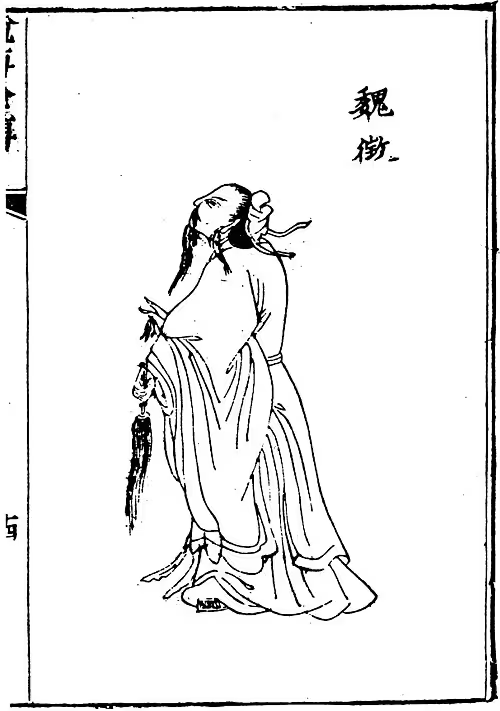
Wei Zheng (580 – January 643) was the most celebrated remonstrating minister in Chinese history — the man who told Emperor Taizong the truth to his face, over two hundred documented times, and made candor into an institution of the Tang court. A veteran of three successive masters during the Sui collapse, he survived the bloodbath of the Xuanwu Gate incident to become the conscience of the Zhenguan era, the age of good government that later dynasties took as their benchmark. His posthumous story is nearly as instructive as his life: honored at death, suspected of faction two months later, mourned again as 'one of my mirrors' when the emperor's wars went wrong.
Origins in the Collapse of the Sui
Wei Zheng was born in 580 in Julu commandery, in the northeast plain of what is now Hebei, into a family that claimed old official descent but had fallen on hard times. His father died while he was still young; the household was poor, and in his youth he drifted into the life of a Daoist novice before returning to the Confucian classics. He came of age at precisely the moment the Sui dynasty — exhausted by two decades of monumental construction and three catastrophic campaigns against Goguryeo — began to come apart.
When rebellion spread across the empire, Wei Zheng attached himself to the most formidable of the rebel powers, the Wagang army of Li Mi, and presented a memorial of ten policy proposals. The histories record that Li Mi admired and adopted them, and Wei Zheng served on his staff. After Wagang’s defeat by Wang Shichong in 618, Li Mi surrendered to the newly founded Tang, and Wei Zheng entered Tang service with him. His first notable service was a single letter: Li Shiji — the commander better known to history as Xu Shiji, the future Duke of Ying — still held Li Mi’s old territories and their great granaries in the northeast, and Wei Zheng urged him to submit to the Tang rather than wait to be crushed between rival powers. Li Shiji took the advice. The episode established Wei Zheng’s reputation as a man whose analysis could move armies without one.
The Crown Prince’s Man
Sent east to serve on the staff of Li Jiancheng, the eldest son of Emperor Gaozu and heir apparent, Wei Zheng did what he believed his duty required: he worked to strengthen the crown prince against his brilliant and increasingly threatening younger brother, Li Shimin, the Prince of Qin, whose campaigns had broken the dynasty’s principal rivals. When the rebel Liu Heita returned to the northeast in 623 at the head of a fresh uprising backed by the Turks, Wei Zheng and the staff officer Wang Gui urged that the crown prince take the field in person — both to win the victory and to gather to himself the allegiance of the Shandong elites. Jiancheng did so, defeated Liu Heita, and returned with new prestige.
But Wei Zheng saw further than his master. Again and again, by the account transmitted in the Zizhi Tongjian, he pressed the crown prince to move against Li Shimin before his power became unassailable. Jiancheng hesitated — a hesitation that ended on a summer morning in 626.
Xuanwu Gate
On 4 July 626, Li Shimin ambushed and killed Jiancheng and his brother Li Yuanji at the Xuanwu Gate, the northern entrance to the palace, and within hours compelled his father to name him crown prince and then retire. Summoned before the victor, Wei Zheng answered without flinching: the brothers had been set at odds by the talk of schemers, he said, and had the late crown prince heeded his advice, “he would not have died this death.” The new emperor — known to history as Emperor Taizong — looked past the provocation and recognized the quality he most needed around him. He pardoned Wei Zheng and set him to work. The partnership that followed became the most celebrated in the whole of Chinese political history.
The Remonstrator in Power
Wei Zheng rose through the admonishing offices and, from 629, served as head of the Chancellery (menxia shangshu), one of the Three Departments, making him effectively a chancellor. The office of remonstrator was ancient, but the Zhenguan court gave it teeth, and Wei Zheng gave it a voice. His documented remonstrances number in the hundreds, on war and peace, taxation and corvée, palace construction, court ritual, and the appointment of favorites. Taizong had deliberately gathered men who would contradict him, and Wei Zheng obliged without cease.
His most famous formulation reached the emperor through a discussion of why rulers go wrong: “The reason a sovereign is enlightened is that he listens to all sides; the reason he is benighted is that he trusts a single voice.” He opposed proposals to make provincial governorships hereditary, blocked — repeatedly and successfully — plans for a lavish feng-shan sacrifice at Mount Tai on the grounds that the state’s finances and the people’s strength could not bear it, and pressed on Taizong a lesson older than the Tang, inherited from Xunzi: the ruler is a boat, the people are the water — and water can carry the boat or overturn it.
Notably, this entire cohort rose without the examination system that would later define Tang officialdom. Wei Zheng, like most of the Zhenguan elite, came up through war, recommendation, and patronage rather than the imperial examinations — a reminder that the great age of Tang government predated the credential that later generations assumed had produced it.
The Ten Reflections and the Ten Faults
Two of his memorials became classics of political literature, studied by every later generation of officials. The “Memorial on Ten Reflections” of 637 — Ten Reflections on Taizong as it is often rendered — argued that the beginning of rule is easy and its ending hard, that the ruler who seeks a tall tree must first strengthen its roots, and it set before the emperor ten disciplines of self-command. Six years later, when Taizong himself asked why governance seemed less good than in the early Zhenguan years, Wei Zheng answered with the “Memorial on the Ten Gradual Failings”: a numbered catalogue of ten ways in which the emperor’s conduct had begun, imperceptibly, to slide from its beginnings. Taizong, who had asked the question, accepted the answer, ordered the memorial displayed where he would see it daily, and told his ministers that he had been shown his own faults. That a sovereign could ask for his own faults, and a minister could list them in public without being destroyed for it, is the essence of the Zhenguan legend — and it was, in part, performance. But the performance held for twenty-three years, which is more than can be said of most courts in any century.
Death and the Mirror
Wei Zheng died in January 643. Taizong suspended court for five days, attended the mourning, and escorted the funeral procession toward Zhaoling, the hillside where his own mausoleum was rising. To his assembled ministers he spoke the words every Chinese schoolchild still learns: bronze for a mirror serves to set one’s cap straight; history for a mirror shows the rise and fall of ages; a person for a mirror reveals one’s own gains and errors. “Since Wei Zheng died,” he said, “I have lost one of my mirrors.”
The posthumous story then took a darker turn. Wei Zheng had recommended the general Hou Junji and the official Du Zhenglun for high office; when Hou was executed in 643 for treason, and slander added that Wei Zheng had kept copies of his own remonstrances to hand to the court diarist for posterity, Taizong’s grief curdled. He cancelled the betrothal of Princess Hengshan to Wei Zheng’s son and toppled the stele he himself had composed for the grave. Two years later, on the bitter retreat from the failed campaign against Goguryeo — a war Wei Zheng would never have permitted — Taizong looked back with open regret: “If Wei Zheng were alive, he would not have let me make this march.” The stele was re-erected and the marriage arrangement restored. The dynasty’s own record thus gives its greatest remonstrator the most ambivalent of tributes: honored, suspected, and honored again.
Texts and Legend
Wei Zheng supervised the compilation of the official histories of the Liang, Chen, Northern Qi, and Sui dynasties — the Book of Sui, completed in 636, carries final assessments that in large part are his judgments — and he co-compiled the Qunshu Zhiyao (“Essentials of Government from Many Books”) as a bedside reader on statecraft for the emperor. His dialogues with Taizong were gathered after his death into the Zhenguan Zhengyao (“Essentials of Government of the Zhenguan Era”), the single most-read handbook of Tang governance ever produced. Popular legend added its own layer: the story of Taizong hiding a hunting hawk inside his sleeve when Wei Zheng arrived for an audience, and Wei Zheng deliberately prolonging the memorial until the bird suffocated, comes from the miscellany Sui-Tang Jiahua — a tale, not a record — but it captures precisely what later ages loved in the man: the one subject the emperor could not charm.
Historical Assessment
Chinese political culture remembers Wei Zheng as the ideal remonstrator — the minister whose duty to the throne outweighed his duty to its occupant’s feelings. His achievement was inseparable from Taizong’s: the Zhenguan government became, and remained, the benchmark by which every later Chinese dynasty measured its own, and Wei Zheng was its institutionalized conscience. Modern historians read the record with more caution. The remonstrator system worked because the ruler chose, for twenty-three years, to let it work; the same court that displayed his catalogue of faults preserved a system in which the catalogue was extraordinary precisely because it was survivable. And the posthumous reversal — the toppled stele, the cancelled marriage, the restoration — reminds us that even in the Zhenguan era, candor at court lived on the sufferance of a single man. That the man tolerated it so long is the real distinction of the age.
References & Historical Sources
- Old Book of Tang (Jiu Tang Shu), biography of Wei Zheng (juan 71); annals of Taizong.
- New Book of Tang (Xin Tang Shu), biography of Wei Zheng (juan 97).
- Sima Guang, Zizhi Tongjian, volumes 191–196 (Xuanwu Gate and the Zhenguan remonstrances).
- Wu Jing, Zhenguan Zhengyao (compiled early 8th century; dialogues of Taizong and Wei Zheng).
- Liu Su, Sui-Tang Jiahua — source of the hawk anecdote; a miscellany of tales, cited here as legend rather than record.