Wang Wei
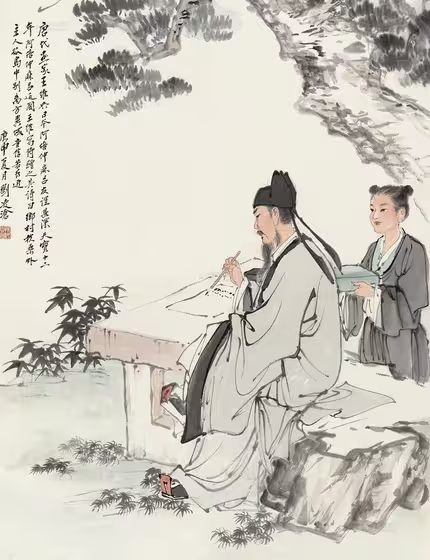
Wang Wei (701–761), whose courtesy name Mojie invoked the Buddhist sage Vimalakirti, was the Tang dynasty's poet of stillness — a painter-musician-official whose landscape poems achieve a silence no other Chinese writer has matched. A jinshi graduate at twenty, a survivor of court disgrace and the rebel occupation of the capital, and a lifelong devotee of Buddhism, he spent his best years commuting between a government post in Chang'an and his Wang River estate, writing the deceptively simple quatrains — 'Empty hills, no one in sight' — that made him the model of the poet-painter and the honored ancestor of Chinese landscape painting itself.
The Great Clan and the Vimalakirti Name
Wang Wei was born in 701 into one of the proudest families of the Tang aristocracy — a branch of the Wangs of Taiyuan, the great northern clan network that the dynasty’s own genealogists ranked at the top of the empire’s pedigree lists, long established in the Puzhou region by the bend of the Yellow River. His father died while Wang Wei was still young, and his formation was in the hands of his mother, a Cui of the Boling Cui clan, who was a devoted Buddhist: she took the lay precepts and studied under a Chan master for the last thirty years of her life. She named her younger son for her faith. “Wei” puns on the Buddhist word for bondage; the courtesy name, Mojie, is the Chinese transcription of Vimalakirti — the lay sage whose wisdom the sutras declare surpassed that of all the bodhisattvas. The boy was baptized, in effect, as the Vimalakirti of the Tang; the name proved to be a life’s program.
The family’s expectations were the standard ones for its class, and Wang Wei met them flawlessly. He was trained in music, calligraphy, and painting as well as letters — the complete courtly repertoire — and in 721, at about twenty, he passed the jinshi examinations. The famous story of how he did it belongs to the anecdotal layer of his biography: young Wang, seeking patronage, is said to have played an original pipa composition, the “Robe of Coiled Silk,” at the residence of a powerful imperial prince, eclipsing the scheduled performers and winning the prince’s decisive recommendation. The tale is first recorded long after his death and may be embroidery; the record of what happened next is fact. Within two years of his degree he had a court post, and the career of a favored son of the great clans had begun.
Disgrace and Return: The Pattern of Withdrawal
It ended, the first time, over a lion dance. In 722 or thereabouts, Wang Wei was serving in the palace music bureau when, by the received account, he allowed court musicians to rehearse a routine reserved exclusively for the emperor’s own spectacle — the dance of the yellow lions. For this breach of protocol he was demoted and sent out to a petty registrar’s post in Jizhou, deep in the northeast, and then successively to posts in the lower Yangzi region. He was in his twenties, exiled from everything his birth had promised, and the response he made set the pattern for the rest of his life: he retreated inward, toward the landscape poetry and the Buddhist practice that needed no capital.
The pattern repeated, in gentler form, for three decades. Recalled to Chang’an as the court’s music establishments expanded under Xuanzong, Wang Wei rose through the court’s ceremonial and literary offices, bought land, and — the pivotal acquisition — took up residence at his estate in the Wang River valley south of the capital’s suburban hills. There, in the years around 750, he wrote the sequence of twenty quatrains that remains his signature: the Wang River Collection, each poem paired with a matching poem by his neighbor and fellow official Pei Di, in which empty mountains, deer-forest silence, cassia flowers falling on an autumn night, and a fisherman passing on the stream become something very close to doctrinal statements — the world as perceived by an emptied mind. “Empty hills: no one to be seen, / but the sound of people talking is heard. / Returning light enters the deep wood / and shines again upon the green moss.” The poems are often described as paintings; Wang Wei would have described them as meditations.
The Rebellion: Captivity and Absolution
The second catastrophe of his life was the empire’s. When An Lushan’s rebels took Chang’an in 756, Wang Wei — sick, and caught in the city like Du Fu — was captured, and unlike Du Fu he could not or did not escape. The rebel regime gave him an office; the sources say he feigned illness and silence, but he held the title, and when the dynasty was restored the title was a capital charge. His life was saved by the poem he had written during the occupation, “At Bibi Pond”: “Ten thousand households, hearts breaking in the wild smoke; a hundred officials, again facing the setting sun. Autumn leaves rustle in the empty palace; sparse bells, in the setting sun.” The poem, passed to the restored court, testified to where his heart had been — “a hundred officials again facing the setting sun” was unmistakably a mourner’s loyalty, not a collaborator’s ambition — and Suzong’s court accepted the testimony, pardoning him and restoring him to office. The absolution was just, and it was also a judgment about what Wang Wei was: a man whose inner life the dynasty could verify by reading his verse.
His last years were the conventional good ending of a Tang official’s career, though worn thin by grief — the death of his mother, to whose Buddhist devotion he had responded by becoming a sterner devotee himself, and of friends and patrons lost in the war. Promoted finally to vice-director of the right in the Department of State Affairs (the “Vice-Director Wang” by which he is often known), he spent more and more time at Wang River, fasting, copying sutras, and painting. He died in 761, in his sixtieth year, requesting — in an account preserved by the tradition — an unadorned Buddhist burial, and was commemorated by the court that had twice nearly destroyed him.
The Painter’s Eye and the Poet’s Silence
Wang Wei’s double fame rests on the unity of his arts, and the tradition’s judgment of that unity was codified by a later master, Su Shi of the Song: “In Mojie’s poetry there is painting; in Mojie’s painting there is poetry.” The paintings themselves survive only in copies — the snowy rivers and river-ford images attributed to him are later reconstructions — but the poetic visuality is everywhere in the verse: the foregrounded detail, the misted middle distance, the exact placement of one human presence in a large emptiness. Within a few centuries, critics had gone further and made him a founder: the great Ming theorist Dong Qichang’s genealogy of Chinese landscape painting made Wang Wei the patriarch of the Southern school, the expressive ink-wash line descending from his hand to the literati masters of the Song and Yuan. The construction served later painting more than it documented Wang Wei’s actual art, but it fixed his position: the poet-painter is the Chinese artist’s ideal type, and Wang Wei is its first exemplar.
As a poet he has always stood slightly apart from Li Bai’s blaze and Du Fu’s weight — quieter, more limpid, more obviously Buddhist, sometimes criticized by Confucian taste as thin or retiring. The criticism misses the depth of the achievement: those twenty Wang River quatrains achieve an effect no other Chinese poet has duplicated, the presentation of a mind at rest so complete that the reader’s own mind slows to match it. His influence ran downward through the landscape tradition, outward to Japan — where his poetry was canonical early and his reputation as painter-poet fed directly into Japanese ink painting — and forward to every later poet who has tried to make emptiness speak.
References & Historical Sources
- New Book of Tang (Xin Tang shu), biography of Wang Wei.
- Old Book of Tang (Jiu Tang shu), literary notices.
- Zizhi Tongjian, annals of the Xuanzong period and the An Lushan rebellion (the 756 occupation).
- Wang Wei, collected works including the Wang River Collection and the paired poems of Pei Di.
- Su Shi’s critical formulation on Wang Wei’s poetry and painting, in his collected writings.