Travelers & Merchants
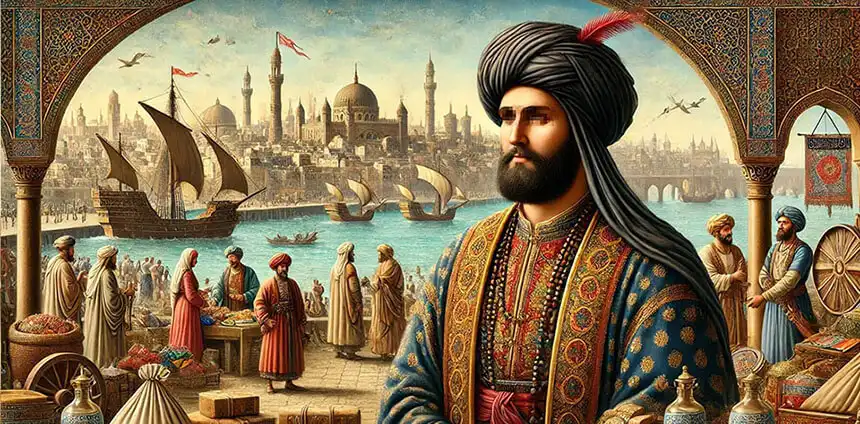
The Tang empire was the destination of the early medieval world's travelers — pilgrims, envoys, students, and above all merchants, who came overland from Persia and Sogdiana and by sea from Arabia and India to the ports and markets of the greatest economy on earth. Some left accounts that preserve the Tang as outsiders saw it: its cities, its customs, its prices, and its astonishing wealth. This page surveys the foreigners who journeyed to Tang China, and the men like Sulaiman al-Tajir whose written testimony lets us watch the dynasty through foreign eyes.
The Foreign Presence in Tang China
Tang China received foreigners on a scale no later dynasty matched until the Mongol age. The capitals quartered tens of thousands: Sogdian and Persian merchants in the western market of Chang’an, Arab and Persian communities in the foreign quarter of Guangzhou, Korean and Japanese students in the schools and monasteries, monks from every Buddhist land. The state managed this influx with its usual bureaucratic thoroughness: foreign envoys were processed by the Court of State Ceremonial, foreign merchants registered and taxed by the customs commissioners, foreign religions — Zoroastrianism, Nestorian Christianity, Manichaeism, Islam — licensed like guilds with their own headmen appointed under imperial authority. The result was the most cosmopolitan society in the world of its century, and a documentary harvest without parallel: for no other medieval empire do we possess, from a single generation, eyewitness accounts in so many foreign tongues.
The Envoys and the Students
Korea sent annual embassies whose students sometimes sat the Tang examinations and rose in Tang service; the Japanese missions — kentōshi — came by sea through appalling losses, bringing cohorts of monks and students who carried the entire apparatus of Tang civilization home: law codes, calendars, medicine, architecture, and the written language itself. The Arab caliphate sent embassies to Chang’an from the 650s onward, and their reports — beginning with the mission chronicled in the early eighth century — fed the Islamic world’s picture of China. Even Byzantium appears at the Tang edge of the record: the Old Book of Tang preserves the court’s register of “Fu-lin” (Roman) embassies arriving by sea in 643 and 711, the farthest reach of Tang diplomacy.
The Merchants’ Accounts
It is the merchants, though, who wrote the fullest picture. The ninth-century Arabic travel literature centered on China — the account associated with Sulaiman al-Tajir of Siraf, supplemented by Abu Zayd al-Sirafi’s continuations — describes Guangzhou in operational detail: the customs house that weighed and taxed every cargo, the fingerprint registers of newly arrived foreigners, the licensed brokers, the porcelain kilns, the granaries, the tea trade, and the enormous settled Muslim community with its own mosque, imam, and judge appointed by the Tang emperor. Persian geographers wrote the westward counterpart, tracing the caravan routes to the Jade Gate. Together with the Korean, Japanese, and Tibetan records, these foreign sources let the historian triangulate: the Tang as its own histories describe it, and the Tang as the world saw it — richer, more orderly, and more astonishing than any dynasty’s self-praise could make it.
Why the Travelers Mattered
The travelers were the empire’s circulatory system. Envoys brought legitimacy and tribute; students carried home the empire’s software; merchants carried its silk, porcelain, and paper west and its horses, aromatics, and silver east; and monks carried its religions in both directions. When the An Lushan rebellion and then Huang Chao’s sack of Guangzhou broke the sea and land routes in the ninth century, the travelers stopped coming — and the sources stop speaking. The foreign eye that had watched the Tang for three centuries closed, and the dynasty’s last decades would be documented, for the first time since the founding, by Chinese alone.
References & Historical Sources
- Abu Zayd al-Sirafi, Accounts of China and India; Sulaiman al-Tajir’s account as preserved in the Arabic tradition.
- Ibn Khurradādhbih, Book of Routes and Provinces.
- Old Book of Tang and New Book of Tang, monographs on foreign peoples and the treatise on the state ceremonial.
- Edward H. Schafer, The Golden Peaches of Samarkand (1963).