Sun Simiao
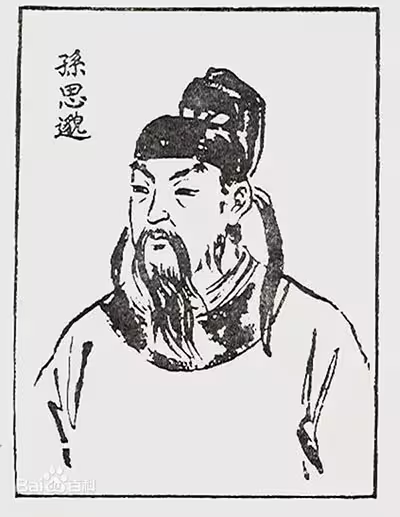
Sun Simiao (c. 581–682), honored for twelve centuries as the King of Medicine (Yaowang), was the Tang dynasty's greatest physician and the most influential medical writer in Chinese history. Declining every office the Sui and Tang courts offered him, he spent a hundred years of legendary longevity practicing among the common people of the Guanzhong hills, compiling the Essential Prescriptions Worth a Thousand Gold — the first great medical encyclopedia — and writing the On the Absolute Sincerity of the Great Physician, the founding text of medical ethics in East Asia. He treated the poor before the rich, and made medicine a calling rather than a trade.
The Physician Who Would Not Take Office
He was born around 581 — the date is the first of the traditions, with 541 given in some later accounts to stretch his life across an even more improbable span — at Huayuan, in the hills south of the future Tang capital. The boy was, by the standard story, prodigiously frail and prodigiously precocious: sickly from childhood, he poured himself into the medical classics, and resolved early on the course he would follow for the rest of his life. Medicine, he concluded, was the one art that served the Way directly; office was a distraction from it. The Sui court summoned him, and he declined; the founding emperor of the Tang, hearing of the physician of the Zhongnan hills, summoned him, and the chronicles describe the interview — the emperor struck by the old man’s bearing, the physician unimpressed by the throne, the gifts and honors waved aside. Emperor Gaozong later made him the formal offer of a high court title, with a government residence attached. He declined that too, with the courtesy of a man who had been declining thrones since before the dynasty existed. He lived, the histories say, to a hundred and one, and died in 682 in the hills where he had practiced.
The verifiable outline beneath the legend is consistent with it: he appears in the official biographies of both Tang histories, in the sections reserved for hermits and masters of technical arts; he was a figure of legendary longevity in his own lifetime — Gaozong, the chronicles note with awe, remarked on meeting him that this was no ordinary man; and he remained, through five reigns, the one medical authority the court consulted when it was in earnest, while declining to live by its favor. The legends that accumulated around him — that he treated six hundred lepers in his own home without infection, that he cured an emperor’s consort by a diagnosis no court physician dared to make, that he recognized a great talent in the young poet Lu Zhaolin, who came to study medicine under him and wrote of his master with reverence — are the growth of a reputation, not a curriculum vitae. Lu Zhaolin’s own testimony, at least, is documentary: the poet, broken by disease, opens his autobiographical preface with the memory of his master Sun, and of medicine learned at the bedside of the great.
The Prescriptions Worth a Thousand Gold
His monument is the book. The Essential Prescriptions Worth a Thousand Gold (Qianjin Yaofang), compiled around 652 and expanded late in his life in the Supplement (Qianjin Yifang), is the first comprehensive medical encyclopedia in Chinese history — thirty volumes organizing everything its author had learned in a lifetime of practice and a library’s breadth of reading: internal medicine, surgery, gynecology, pediatrics, dietetics, acupuncture, pulse diagnosis, and the pharmacy of his era, with prescriptions given against named conditions and their modifications explained. The title itself declares the ethic: prescriptions so valuable they outweigh a thousand in gold.
The work’s lasting contributions are of several kinds. It preserved, against the loss of the earlier dynastic medical literature, the clinical inheritance of the centuries before him. It recorded observations of striking originality — the recognition that goiter flourished in certain mountain regions and could be treated with preparations rich in iodine; the treatment of beriberi and other deficiency diseases by dietary correction, centuries before the concept of a vitamin existed; the use of insects and animal preparations against what modern medicine would recognize as specific infections. And it made two institutional arguments that reshaped Chinese medicine: that the diseases of women and of children were distinct subjects deserving their own sections — the book is the first in the tradition to give them systematic, separate treatment — and that medicine’s practitioners required a code of conduct worthy of the art. The essay he placed at the head of the work, On the Absolute Sincerity of the Great Physician (Dayi Jingcheng), remains the most quoted text in the history of Chinese medical ethics: the great physician, Sun wrote, must first calm his mind and fix his resolve to relieve the suffering of every living creature; must treat nobles and commoners, the ugly and the beautiful, the hated and the beloved, as one; and on entering a sickroom must comport himself as if the patient’s anguish were his own. No court ever enforced it. Every serious physician in East Asia has read it.
Healer of the People, God of the Hills
His practice was, by the unanimous tradition, conducted among the common people of the Guanzhong hill country — the villages, post stations, and temple fairs within reach of his hermitages — rather than the capital’s palace wards, and the stories that cluster thickest around him are the physician’s small kindnesses and impossible diagnoses magnified by retelling. He died in 682, and the court honored him with posthumous titles; the people went further. Within generations the physician of the Zhongnan hills was being worshipped as a god — Yaowang, the King of Medicine — in temples across north China, his image flanked by the green tiger of the mountain pharmacies, his birthday kept as a festival, his name invoked by every apothecary who mixed a prescription for a stranger without first asking his fee. The tradition he embodied — the physician as moral agent, medicine as the one art that cannot be practiced honestly for money — passed into the professional self-conception of Chinese medicine itself; the phrase “the heart of the great physician” (dayi zhicheng) from his essay entered the language as a standing term for medical conscience.
Modern assessment has been kind. The Prescriptions Worth a Thousand Gold has been studied continuously for thirteen centuries, republished in every age, and remains the largest single source for Tang medical practice; its gynecology and pediatrics founded the two disciplines as Chinese medicine knows them; its ethics text has been translated into every major language. Of the Tang’s gallery of great men — the generals, the chancellors, the poets — the one the common people chose to make a god was the physician who would not take office. The choice says something about both.
References & Historical Sources
- Old Book of Tang, treatise section on technical masters (Fangji), biography of Sun Simiao.
- New Book of Tang, biographies of recluses (Yinyi), biography of Sun Simiao.
- Sun Simiao, Essential Prescriptions Worth a Thousand Gold (Qianjin Yaofang), 652, with the Supplement, and the essay On the Absolute Sincerity of the Great Physician.
- Lu Zhaolin, preface to his illness writings, on his master Sun.
- The later Yaowang temple tradition, distinguished from the contemporary record.