Princess Wencheng
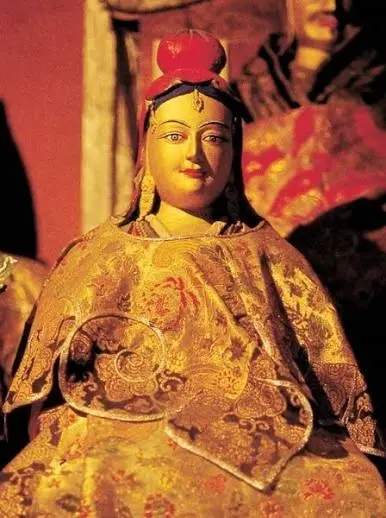
Princess Wencheng (c. 623–680) was the Tang imperial clanswoman whose marriage to the Tibetan emperor Songtsen Gampo in 641 became the founding legend of Tang–Tibet relations — and one of the most enduring peace symbols in Asian history. Escorted to Lhasa through a year's overland journey, she brought to the plateau, by Tibetan tradition, the technologies, texts, and Buddhism that shaped Tibetan civilization; the wars that followed her death were vast, but the two empires ended by swearing eternal kinship in the treaty of 821, on a pillar that still stands. In China she is remembered as a heroine of the frontier; in Tibet, as an emanation of the goddess Tara.
A Daughter of the Clan, Not of the Emperor
She was not, in the strict sense, a princess. Wencheng was a daughter of the Tang imperial clan — the sources associate her with the household of Li Daozong, the Prince of Jiangxia, a distinguished general of the founding generation — chosen in 640 for a marriage the court needed and no emperor’s daughter could be asked to make. The recipient was Songtsen Gampo, the btsan-po of the newly unified Tibetan empire, whose envoys had come to Chang’an with tribute and a request for a Tang bride and been refused; whose armies had then demonstrated, in a sharp raid on the Tang’s western frontier prefectures, what refusal cost; and whose renewed embassy, in 640, brought a gift of gold and a pointed message about the relative size of the two realms’ empires. Taizong agreed. The bride designated for Lhasa was in her late teens; the records of her birth name do not survive, and “Wencheng” is the title-style by which history knows her.
The marriage was one element in a coherent policy. The same years saw Taizong’s other famous marriage alliances — to the Tuyuhun king, to the Tibetan neighbor states — and the embassy of the pilgrim Xuanzang passing the other way. The Tang court understood perfectly what it was doing: the histories record the emperor’s own assessment that a marriage alliance would bind the plateau’s new power where armies could not reach it, and the tribute-bride system of the era was an instrument of statecraft as deliberate as any campaign.
The Journey to Lhasa
The journey became the legend. The sources give it a year — the slow ascent through the Qinghai passes, the caravan of escorts, attendants, and the princess’s dowry — and the escort was commanded by her kinsman Li Daozong himself, who delivered her to Songtsen Gampo at the edge of the Tibetan heartland. The Tibetan tradition, which remembers everything about this marriage in golden detail, tells that the princess brought with her the statue of the Buddha that still stands in Lhasa’s Jokhang temple — the image said to have been brought from China as the foundation of Tibetan Buddhism — along with Chinese craftsmen, agricultural techniques, silk and papermaking, medical texts, and works on divination and calendrics; that she taught the plateau to grind grain and to stop the Tibetan custom of painting the face red; and that her mausoleum, facing east toward Chang’an, still keeps her vigil over the road home. The modern historian’s caution is required here: the detailed traditions are late, compiled centuries after the events by a Tibetan Buddhism eager for royal origins, and the contemporary Chinese record is much thinner — it confirms the marriage, the dowry, and the honors, not the curriculum of gifts. But the direction of the tradition is not in doubt. The marriage did bring the plateau into sustained contact with Chinese technology, art, and writing, at the moment the Tibetan state was building its institutions, and both civilizations dated their connection from it.
The marriage itself, by the record, was a success of statecraft if not of intimacy. Songtsen Gampo, who had a senior queen from Nepal by the same tradition, honored the Tang bride with a palace rebuilt in Chinese style, sent his nobles’ sons to Chang’an to study the classics, and asked — the detail the Chinese sources preserve with pride — for Tang scholars to be sent to teach the Tibetan court the histories and the classics of China.
The Peace That Was Not, and the Peace That Was
The marriage did not hold the peace, and Wencheng lived long enough to see the failure. Songtsen Gampo died in 649 or 650; within twenty years the two empires were at war along their whole frontier — the great Tang defeat on the Dafei River in 670 fell within her lifetime — and the two centuries that followed were the longest sustained great-power war in the dynasty’s history. The princess herself, by Tibetan tradition, lived on at Lhasa until about 680, honored in the Tibetan court even in wartime; the Chinese records of her last years are silent, and the silence itself tells the story of how thoroughly the relationship’s golden opening had been buried under its wars.
Yet the kinship outlasted the war — that is the marriage’s strangest legacy. In 821, after two centuries of fighting that had exhausted both empires, the Tang and Tibet negotiated their great treaty, and the surviving inscription of 823 styles the two sovereigns as uncle and nephew, the kinship descending explicitly from Wencheng’s marriage, the two rulers “as close as if one family.” The Lhasa pillar stands in front of the Jokhang to this day, the oldest surviving treaty text between two Asian great powers, and its fictive family is hers.
Two Memories
Her afterlife divides, like the relationship, into two civilizations’ keepsakes. In China, Wencheng entered the standard gallery of frontier heroines — the woman sent to civilize the barbarian, dramatized in ballads and opera for a thousand years, her statue in the Princess Wencheng temple near the Qinghai frontier a place of pilgrimage, her marriage the textbook example of the heqin alliance policy working exactly as designed. In Tibet the memory is deeper and more religious: later Buddhist tradition came to regard her and the Nepalese queen Bhrikuti as incarnations of the goddess Tara, the green and the white, whose marriages brought the Dharma to the Land of Snows, and the Buddha-statue she is credited with bringing remains the holiest image in Tibetan Buddhism, housed in the Jokhang her husband founded. The modern verdict of historians is kind to both memories and stricter than either: the marriage was real statecraft with real cultural consequence, and the legend that grew from it is among the most successful pieces of diplomatic mythology any two countries ever made together.
References & Historical Sources
- Old Book of Tang and New Book of Tang, the monographs on Tibet (Tufan zhuan), for the embassy, the marriage of 641, and the dowry.
- Zizhi Tongjian, volumes 195–196 (the embassy and the marriage).
- The Lhasa treaty inscription of 823, which derives the two sovereigns’ kinship from the marriage.
- The later Tibetan historical and religious tradition, used with due caution.
- Christopher I. Beckwith, The Tibetan Empire in Central Asia (1987), on the strategic setting.