Li Shangyin
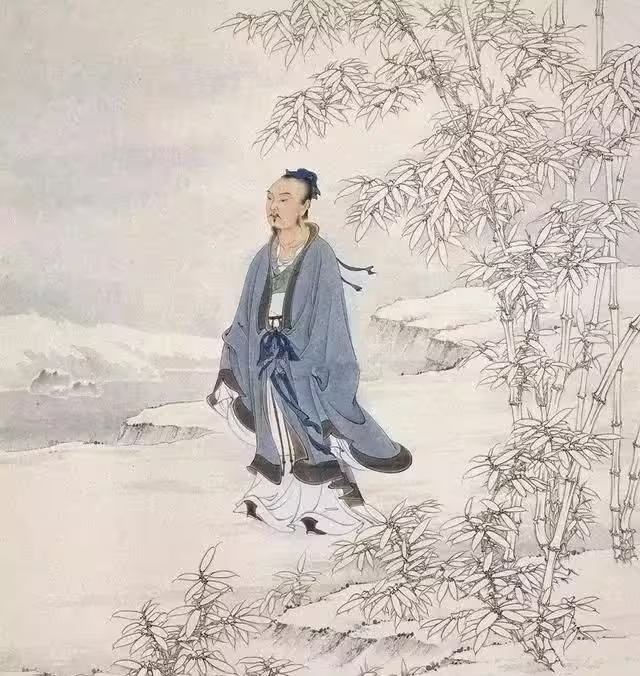
Li Shangyin (c. 813–858), courtesy name Yishan, was the last great master of the Tang dynasty — the poet who took the regulated verse inherited from Du Fu and turned it into an instrument of incomparable density and ambiguity. Orphaned early and trained by a great statesman's patronage, he was ruined between the court's two warring factions and spent his career in the provinces on other men's staffs. His untitled love poems, gorgeous and inexhaustibly allusive, have been read for eleven centuries as autobiography, as political allegory, or as pure art — and the debate itself has become part of his legend.
A Scholar’s Orphan
Li Shangyin was born about 813 into a family of the minor official stratum — the stratum that produced the examination elite and nothing grander: his ancestry was traced to the imperial clan of the distant Han, a genealogical flourish that the Tang took seriously and that bought his family nothing. His father, a district official, died when the boy was about nine, and the family was thrown back on its women; the biography preserved in the New Book of Tang records the young Li Shangyin escorting his father’s coffin home and thereafter copying texts for a living to support his mother — the founding hardship of the archetypal poor scholar, and a detail the tradition never forgot.
His talent attracted the one patronage that mattered. Linghu Chu — a former chancellor, one of the most powerful men of the day, and master of the ornate parallel-prose style in which all state documents were written — took the young man into his household in his late teens and taught him the difficult art. Li Shangyin repaid the instruction by becoming one of its masters; his parallel prose, collected after his death in the four books of the Fannan Collection, was studied as a model for centuries. But the style was the least of the inheritance. Linghu Chu stood at the head of the so-called Niu (Ox) faction; the examination world, and the world, was split between it and the rival Li (Rams) faction, and the fault line ran directly through everything Li Shangyin would do for the rest of his life.
Between Two Factions
The disaster arrived in the usual form: a marriage. In 837, with Linghu Chu’s son Linghu Tao smoothing the way, Li Shangyin passed the jinshi examinations — and almost immediately afterward, in 838, he married the daughter of Wang Maoyuan, a general who happened to belong to the Li faction. The marriage was happy; the politics were fatal. To the Linghu connection, his taking service under Wang Maoyuan was betrayal; to the Li faction, he was a Linghu client and always would be. The language of the histories is blunt: he was “alienated” by both sides, squeezed from both sides, and the offices that came his way were petty ones — a county registrar’s post at Hongnong, from which he attempted to mitigate the cruelty of the local penal system and was reprimanded for his pains.
The pattern of his working life was set: the provincial staff. In the late 840s he served under successive military governors, the standard employment of a talented man without capital connections — most fruitfully in the far south, in the Guilin secretariat of the commissioner Zheng Ya from 847 to 849, where the strange watery landscape of Guangxi poured into his verse; then in Sichuan, on the staff of the governor of Zizhou, from 851. Between postings he returned to the capital region and to Luoyang. It was a career of almost constant motion and almost no advancement, and the poems keep the score: the traveler at a ruined shrine, the exile watching the rain, the official writing home at year’s end.
The Wife and the Untitled Poems
In 851 his wife died. The marriage of thirteen years had produced children and a small library of exchange poems, and the loss hollowed the middle of his life. He never remarried. The bereavement produced the sequence of autumnal poems that ranks among the greatest elegies in the language — and, more hauntingly, it frames the reading of the Untitled poems (Wuti shi), the series of quatrains and octaves on frustrated love, written in no recoverable order, that made him immortal: “When, at the west window, shall we trim the candle together, and talk of the night rain on the Ba mountains?” The question mark that governs the whole corpus is whether “we” is the dead wife, an unnamed court lady, the patronage he lost, or the dynasty itself as it slid toward its final half-century of decay. The tradition split early: one school read the Untitled poems as veiled political allegory (the beloved as the court that rejected him), another as disguised autobiography, and the mature position is that the poems were built to sustain all these readings at once — the allegory and the love letter made indistinguishable, which is precisely their power.
The craft is Du Fu’s — the same packed allusion, the same exacting form — carried past intelligibility into something new: imagery so dense (“The spring silkworm’s thread ends only with its death; the wax torch’s tears dry only into ash”) that each line functions simultaneously as statement, emblem, and riddle. Eleven centuries of commentary, much of it line-by-line and much of it mutually contradictory, have not exhausted them.
Late Years and Reputation
Li Shangyin spent his last years back in the Luoyang–Zhengzhou circuit, serving under the patron of his final years, Liu Zhongying, and then in semi-retirement, turning — as the exhausted often did — toward Buddhism, writing commentaries on the sutras and poems in the voice of a devotee. He died in 858, aged about forty-five, leaving the corpus that his editorial executor assembled into the Fannan Collection: several hundred poems, nearly all of the regulated forms, plus the prose. He was too late, and too strange, to be canonized immediately; the taste of the following centuries had to catch up with him. The Song dynasty’s great critics ranked him below Du Fu and the High Tang masters; the reversal came late, and when it came it was total — by the Ming and Qing, commentators were treating his verses as a lifetime of coded confession requiring a key, and by the twentieth century the modern anthology tradition had settled the question: Li Shangyin stands as the last summit of Tang verse, the poet in whom the dynasty’s great tradition achieved its final, most compressed flower, one generation before the dynasty itself fell. His influence runs through the whole later canon of the dense, allusive mode — through the Song’s most learned poets, the Ming’s archaists, and into the modern era, where the Untitled poems, endlessly retranslated, remain the standard test of any translator’s art.
References & Historical Sources
- New Book of Tang (Xin Tang shu), biography of Li Shangyin.
- Zizhi Tongjian, annals of the late Tang (factional history and staff appointments).
- Li Shangyin, Fannan Collection (poems and parallel prose), with the traditional commentarial tradition.
- The memorial writings for his wife and his own prefaces, for the biography of the marriage.