Li Jing
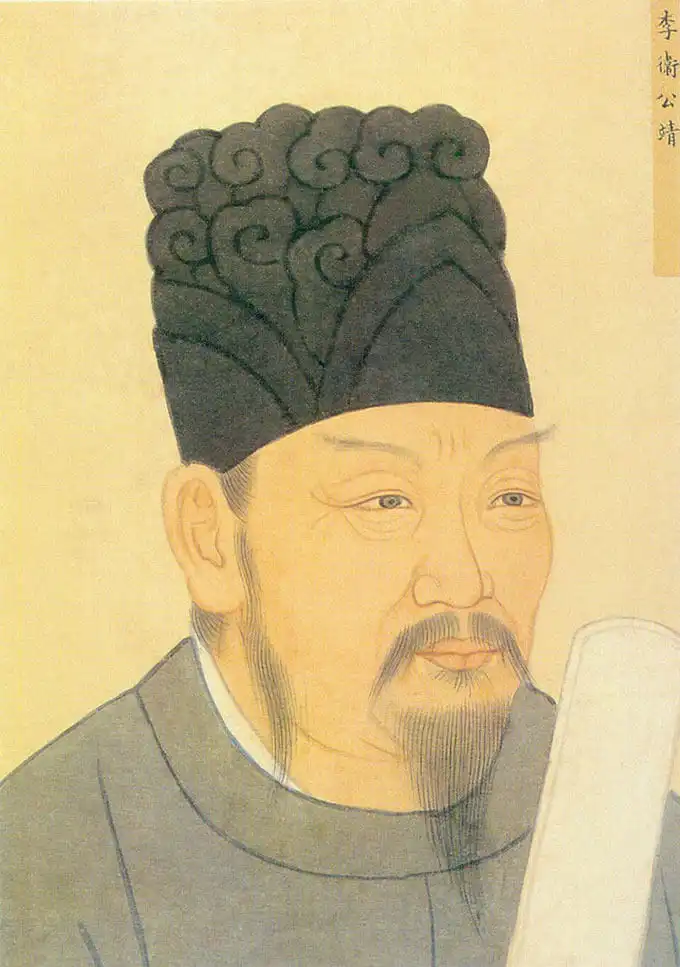
Li Jing (571 – 2 July 649), courtesy name Yaoshi, posthumously Duke Jingwu of Wei, was the Tang dynasty's supreme strategist — the general who destroyed the Eastern Turkic Khaganate in a single winter campaign of 630, securing the founding dynasty against its most dangerous enemy forever after. Soldier, scholar, and military writer, he retired as the empire's most honored subject, and posterity raised him further: into the Taoist pantheon and the Chinese martial imagination, where he remains the model of the general who wins without waste.
The Almost-Martyr of the Founding
Li Jing’s path to glory began with his near-execution. Born into the Guanlong aristocracy — his uncle was the great Sui general Han Qinhu — he served the Sui as a county official and then on the staff of the counter-rebel campaigns, where his strategic memoranda on the state of the empire, submitted to the Sui court in its last years, already showed the mind that later generations would study. In 617–618, as Li Yuan’s rebellion rose at Taiyuan, Li Jing — then serving the Sui in the Chang’an region — attempted to slip away to warn the Sui court at Jiangdu of the danger. The rebel army caught him, and he was brought before Li Yuan for execution; on the block, he shouted his protest that the founder of a new dynasty should not kill a man for loyalty to the old one. Li Yuan, impressed, released him, and Li Shimin took him onto his staff. It was the founding’s luckiest reprieve.
The Conquest of the Turks
His campaigns define the early Tang’s military golden age. In the civil wars he served Taizong against Wang Shichong and in the southern campaigns; but his masterpiece was the war against the Eastern Turks. The khaganate of the steppe — two centuries of China’s northern nightmare — had been weakened by snow famine, internal revolt, and the defection of its tributaries, and in 629 Taizong gave Li Jing command of the punitive expedition. His plan was the antithesis of the ponderous frontier war: six columns, ten thousand light cavalry in his own van, advancing in the dead of winter across the steppe to the Khaganate’s heartland on the Orkhon. In March 630 his leading regiments, after forced marches of hundreds of li through blizzards, fell on the camp of Jieli Khan at the Iron Mountain; the khagan fled, was run down by the column of Li Shiji, and was delivered to Chang’an. The Eastern Turkic Khaganate ceased to exist in a single campaign of a few weeks — the most decisive victory in the dynasty’s history, achieved at negligible cost. Taizong received the captive khagan at court and was acclaimed by the northern tribes as the “Heavenly Qaghan”; the steppe menace that had defined Chinese statecraft since the Han was ended, and the Tang’s century of expansion could begin.
Strategist and Writer
Li Jing was more than a battlefield commander. With Li Shiji he conducted the 635 campaign that broke the Tuyuhun of the Qinghai plateau; he directed the planning of the wars against Goguryeo in the 640s, and his advocacy of the long war of attrition there — against the court’s impatience — was vindicated by every campaign that ignored it. His military writings, the Questions and Replies between Tang Taizong and Li Weigong on military matters (recorded as the Li Weigong Bingfa dialogues), became one of the Seven Military Classics of later China: a terse, pragmatic corpus on intelligence, terrain, morale, and the commander’s mind, famous for its insistence that the general who knows when not to fight is worth ten who only know how. Taizong consulted him to the end; on the emperor’s deathbed roster of achievements, the destruction of the Turks stood first, and Li Jing’s name was inseparable from it.
Retirement and Deification
He retired early, by Tang standards — deaf and ailing in his last years, he kept his household small and his guests few, a studied modesty that spared him the fate of colleagues who stayed too visible at court (his fellow conqueror Hou Junji died on the execution ground in 643; Li Jing died in his bed in 649, aged seventy-eight, buried with the highest honors at the imperial mausoleum). Posterity did the rest. In later Taoism he became a celestial marshal; in the Ming novel Investiture of the Gods he is the pagoda-bearing heavenly king; in the Journey to the West he is the general of heaven’s armies, father of the boy-hero Nezha. The historical man — austere, precise, and unbloodthirsty — would, the histories hint, have been quietly amused.
References & Historical Sources
- Old Book of Tang, biography of Li Jing.
- New Book of Tang, biography of Li Jing.
- Zizhi Tongjian, volumes 191–197.
- Li Weigong Bingfa (Questions and Replies), in the Seven Military Classics.