Li Bai
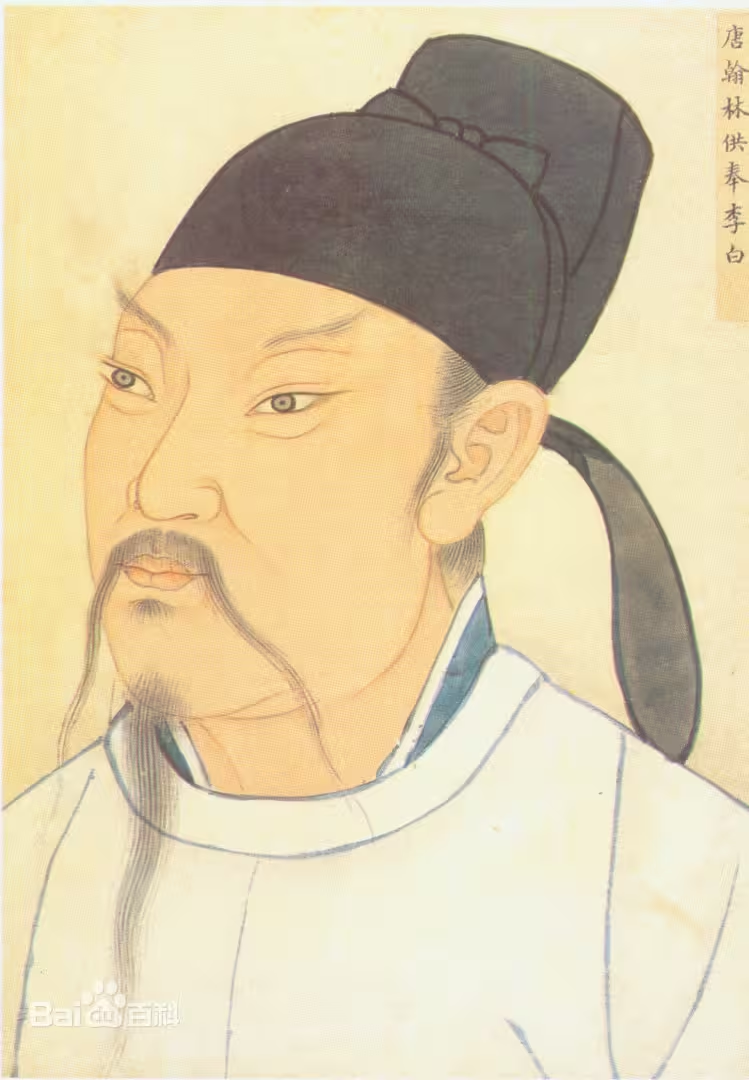
Li Bai (701–762), also written Li Bo and called Li Taibai, was the supreme poet of the Tang dynasty's High period and, by the verdict of thirteen centuries of Chinese readers, the greatest romantic poet in the language. A wanderer who never passed the examinations, a courtier famous for being dismissed, and a rebel's employee who narrowly escaped execution, he turned a life of failure and flight into verse of unsurpassed imaginative freedom — over a thousand poems of mountains, moonlight, wine, and the open road, which remain the most recited and most translated body of Chinese poetry ever written.
Origins: The Boy from the Western Frontier
Li Bai’s beginnings are a matter of legend layered on a thin documentary base, and the legends begin with his birthplace. The official biographies in the Old Book of Tang and New Book of Tang state only that he was a man of Shandong (in Tang usage, the region around the eastern capital Luoyang) whose family had been banished to the far west; later tradition placed his birth in 701 at Suyab — the Tang garrison city on the Chu River, in what is now Kyrgyzstan — where his family reportedly traded, and where a stone monument to the poet was raised in modern times. What is certain is the outline: he grew up in the Jiangyou region of Sichuan, in a wealthy household outside the gentry order, and that order’s consequences shaped his whole life — as the descendant of a disgraced or merchant family, he was ineligible for the civil examinations that were the only normal road to high office. He never took them. “I am not one for the boxed-in carriage of office,” he wrote of himself, and the histories confirm that he sought advancement by another route entirely: patronage, reputation, and the road.
His education, by every account, was extraordinary — not the examination curriculum but the whole archive of the age, from the Daoist classics and the Songs of Chu to the sword, for he trained seriously as a swordsman, killed at least one man in his youth by his own boastful account, and traveled in the company of fighting men. Two commitments made in these years lasted his life: devotion to Daoism, which he would pursue through formal ordination rites, and the friendship network of Sichuan’s recluses and adepts, through which he would eventually reach the throne itself.
The Wanderer: Twenty-Five Thousand Li
At twenty-five, Li Bai left Sichuan by boat down the Yangzi, beginning the wandering that would consume most of his life and fill most of his verse. For the next decade he traveled through the lower Yangzi and the southeast, marrying into the Xu family of Anlu (in modern Hubei) — the family of a retired chancellor, whose connections and library gave him his first footing — and building the persona that made him famous: the immortal-in-waiting, dazzled by mountains and rivers, generous with his calligraphy and his gold, forever departing. “A hundred thousand in gold, spent and gone — but a warm-hearted man leaves a name for a thousand years,” he wrote, and lived accordingly.
His search for patronage produced one of the most consequential friendships in Chinese literary history: in Shandong he met the poet and Daoist priest Wu Yun and, through him, the Daoist master Sima Chengzhen, who in turn recommended Li Bai to the throne. In 742, the forty-one-year-old poet received the summons of Emperor Xuanzong. The twelve years of wandering had made him the most famous living writer in the empire; the court was about to test whether fame could survive contact with power.
Chang’an and the Banished Immortal
The summons was everything he had wanted, and it ended badly. Xuanzong received him with honors, appointed him to the Hanlin Academy — nominally a scholar’s post, in practice a court writer of edicts and entertainments — and, by the most famous anecdote of the age, the elderly official He Zhizhang, reading his verse, exclaimed that Li Bai was a banished immortal: a star deity sent down to earth. The stories of his Chang’an years, embroidered by later biographers, have him composing at command while drunk, having the court eunuch Gao Lishi remove his boots, and watching the consort Yang Guifei grind his ink; the core record is more sober. He was employed to write court verse, he performed brilliantly, and within two years he had worn out his welcome — demanding the retreat of a jealous minister, mocking the great families, and treating the palace as one more roadside tavern. In 744, at his own request or the court’s, he left Chang’an, receiving from the emperor a generous parting gift and, with it, the freedom to be Li Bai again.
What Chang’an had given him was the confirmation of his myth, and on the road out of the capital he collected the second great friendship of his life: in Luoyang, in the autumn of 744, he met Du Fu. The younger poet, twenty years his junior, was awed; they traveled together, hunted, drank, and wrote poems to each other, and Du Fu’s later verses to the absent Li Bai — thirteen of them, more than to any other friend — remain the most moving testimony we have to what Li Bai was like to be near. “When I think of you, deep in the night, I turn and look toward the white moon; of its light, a thousand miles, I see your face in the frost.”
The Rebellion and the Edge of Death
The catastrophe of the dynasty caught the wanderer at last. When An Lushan’s rebellion erupted in late 755, Li Bai was living in the Yangzi region; in 756, as the emperor fled southwest and rival courts sprang up in the fragmentation, he accepted a staff appointment from Li Lin, the sixteenth son of Xuanzong, who had been given command of the lower Yangzi. When Li Lin’s army was declared rebellious and destroyed by the loyalist general Li Guangling, Li Bai fled — and was captured. His case went to the top: the new emperor Suzong’s court condemned him to death as a rebel collaborator; the sentence was commuted to exile in the far southwest, to Yelang, in the malarial mountains of modern Guizhou.
The journey nearly broke him, and the pardon saved his life and made one of his most famous poems. In 758, proceeding up the Yangzi under guard, he learned at White Emperor City that an amnesty had been proclaimed; released, he turned downriver and wrote what generations of Chinese schoolchildren have memorized ever since: “At dawn I left White Emperor City, high in the colored clouds; a thousand li to Jiangling, and back in a single day. The apes on the banks cried endlessly, while my light skiff had already passed ten thousandfold mountains.” He was fifty-seven. The remaining years were an anticlimax of dependence on younger relatives and well-wishers in the Dangtu region of Anhui, a bout of illness, and in 762 his death — recorded, as with everything about him, in competing versions: illness, or the legend that, drunk on a boat on the Yangzi, he leaned to embrace the reflection of the moon and drowned in it. The legend is false and perfect, and it is the one most people remember.
The Poetry: The Immortal’s Art
Roughly a thousand of Li Bai’s poems survive in the Quantangshi, and their range is wider than his legend suggests. There are the frontier ballads in the old yuefu forms, drinking songs of enormous formal control disguised as spontaneity, the farewell poems that Chinese parting culture made its highest art, the landscape hymns of Mount Lu and the Yangzi gorges — and beneath all of them, the signature mode: direct address to the universe. He speaks to the moon as an equal, to the mountains as companions, to history’s failures as fellow drinkers; the register is the Daoist one of returning to the uncarved block, of a self too large for the world’s boxes. The technical achievement is easy to miss behind the spontaneity: he was a rigorous master of the old-style forms, and his contemporaries’ admiration — Du Fu called his work “unfettered as a whale swallowing a hundred rivers” — was for a craft as much as a gift.
His afterlife is a history in itself. Within decades of his death he was being anthologized beside Du Fu as one of the twin summits of the age; by the Song dynasty he was simply the Poet-Immortal, a figure of folklore as much as letters. In the twentieth century he became the first Chinese poet fully at home in English — Arthur Waley’s translations, Ezra Pound’s Cathay, and a continuing line of versions have made him, for most of the world, the classical Chinese poet, the way Shakespeare is the English one: the name that stands for the whole tradition.
References & Historical Sources
- Old Book of Tang (Jiu Tang shu), literary biography of Li Bai.
- New Book of Tang (Xin Tang shu), biography of Li Bai.
- Zizhi Tongjian, annals of the Xuanzong period and the An Lushan rebellion.
- Quantangshi (Complete Tang Poems), Li Bai’s collected verse.
- Li Bai, miscellaneous prose including letters on his own life and travels.