Empress Wei
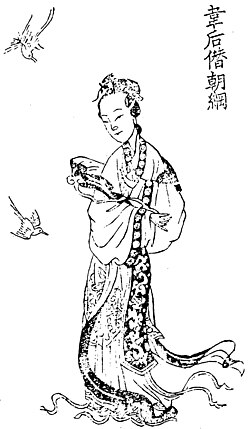
Empress Wei (died 21 July 710) was the second wife of Emperor Zhongzong of Tang and, for the five years of his restored reign (705–710), the effective ruler of the empire. Determined to repeat the usurpation of her mother-in-law Wu Zetian, she dominated a pliable emperor, sold offices, built a faction of courtiers and magicians — and, by the standard account, poisoned her husband to seize power as regent. Seventeen days later she was dead in a palace coup, her clan exterminated, a spectacle that closed the era of female imperial ambition the Wu dynasty had opened.
Exile and Return
Wei entered history as a victim of Wu Zetian’s terror. Her husband, the future Emperor Zhongzong, was deposed by his mother in 684 after only six weeks on the throne, and the couple were exiled to Fangzhou on the Han River, living for years under the shadow of Wu’s informers, who reported their every sigh. The Old Book of Tang records the couple’s fear-driven devotion of that period, and the birth of their youngest daughter, Li Guo’er, on the road — the future Princess Anle, whom Zhongzong famously cherished from a makeshift cradle of his own robe. When the Shenlong coup of 705 finally toppled the aged Wu and restored Zhongzong, Wei emerged from fourteen years of terror as empress — and the terror had taught her its methods.
The Shadow Empress
The restored Zhongzong was a broken sovereign: timid, pleasure-loving, and helplessly grateful to the wife who had shared his exile. Wei ran the government. She and her daughter Anle sold offices and promotions openly — by the histories’ count, tens of thousands of posts — through a traffic managed by palace women and their favorites; she placed her clansmen in key commands, most fatally her cousin Wei Wen, and she leaned politically on Wu Sansi, a nephew of Wu Zetian who had survived the restoration by marrying into the restored court; she sponsored magicians, soothsayers, and construction projects that drained the treasury, including a great artificial lake in the palace grounds. Officials who protested were silenced — some murdered, like the censor who accused her of impropriety and was found dead on the road. Her model was explicit and everyone saw it: she kept portraits and precedents of Wu Zetian close, studied them, and let it be known she intended to follow them. The court watched her build the apparatus of a second usurpation in the open.
The Poisoning and the Coup
On 3 July 710 the fifty-five-year-old Zhongzong died suddenly after eating cakes brought by Anle. The official account — recorded by the historians of the winning side, and accepted by most modern scholarship — is that Wei and Anle poisoned him, so that Wei could rule as regent for the child emperor Li Chongmao. The speed of what followed shows how little the court believed the death natural. Within days, Wei had the palace guard in her clansmen’s hands, the government sealed, and the capital quiet. She had not, however, secured the northern gate commands, and she had fatally underestimated two people: Princess Taiping, Wu Zetian’s daughter and the most practiced intriguer of the age, and Taiping’s nephew Li Longji, the Prince of Linzi. On the night of 20–21 July, Li Longji led several hundred guardsmen over the palace walls — some of the gate troops went over to him on the spot — and the coup dissolved Wei’s power in hours. Wei fled toward the palace guard barracks and was cut down; Anle, braiding her hair when the soldiers came, was dragged out and killed; and the extermination of the Wei clan began at dawn.
Historical Assessment
Empress Wei’s seventeen-day regency is a footnote; her five-year shadow rule is not. The historians who wrote her down — servants of the Xuanzong court that destroyed her — made her the textbook warning against waiqi, the consort clan, and the histories’ verdict on the Zhongzong era (“the court was sold like a market”) is largely a verdict on her. Modern historians qualify the portrait: her corruption was real but conventional by the standards of the age, her ambition unremarkable in the dynasty Wu Zetian had founded on the same premise, and her crime — if crime it was — was failure. Wu had taken the throne with the bureaucracy, the army, and two generations of patronage behind her; Wei had a weak husband, a spoiled daughter, and magicians. The coup of 710 ended not just her regency but the whole era of female imperial power: Taiping herself, the last claimant, was dead by 713, and no woman would rule China in her own name again for over a thousand years.
References & Historical Sources
- Old Book of Tang, monograph on empresses; annals of Zhongzong.
- New Book of Tang, monograph on empresses.
- Zizhi Tongjian, volumes 208–209.