Emperors & Royalty
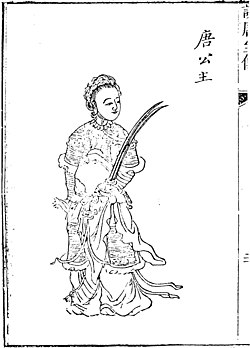
The Tang imperial family produced not only twenty emperors but a remarkable supporting cast: crown princes who never reigned, princesses who raised armies, empresses who ruled in fact or tried to rule in name, consorts whose clans rose and fell with dizzying speed, and in-laws whose ambitions turned the palace into a battlefield. This page surveys the dynasty's royal house — its blood, its marriages, and its women and near-misses — as a window into the family politics beneath the throne.
The Blood of the Dynasty
The Tang house was a northwestern aristocratic clan — the Lis of Longxi — deeply intermarried with the Tuoba-Xianbei military nobility of the Northern dynasties, a heritage that gave the family its name (Li, claimed from Laozi), its martial culture, and its network of marriage alliances with the great clans of the era. Its founding generation was formidable: Li Yuan, the Duke of Tang who took the throne as Emperor Gaozu; his cousin Li Xiaogong, who conquered the south; and above all the children of Gaozu and his Duchess Dugu. Through Dugu, the family was tied to the most powerful kin-network of the age: Dugu’s sister was the mother of Yang Jian, founder of the Sui — meaning the dynasties the Tang replaced and displaced were, literally, cousins. Tang history begins, like so much of Chinese history, inside a family.
The Women of the House
Tang royal women were, by the standards of any pre-modern dynasty, astonishingly active. Princess Pingyang raised an army — the “Army of the Lady” — that conquered the approaches to the capital for her father and remains the only Tang princess buried with military honors. Princess Taiping wielded chancellorship-level influence through two successions and died in a failed bid to repeat her mother’s usurpation. Empress Wei dominated the restored Zhongzong court and reached for the throne herself. These women operated within the politics of the inner court — marriage, motherhood, regency — but the Tang inner court was itself a government: whoever controlled the emperor’s household controlled the appointment of generals, the drafting of edicts, and the succession. The dynasty’s famous tolerance of female power had a limit, however: every woman who reached for the throne in her own name, from Wei to Taiping, was destroyed, and only Wu Zhao — who took the throne and held it fifteen years — stands outside the pattern.
The Price of Proximity
To be born or married near the Tang throne was to live inside a centrifuge. Crown princes were deposed or killed in a grim progression — Li Chengqian schemed and fell, Li Hong died mysteriously (his mother Wu suspected by tradition), Li Xian was forced to suicide by the same mother, Li Chongmao reigned seventeen days, Li Ying was murdered on Xuanzong’s suspicion. Princes who survived did so by being useless: the pattern set by the first generation — Li Yuanji and Li Jiancheng dead at Xuanwu Gate, their sons executed — taught every later prince the same lesson and offered no safe way to apply it. In-laws fared worse: the consort clans of the Tang — the Wus, the Weis, the Yangs of Yang Guifei — rose to dominate the state and then, within years, were exterminated root and branch when their woman fell. The imperial clan’s own register, the imperial genealogy of the New Book of Tang, reads in places like a casualty list.
The Royal Family as Mirror
Because the histories of the Tang were written by the victors of each palace struggle, the royal family is the most heavily edited stratum of the record. Li Jiancheng was a competent administrator before his brother’s historians made him a fool; Li Yuanji’s villainy grew in the retelling; Empress Wei’s poisoning of her husband, though almost certainly true, was prosecuted as fact partly because her destroyers needed it to be. Reading the dynasty’s princes, princesses, and consorts therefore means reading against the grain — and it is precisely there, in the biographies of the near-misses and the destroyed, that the Tang’s true political culture shows most clearly: brilliant, violent, familial, and utterly without a safe succession.
References & Historical Sources
- Old Book of Tang and New Book of Tang, annals and the monographs on empresses and the imperial clan.
- Zizhi Tongjian, palace-coup volumes 191, 208–210, 249.
- D. C. Twitchett (ed.), Cambridge History of China, vol. 3, on court politics.