Du Fu
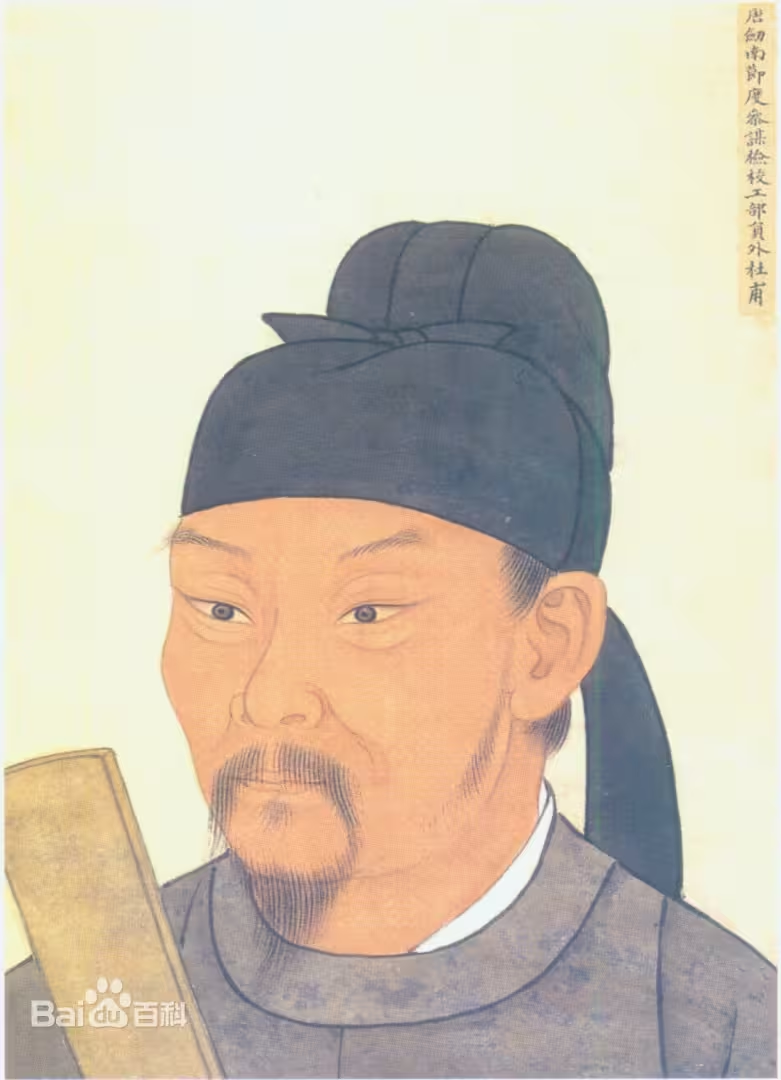
Du Fu (712–770), later canonized as Du Shaoling or the Sage of Poetry (Shisheng), was the greatest poet of the Tang dynasty and, by the settled verdict of Chinese tradition, the greatest poet in the history of the language. In his own lifetime he was obscure, failing his examinations, scraping by on minor posts and patrons, and dying in exile on a riverboat. But the poetry he made out of the age's catastrophes — the An Lushan rebellion above all — was so morally and technically complete that within a century he stood beside Li Bai as one of the two summits of Chinese verse, and has never since been displaced.
Lineage and Ambition
Du Fu was born in 712, the grandson of Du Shenyan — one of the court poets of the early Tang, and proof that the Du family of Xiangyang belonged to the literary aristocracy of the age. The grandson grew up in the confidence such lineage was meant to confer. His early poem on climbing Mount Tai, written in his twenties, states the family creed without embarrassment: “I must reach the highest peak — and in one glance, all mountains are small.” He was young, gifted, and connected; everything about his origins predicted a career at the center of the empire.
The examinations — the one door that mattered — never opened for him. He failed the jinshi examinations in 736, and in 747, when Emperor Xuanzong proclaimed a special examination to recruit men of talent outside the normal channels, Du Fu sat it and failed again: the chancellor Li Linfu, jealous and contemptuous of men of letters, reported to the throne that the search had turned up no talent left in the empire, and the candidates were simply sent home. Du Fu was thirty-five, with a wife and children, and the decade of wandering and petitioning that followed was the making of his art and the ruin of his career. He traveled, wrote presentation poems to officials, married into the Cui family of a great clan, and watched from below as the golden age he had expected to serve reached its glittering, unstable summit.
The Rebel Capital: Spring in Chang’an
In 755 the catastrophe came. Du Fu had just received, after years of waiting, a minor appointment — registrar in the heir apparent’s household — and was away from the city when An Lushan’s rebels took Chang’an in 756. The imperial family fled to Sichuan; the population that remained faced occupation, famine, and death. Du Fu’s response was characteristic: he sent his family ahead and tried to reach the fugitive court of the new emperor Suzong, was captured by the rebels, and spent the better part of a year trapped in the fallen capital — the occupied poet of the occupied city. From that captivity came the poems that made his name immortal, among them “Spring View”: “The nation shattered, mountains and rivers remain; spring in the city, grass and trees run deep. Moved by the times, even flowers shed tears; hating the parting, the very birds startle the heart.” His own infant son had starved to death during the flight.
He escaped the city in 757, found Suzong’s provisional court, and was rewarded with a post at the emperor’s side — the remonstrating office of Left Reminder (Zuo Shiyi), which permitted, indeed required, its holder to criticize the throne. Du Fu took this seriously enough to ruin himself. When his friend and patron, the chancellor Fang Guan, was removed after a military failure, Du Fu repeatedly petitioned for his reinstatement, and the emperor’s patience ended: Du Fu was interrogated, and though pardoned, he was sent away from court. The verdict of later ages is that he had behaved exactly as the Confucian official was supposed to behave, and that the dynasty of Xuanzong’s degenerate court no longer deserved the loyalty he gave it.
The Itinerant Years and the Thatched Cottage
The second half of Du Fu’s life was a long retreat down the map of the empire. In 759, as the war dragged on, he resigned a minor local post in the western capital region and took his family on the desperate migration into Sichuan, where the fugitive court and the greatest city of the southwest, Chengdu, offered shelter. There, with support from friends and local officials — the military governor Yan Wu above all — he built the thatched cottage by the Huanhua stream that is now the most visited literary shrine in China. The four Chengdu years were the most stable of his life and among the most productive: the poems of the cottage are meditative, domestic, and serene, “My Thatched Roof, Ruined by the Autumn Wind” among them, in which a leaking roof becomes a parable of the empire’s poor. When Yan Wu was recalled to the capital, Du Fu followed him downriver in 765; Yan Wu died the next year, and the poet’s last protection was gone.
His final years were wandering and privation in the gorges and lakes of the middle Yangzi — Kuizhou above all, where he lived from 766 to 768 in a town still battered by the war, and wrote with a density and formal ambition that no earlier Chinese poetry had approached: the eight autumn meditations, the climbing of the heights on the Double Ninth festival (“the boundless falling leaves rustle down; the endless Yangzi rolls on”), poems in which personal decay, historical ruin, and the turn of the seasons fuse into a single music. He pressed on downriver toward his ancestral home in the northeast, never reaching it. In 770, in Hunan, on a boat on the Xiang River’s connected waters, he died at fifty-nine, leaving — by the account preserved by his biographers — verses still unedited on his table. He was buried provisionally by the river; decades later his grandson recovered the remains and reburied them with the family at Yanshi, and the grave in Gongyi, Henan, has been tended as a shrine ever since.
The Poet as History
The case for Du Fu’s supremacy rests finally on the work itself, and on the historical judgment the Chinese tradition has made about it. His contemporaries ranked him below the glamorous Li Bai; the reversal came within a generation. The poet Yuan Zhen, in the tomb inscription he composed for Du Fu in 813, pronounced that there had never been a poet like him, and the verdict hardened into orthodoxy during the Song dynasty, when the critic-poets who defined the canon made Du Fu the model of the poet as moral witness and technical master — the one figure every serious writer had to answer to. The Chinese phrase for what his best poems achieve is shi shi, “poetic history”: the poems of the war years function as a primary source of unmatched immediacy, the more trustworthy for being art. Over fourteen hundred poems survive, and their range — regulated verse in its perfected forms, narrative ballads, the “three officials and three partings” of the war’s human cost, domestic comedy, abstruse learning, plain grief — has no parallel in the tradition before or since.
His reach beyond China came later and more selectively than Li Bai’s, but it is real: his poems of war and displacement have been translated into every major language, and poets from the Japanese Heian anthologists to the modern Anglophone translators — Kenneth Rexroth’s One Hundred Poems from the Chinese, David Hinton’s volumes — have found in him what Chinese readers found: a voice that makes suffering recordable. “The country’s mountains and rivers are broken, but the spring wind blows over grass and weeds again” — the line has been read as consolation, indictment, and plain description, and it has carried all three readings for twelve centuries.
References & Historical Sources
- New Book of Tang (Xin Tang shu), biography of Du Fu.
- Old Book of Tang (Jiu Tang shu), literary notices.
- Zizhi Tongjian, annals of the Xuanzong, Suzong, and Daizong periods.
- Du Fu’s collected poems, in traditional commentated editions and the Quantangshi.
- Yuan Zhen, “Tomb Inscription for Du Zimei” (813), the foundational early assessment.