Di Renjie
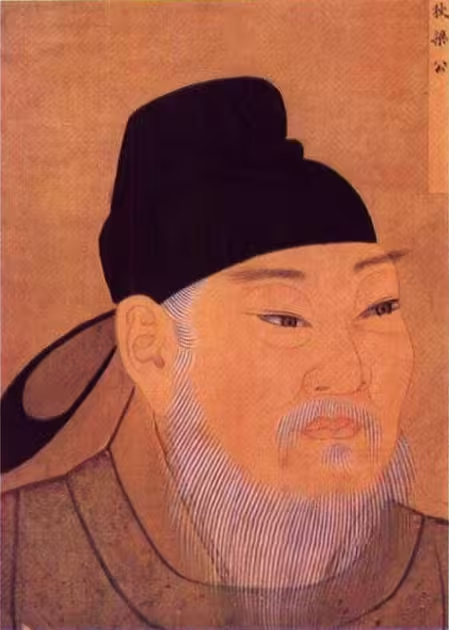
Di Renjie (630–700) was the great minister of Wu Zetian's Zhou dynasty — the one man who served the empress who had usurped the Tang without serving her usurpation. A fearless judge and remonstrating official under the early Tang emperors, he survived the cruel officials' prisons by outthinking them, rose twice to the chancellorship, talked the empress into restoring her exiled sons, and filled the government with the men who would overthrow her and put the Tang back. The Chinese tradition remembers him as the model upright minister; the modern world knows him as Judge Dee, the detective of Robert van Gulik's novels and a hundred screen adaptations — in both lives, the man who could not be bought, frightened, or silenced.
The Judge of Taiyuan
He came from the Di family of Taiyuan, a lineage of modest official rank in a city that bred great clans, and entered government through the mingjing — the classics-examination track, less prestigious than the jinshi but quicker. His first appointments were judicial, and the judicial posts made his reputation. As a judge in the capital region he acquired the caseload statistics that the histories never fail to quote: tens of thousands of accumulated cases, in his year at the Court of Judicial Review, cleared without a single complainant — no man who came before him, the Old Book of Tang says, found his judgment wrong enough to appeal. The number is surely rounded by admiration, but the reputation it records was real, and it was the specific kind Tang government valued: the judge who read the file, the man whose verdicts survived scrutiny.
Promotion carried him upward through the inspection and censorship bureaus and out into the provinces — a prefect’s post in the northwest, where the histories record that his administration was so clean and so popular that the local worthies petitioned to have his portrait painted in the temple. It carried him too close, eventually, to the center of power. In 691, with Wu Zetian’s Zhou dynasty four years old and her network of spies and informers in full operation, Di Renjie — by then in his sixties and a senior minister — was appointed chancellor. He held the post for months, not years. The cruel official Lai Junchen, the most feared of the empress’s inquisitors, had him arrested on a fabricated treason charge.
The Prison of the Cruel Officials
What followed is the most famous prison story of the dynasty. Lai Junchen’s interrogations were designed to end in confession — the law of the period, perversely, treated a confession as proof of repentance and punished it less severely than defiance, while refusal to confess met the full horror of the prescribed tortures. Di Renjie, by his own later account, confessed at once. He wrote out his “guilt” in full, and the inquisitors, satisfied, relaxed their guard. Then he wrote a real appeal, concealed it inside the lining of a garment he sent home to his family for washing, and his son carried it to the empress. Wu Zetian summoned him. The interrogation before her throne, as the Zizhi Tongjian records it, was a duel between the two most acute minds of the age: Di admitted he had confessed falsely to avoid torture; Lai Junchen’s lieutenants produced forged evidence of his guilt; and the empress — who understood exactly what each of them was — declined to execute him. She demoted him instead, to the magistracy of Pengze county on the middle Yangzi: the standard compromise by which she punished a minister without losing him. She is reported to have said, of the whole affair, that it had been a close thing.
Chancellor Again: The Argument for the Tang
The second chancellorship came in 697, after the worst of the terror had passed and the empress had begun, at last, to think about the succession. This was the question on which Di Renjie staked everything. Wu Zetian’s Zhou dynasty rested on the exclusion of her Tang sons — Zhongzong, the deposed emperor, had been living under guard in exile for a decade and a half — and on the claims of her nephew Wu Chengsi and the wider Wu clan. Her own council was divided; the Wu interest pressed its case with hired omens and court sentiment. Di Renjie argued the other side with the patience of a man who had spent thirty years learning how the empress reasoned. Her nephews, he said, were nephews; her sons were sons. A nephew enshrined in the ancestral temple would worship his own father; a son restored would worship her. The question was not who should rule now, but who would remember her when the ruling was done — and only a son would remember his mother. The persuasion, delivered across many conversations over several years, worked. In 698 the empress recalled Zhongzong from exile and named him crown prince. The Tang succession, which Di Renjie would not live to see restored, was saved in the only way it could have been — by the one minister the usurper trusted enough to hear.
He spent his last years less on arguments than on appointments. The chronicles preserve the empress showing him a list of his recommendations and asking why so many of his men were in office; his answer — they were the empire’s talent, not his clients, though if the throne wanted to know whom he knew personally, here was the list — became the classic formulation of what recommendation was for. On the list were Zhang Jianzhi, Huan Yanfan, Jing Hui, and Yao Chong: the men who, five years after his death, organized the coup of 705 that deposed the aged empress and put Zhongzong back on the throne. When Wu Zetian, dying in 705, asked who had turned her ministers against her, the answer the histories give is the one Di Renjie had arranged: the men she had trusted had been Tang men all along.
Judge Dee and the Two Afterlives
He died in 700, in office, seventy years old, and was buried with honors; later courts restored his titles and, under the restored Tang, elevated him to posthumous dukedom. The official histories’ verdict was unambiguous — the upright minister who had preserved the dynasty’s core through its usurpation — and the popular tradition began from there. Through the Song and Ming, storytellers built around the upright judge the cycle of crime-and-punishment tales that every Chinese magistrate acquired; the eighteenth-century collection Judge Dee’s Cases gave the cycle its fixed form. In 1949 the Dutch diplomat and scholar Robert van Gulik, finding a stray copy of that collection in a Tokyo bookshop, translated part of it, found the conventions irresistible, and began writing his own Judge Dee mysteries — first in English, then in Chinese, eventually more than a score of novels and novelettes in a dozen languages. Van Gulik’s Dee, walking the night streets of the Tang capital with his three lieutenants, solving crimes that ladder up to the palace itself, became one of the most widely read detective figures in world fiction, and the anchor of a screen franchise that has never since left Chinese television. It is a strange double life: the histories remember a chancellor who talked an empress out of her empire; the world remembers the detective who could not be fooled. Both, on the record, were the same man.
References & Historical Sources
- Old Book of Tang, biography of Di Renjie (juan 89).
- New Book of Tang, biography of Di Renjie (juan 115).
- Zizhi Tongjian, volumes 204–207 (the treason case, the succession debate, and the 705 coup).
- Di Renjie, memorials on law and administration, quoted in the histories.
- The Judge Dee cycle of popular fiction, from the Qing collection to Robert van Gulik’s novels (1949–1968).