Bai Juyi
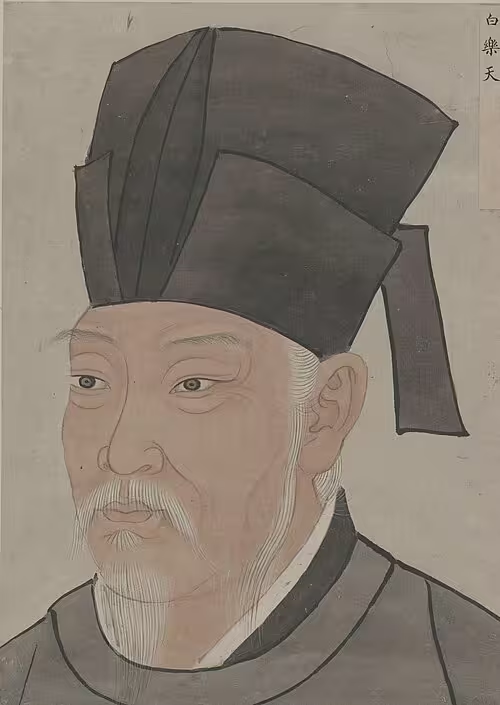
Bai Juyi (772–846), also known as Bai Letian, was the most popular poet of the Tang dynasty — and remains, by some measures, the most widely read classical Chinese poet in East Asia. A jinshi graduate who rose to high office, he was twice banished for writing poetry too honest for the court's comfort; his long narrative ballads — The Song of Everlasting Regret and The Pipa Player — made him a legend in his lifetime, copied on monastery walls and chanted in foreign capitals. He ended his seventy-five years in comfortable retirement at Luoyang, editing the collected works that Japan and Korea preserved when China's own copies were lost.
The Youngest Man at the Top
Bai Juyi was born in 772 at Xinzheng, near the eastern capital, into a family of middling officials that prided itself more on learning than on rank; the family soon moved south, and the poet’s childhood was spent in the Yangzi region, in the flavor of its towns and waterways that never left his verse. He was a prodigy of a very Tang kind — not a romantic immortal but an examination machine, mastering the regulated forms early and aiming, with his family’s full support, at the jinshi degree that was the door to everything. In 800, at twenty-nine, he passed, and inscribed his name at the Da Ci’en pagoda in Chang’an with the boast the city remembered: “At the place of inscription beneath the Ci’en tower — the youngest man among the seventeen.”
His first official years were spent in the provinces, where he began the practice that would define his career: writing poems about what he saw — the tax collector’s visit, the conscript’s parting, the peasant family selling its mulberry crop to pay a levy — in plain language deliberately aimed past the literary coteries at the widest possible audience. With his close friend Yuan Zhen, he theorized the project explicitly: “Literature should be composed for the times, and songs for affairs.” The resulting collections, the Ten Poems of Qin and the fifty New Ballads of 809–810, were published together with the poet’s own critical preface, and they made him famous and dangerous in the same season.
Exile to Jiangzhou: The Pipa Player
The danger detonated in 815. That year the chancellor Wu Yuanheng was assassinated in the streets of Chang’an by agents of a rebellious military governor; the court was scandalized, and Bai Juyi — then a court official — outraged protocol by submitting a memorial demanding immediate investigation beyond his proper remit. His enemies struck back with a weapon drawn from his own art: they accused him of an offense against propriety in his verse, noting that his mother had drowned after falling into a well while mentally ill, and that the poet had nonetheless written poems about flowers and the view from a new well. The charge was grotesque; it worked. Bai Juyi was demoted to the post of assistant magistrate in Jiangzhou, on the middle Yangzi, far from the capital — the standard Tang method of ruining a man without quite killing him.
The exile produced the poem that made him immortal. In the autumn of 816, seeing off a friend on the bank at Xunyang, Bai Juyi encountered a former capital courtesan, now married to a merchant, playing the pipa on a moored boat. The encounter became The Pipa Player (Pipa Xing), the long narrative ballad in which the musician’s broken life and the exile’s own exile mirror each other to the poem’s famous closing ache: “We are both castaways at the world’s edge; why need we have known each other before we meet?” The poem spread through the empire within months, was copied on the walls of monasteries and courtesan houses, and fixed Bai Juyi’s public identity for good.
Hangzhou, Suzhou, and Luoyang
Recalled to the capital in 819, Bai Juyi served through the complicated politics of the late Xianzong and Muzong years, and in 822 accepted what became the happiest phase of his official life: prefect of Hangzhou. There he governed with the same plain-spoken pragmatism as his verse — dredging the silted lake, rebuilding the storage dikes, and leaving, as the city still remembers, the causeway that bore his name for twelve centuries and the poems about West Lake that made it the most painted landscape in China. A similar term at Suzhou followed; then, weary of court faction, he withdrew progressively to Luoyang, taking sinecure posts near home and building the retirement estate at the Daoist mountain retreat of Longmen. His friendship with the poet Liu Yuxi — the two aging men exchanging regulated verses on everything from peonies to philosophy — is the most charming epistolary partnership in the tradition. He styled himself Lay Buddhist of the Fragrant Hills and Old Man of the Nine Graces, edited his own collected works with obsessive care, and died in 846 at seventy-five, leaving instructions for a plain burial.
A Poem in Every Mouth
Bai Juyi’s fame has a different texture from that of Li Bai or Du Fu: it was mass fame, achieved in his lifetime, across the whole of East Asia. His own account, in letters and prefaces, records the evidence with some amazement: monks and schoolboys reciting his ballads; soldiers and peddlers quoting lines; a military governor in the far south who sent a singer to learn his latest poems; merchants offering his collected works in the markets of Yangzhou. After The Song of Everlasting Regret — the 806 narrative of Emperor Xuanzong and Yang Guifei that made the dynasty’s great love tragedy into national myth — his name was genuinely a household word, and the story goes, with some contemporary support, that his poems were copied on paper screens and sold between drinks.
His deepest influence ran east across the sea. In Japan, the Bai Juyi vogue of the Heian period was total: the court ladies of the Tale of Genji quote him as naturally as Scripture, his works headed the reading lists of the aristocracy, and the definitive early manuscripts of the collected Bai Juyi — complete, dated, and annotated — survive in Japanese temple and court libraries, preserved through the centuries when the Chinese originals were repeatedly lost in war and reassembled from scattered copies. Korea took him up with the same enthusiasm. Within China his standing among critics has run lower than the romantics’ — too plain, too smooth, too popular — a judgment the reading public has never once accepted, and one the modern anthologists have decisively rejected: the accessible, humane, technically flawless poet of ordinary life and ordinary sorrow remains, as he wished, the poet of everyone.
References & Historical Sources
- Old Book of Tang (Jiu Tang shu), biography of Bai Juyi.
- New Book of Tang (Xin Tang shu), biography of Bai Juyi.
- Bai Juyi, collected works (Bai shi Changqing ji), including his own prefaces and the “Letter to Yuan Zhen” on his poetics and fame.
- Zizhi Tongjian, annals of the Xianzong period (the Wu Yuanheng assassination and Bai’s demotion).
- Early Japanese manuscripts and Heian quotations, for the East Asian transmission.