
An Lushan
An Lushan (703 – 29 January 757) was the Sogdian-Turkic frontier general whose …
The Tang dynasty's history is a history of remarkable individuals. Twenty emperors held the throne, but the age was equally shaped by the people around and against them: chancellors who built and unmade administrations, generals who conquered steppe and desert, consorts and princesses who wielded power from the inner palace, poets and painters who defined Chinese aesthetics, monks who carried faith across deserts and oceans, and foreign merchants who wrote the first outside accounts of Tang China. This section gathers the men and women without whom the story of the Tang cannot be told.
Beyond the twenty emperors chronicled in the Emperors section, the Tang state and the Tang age were the work of figures of every kind. The founding itself was a family affair — a daughter who raised an army, sons who destroyed rival regimes and then turned on each other — and the dynasty’s greatest crises were met by individuals as often as by institutions: Guo Ziyi standing between the throne and destruction in 757, Zhang Jiuling resisting the court’s slide into complacency, Jianzhen crossing a hostile ocean six times to carry Buddhism to Japan.
The figures in this section fall into six groups. Chancellors and statesmen — from the upright Zhang Jiuling to the notorious Li Linfu — governed the empire and often paid for it with their lives. Emperors and royalty beyond the throne itself includes the doomed Li Jiancheng, the formidable Empress Wei, and Princess Pingyang, the dynasty’s only princess-general. Generals and rebels range from Li Jing, conqueror of the Turks, to An Lushan and Huang Chao, the two men whose rebellions bracket the dynasty’s decline. Poets and scholars — here the great painters Han Gan, Zhang Xuan, and Zhou Fang, whose surviving works are the Tang world’s most vivid visual record. Religious figures: Xuanzang and Jianzhen, whose travels linked the Tang to India and Japan. And travelers and merchants: Sulaiman al-Tajir, whose Arabic account of Guangzhou preserves the Tang as foreigners saw it.
Each biography in this section is built on the primary record — the Old and New Books of Tang, the Zizhi Tongjian, and, where they exist, the subject’s own writings or foreign accounts. Where the received tradition is shaped by politics — and in the Tang, victors often wrote their rivals’ biographies — the articles say so. The figures here were chosen not for fame alone but for what each reveals about the dynasty: its openness to talent of every origin, its fatal succession politics, its military brilliance and military catastrophe, and the cosmopolitan confidence of its cosmopolitan age.
An Lushan (703 – 29 January 757) was the Sogdian-Turkic frontier general whose …

The Tang chancellorship was not a single office but a circle of trust at the top of …

Dou Jiande (573 – 3 August 621) was the most admired of the rebel leaders who rose …

Lady Dugu (544 – c. 590s), Duchess of Tang and posthumously Empress Yuanzhen, never …

The Tang imperial family produced not only twenty emperors but a remarkable …

Empress Wei (died 21 July 710) was the second wife of Emperor Zhongzong of Tang and, …

Gao Xianzhi (died 24 January 756), known in Korean sources as Ko Sŏnji, was the …

The Tang empire was won by generals, saved by generals, and finally destroyed by the …
Guo Ziyi (697 – 9 July 781), posthumously Prince Zhongwu of Fenyang, was the general …
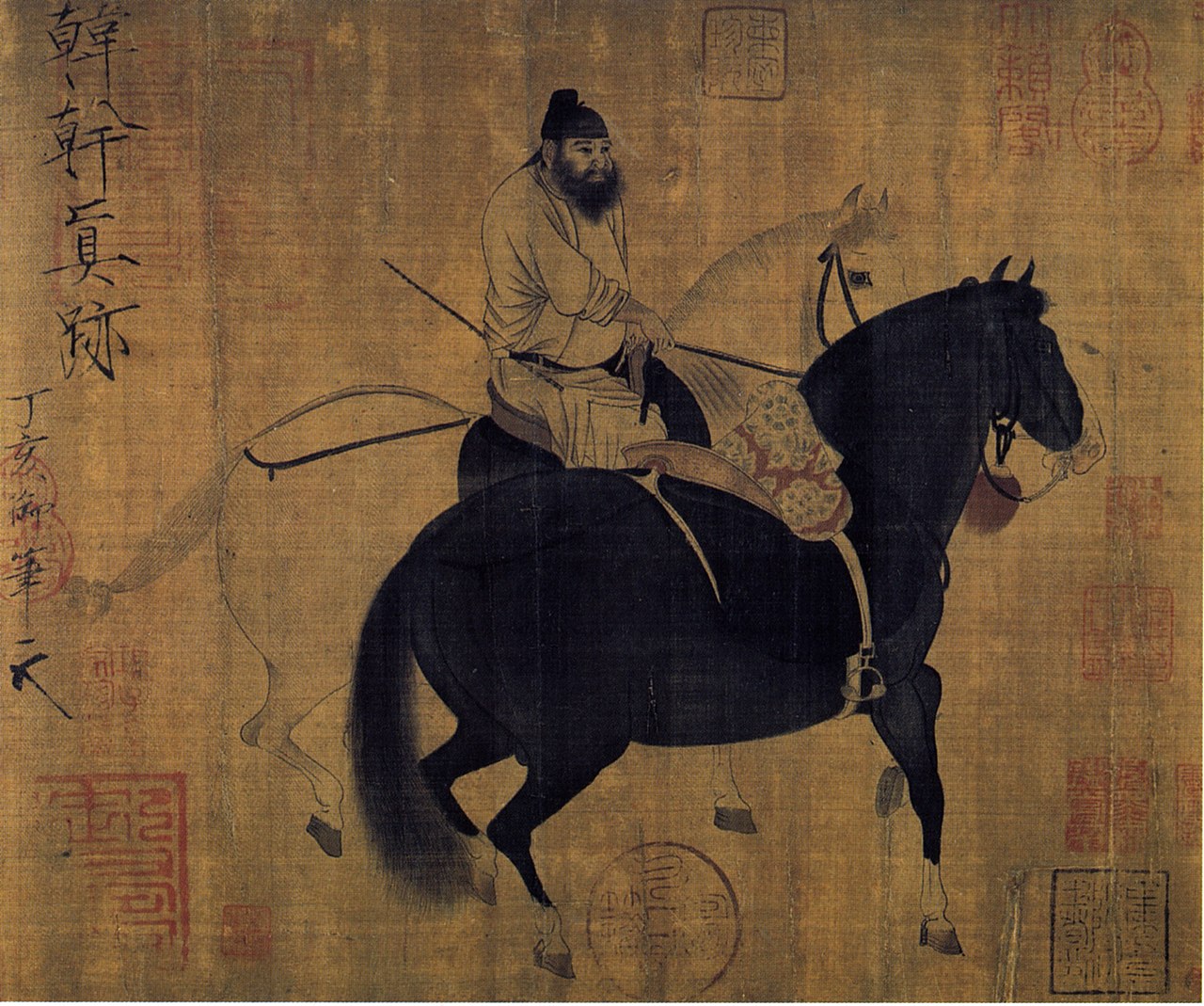
Han Gan (c. 706–783) was the supreme horse painter of the Tang dynasty — the …

Hou Junji (died April 29, 643) was a general of the early Tang who rose with the …

Huang Chao (835 – 13 July 884) was the salt smuggler and failed examination candidate …

Jia Dan (730 – 805), courtesy name Dunshi, Duke Yuanjing of Wei, was the Tang …

Jianzhen (688–763), revered in Japan as Ganjin, was the Tang monk who, after five …

Laozi — 'Old Master', traditionally identified as the sage Li Er — is the legendary …

Li Jiancheng (589 – 2 July 626), posthumously Crown Prince Yin, was the eldest son of …

Li Jing (571 – 2 July 649), courtesy name Yaoshi, posthumously Duke Jingwu of Wei, …

Li Linfu (died January 3, 753), Duke of Jin, was chancellor of the Tang empire for …

Li Yuanji (603 – 2 July 626), Prince of Qi, posthumously Prince La of Chao, was the …

The Tang is remembered as the age of Chinese poetry's absolute summit — the era of Li …
Princess Pingyang (died March 623), formally Princess Zhao of Pingyang, was the third …

The Tang dynasty was the great age of Chinese religious exchange. Buddhism reached …

Shangguan Wan'er (c. 664 – 21 July 710) was the most powerful woman at the Tang court …

Shi Siming (703 – 18 April 761), born Shi Sugan, was An Lushan's childhood friend, …

Sulaiman al-Tajir — 'Sulaiman the Merchant' — was a ninth-century Persian trader from …
The Tang empire was the destination of the early medieval world's travelers — …
Xuanzang (602 – 5 February 664), born Chen Hui, was the Tang monk whose pilgrimage to …

Yuwen Huaji (died 22 March 619) was a Sui dynasty general and court favorite who …
Zhang Jiuling (678 – 5 June 740), courtesy name Zishou, was a poet-statesman of the …
Zhang Xuan (713–755) was the great painter of Tang court ladies — the visual …

Zhou Fang (c. 730–800), courtesy name Zhonglang, was the painter who perfected the …

Zhu Wen (852 – 18 July 912) — later Zhu Quanzhong, then Emperor Taizu of Later Liang …