The Five Dynasties and Ten Kingdoms: The Long Interregnum (907–979)
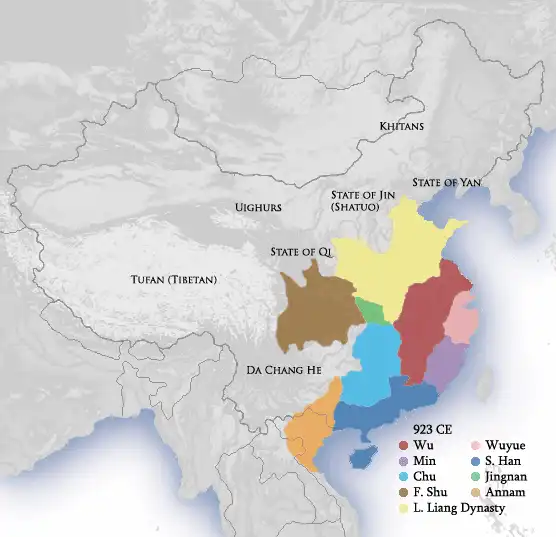
When the Tang emperor Ai abdicated to the warlord Zhu Wen in 907, China entered fifty-three years of division conventionally called the Five Dynasties and Ten Kingdoms. Five short-lived dynasties ruled the north from the Yellow River while a dozen or so kingdoms — conventionally ten — held the south and the far west. It was an age of coups, of soldiers choosing emperors, and of the south's economic rise; it ended with the Song dynasty's reunification in 979, having quietly prepared the ground for everything the Song would become.
The Five Dynasties in the North
The “Five Dynasties” succeeded one another in the Yellow River heartland: Later Liang (907–923), founded by Zhu Wen, the Tang traitor who orchestrated the dynasty’s final years; Later Tang (923–937), founded by the Shatuo Turk Li Cunxu, son of the Tang-loyalist general Li Keyong, which claimed to restore the Tang; Later Jin (936–947), which accepted Shatuo-Turkish Khitan overlordship and lost the Sixteen Prefectures — the strategic defense line north of the Yellow River — to the Liao empire, with consequences that shadowed Chinese defense policy down to the Ming; Later Han (947–951); and Later Zhou (951–960), whose capable second emperor, Chai Rong, was the last reunifier before the Song and died young. Average reigns were brutally short: of the dynasty-founders, Zhu Wen was killed by his own son, Li Cunxu died in a mutiny, and the founder of Later Jin died in exile among the Khitan.
The period institutionalized a principle the Tang had already flirted with: legitimacy in the north flowed from military power, conferred by armies that expected regular donatives and chose or discarded emperors accordingly. Of the eleven men who held the northern throne between 907 and 960, most died violently.
The Ten Kingdoms in the South
The south, by contrast, was a patchwork of relatively stable, commercially dynamic states: Wu and its successor Southern Tang around the lower Yangzi; Wuyue in the delta, famed for seawalls, temples, and prudent management under the Qian family; Min in Fujian; Chu in Hunan; Former and Later Shu in Sichuan — the most cultured court of the age, where painting and poetry flourished under Meng Chang; Jingnan (Nanping), a small buffer state that survived by taxing riverine tribute traffic; and Southern Han in Guangdong. There was also the Northern Han, a Shatuo-Turkish holdout in Shanxi backed by the Liao.
The south’s two centuries of near-peace — it had suffered far less in the late Tang wars than the north — drove the definitive economic shift that the An Lushan rebellion had begun. Irrigation works multiplied, double-cropping rice spread, tea and porcelain exports boomed, and the great southern cities of Yangzhou, Hangzhou, Chengdu, and Guangzhou grew to unprecedented size. Historians increasingly treat the “Ten Kingdoms” not as a failure of unity but as the incubator of the Song economic miracle.
The Interregnum as Tang Aftermath
Politically, every major figure of the period descended from the Tang’s final war: Zhu Wen from Huang Chao’s rebellion, Li Keyong from the Tang’s Shatuo auxiliaries, the southern founders from Tang jiedushi and prefects who simply stopped reporting to Chang’an. The Ten Kingdoms courts consciously continued Tang institutions, art, and calendar; Southern Tang even claimed to be the Tang’s legitimate continuation. Ouyang Xiu’s New History of the Five Dynasties, written three centuries later, condemned the age’s moral chaos — “three generations, and both father and son turn on each other” — but his own historical method helped restore the line of legitimacy the period had interrupted.
Reunification
Two attempts ended the division. The Later Zhou’s Chai Rong had already recovered much of the Huai and the northwest when he died in 959. His general Zhao Kuangyin then took the throne bloodlessly in the Chenqiao mutiny of 960, founded the Song, and with his brother Emperor Taizong of Song destroyed the remaining kingdoms one by one: Jingnan and Hunan in 963, Later Shu in 965, Southern Han in 971, Southern Tang in 975, and finally Wuyue and Northern Han in 979. The Song then re-centered the empire’s economy and culture on the southeast in ways that permanently reshaped China.
Historical Assessment
Old historiography called the Five Dynasties and Ten Kingdoms a dark age between two glories. Modern scholarship inverts the verdict for the south: the period transferred China’s demographic and economic center of gravity to the Yangzi delta, sustained a commercial revolution, and preserved Tang cultural traditions through the north’s chaos. For the Tang dynasty whose story this site tells, 907 is the terminus — but the institutions, the economy, and much of the culture that followed lived on.
References & Historical Sources
- New History of the Five Dynasties (Xin Wudai shi 新五代史) by Ouyang Xiu; Old History of the Five Dynasties (Jiu Wudai shi).
- Zizhi Tongjian, volumes 266–294.
- Wang Gungwu, The Structure of Power in North China during the Five Dynasties (1963).
- Naomi Standen, Unbounded Loyalty: Frontier Crossings in Liao China (2007), on the northern frontier states.