Early Tang (626–712)
The early Tang (626–712) carried the dynasty from its bloody founding to the …
The Tang dynasty did not begin in 618 and did not end in 907 without consequences. This section traces the full arc: the Sui order the Tang overthrew, the wars of reunification, the golden age and its coups, the catastrophic midpoint of the An Lushan rebellion, the long afterglow of the late Tang, and the age of division the dynasty's fall unleashed. Read in order, these pages are the dynasty's complete chronicle in miniature.
The Tang stands at the center of the most consequential six centuries in Chinese history. Behind it lay four hundred years of division after the Han; before it stood the Sui, which reunified the empire and exhausted itself doing it. The Tang inherited the Sui’s institutions, its capitals and its canal, and turned them into the most brilliant century of governance and culture China had known. The midpoint catastrophe of the An Lushan rebellion broke the machine without quite stopping it; the dynasty then ran for another century and a half on momentum, memory and the wealth of the south, until the warlords it had created consumed it. What followed — fifty years of the Five Dynasties and Ten Kingdoms — was the price of the Tang’s failure, and the bitter education from which the Song would learn.
The topic pages give each period its coherent narrative; the milestone pages zoom in on the single events — a gate, a rebellion, a dynasty — that changed everything. Together they are the skeleton on which every other section of this wiki hangs: the emperors, the battles, the poets and the cities all move along these bones.
The early Tang (626–712) carried the dynasty from its bloody founding to the …
The High Tang (712–755) was the summit — the Kaiyuan golden age, the most celebrated …
The middle Tang (755–880) was the dynasty's long, contested convalescence after the …
The century and a half after the An Lushan rebellion was the long twilight of the …
The Sui-Tang transition (581–626) was the hinge between four centuries of division …

The rebellion that the Tang subject An Lushan launched on December 16, 755 was the …

When the Tang emperor Ai abdicated to the warlord Zhu Wen in 907, China entered …
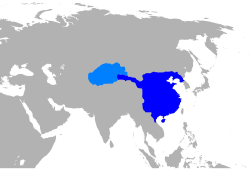
Four centuries before the Tang, the Han dynasty built the imperial template that …

The Sui dynasty reunified China after nearly three centuries of division and built …

On the morning of July 2, 626, Li Shimin, second son of the founding emperor and …