The Zhaozhou Bridge
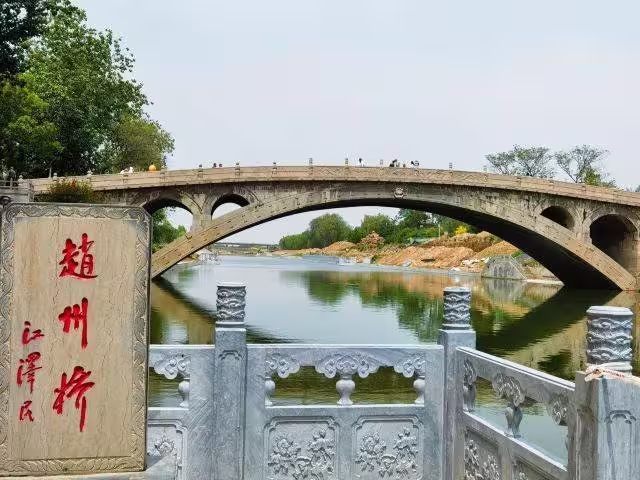
The Zhaozhou Bridge — the Anji Bridge over the Xiao River at Zhao County in Hebei — is the oldest surviving stone arch bridge in the world and the supreme surviving monument of Sui engineering. Built around 600 by the master mason Li Chun, whose name the histories preserve in a single sentence, its low segmental arch and open spandrels solved, a thousand years ahead of European practice, the two problems that governed all stone-bridge design: how to span wide without rising steep, and how to let floodwater through without breaking the structure. It has carried traffic for fourteen centuries, through forty documented floods and repeated earthquakes, and stands today as the Tang empire's inherited proof that Chinese engineering had reached its classical maturity before the dynasty itself began.
One Sentence of History
Almost everything certain about the bridge’s builder comes from a single sentence, and the sentence is famous because it is nearly all there is. In 725, the court official and calligrapher Zhang Jiazhen, passing through Zhao County on a journey, composed an inscription commemorating the bridge, and his text — preserved in the later gazetteers — contains the earliest and most of the only contemporary record of the man who built it: “The stone bridge over the Xiao River at Zhaozhou is the work of the Sui craftsman Li Chun; its construction is so extraordinary that no one knows how he did it.” No biography of Li Chun survives. No other work can be assigned to him with confidence. The dynasty’s own histories, which record the names of tax commissioners and court painters by the thousand, preserved the greatest engineer of the age in a clause — the standing proof, historians of technology have observed, of how little the written tradition cared for the men who actually built China, and how much the built record itself can still tell us.
What the clause dates, and what the fabric confirms, is that the bridge was erected in the last years of the sixth or the first years of the seventh century, during the reign of Emperor Wen of Sui or his successor — the same building age that raised the Grand Canal and the Sui’s twin capitals, when the reunified empire poured its surplus into works of a scale the divided centuries had not attempted. The bridge carried the imperial road north from the Yellow River plain toward the Juma valley and the northeastern frontier; the county it served was a middling market town, and the river it crossed, the Xiao, was a modest tributary that became, in flood, anything but modest. Fourteen centuries of Chinese traffic — carts, caravans, armies, and for the last century motor vehicles — have crossed it since.
The Geometry of the Arch
The bridge’s fame rests on two structural decisions, each of which anticipated European bridge engineering by something like a millennium, and each of which can still be read plainly in the masonry.
The first is the segmental arch. The semicircular arch of the ancient Mediterranean — the form Europe knew from the Romans — spans a river by rising as high as half its width, and pays for that rise in steep approaches: a semicircular arch wide enough for a road must climb a ramp on both banks, and the ramp eats land, labor, and the patience of every cart that crosses. Li Chun instead cut his arch from a segment of a much larger circle — a shallow, less-than-semicircular arc whose crown rises only about a seventh of the span — giving the bridge its celebrated low, flat profile, an approach road nearly level with the banks, and the elegant, almost floating line that Chinese painters have never since tired of. The engineering cost of a flat arch is that its masonry is pushed outward at the haunches with greater force, and must be resisted by abutments of real strength; the Xiao’s banks, of compacted gravel and loess, supplied them, and the strength was still being admired by the modern engineers who surveyed the bridge in the twentieth century. In Europe, the shallow segmental stone arch appears in the great bridges of the Renaissance, a thousand years later.
The second decision is the open spandrel. On either side of the main arch, where a solid stone bridge would carry its roadway on heavy masonry fill, Li Chun opened the spandrels into two small auxiliary arches — one at each end of the main span on both faces, four in all — letting the flood pass through the bridge’s shoulders instead of against them. The consequences were compounding. The small arches cut the structure’s weight by roughly a fifth, which reduced the outward thrust at the haunches, which reduced the abutment burden; they admitted the Xiao’s flood crests through the bridge rather than under it, sparing the foundations the scouring that destroyed ordinary bridges; and they made repairs local — a damaged small arch could be rebuilt without touching the main span. Modern structural analysis, run on the bridge more than once, has confirmed what the survival record already argued: the design is not merely sound but superbly proportioned, the work of a tradition of mason’s mathematics that Chinese written sources never thought to describe.
The details complete the picture. The arch rings were assembled with dressed voussoirs locked by dovetailed iron keys, so that the structure behaves less like stacked masonry than like a machine of interlocked stone; the parapet panels of the original Sui fabric were carved with vigorous dragon and beast reliefs, among the finest surviving Sui sculpture, now preserved largely in museum collections after the twentieth-century restorations. The deck and balustrades have been renewed many times across the centuries — a road surface is, after all, a consumable — but the arch, the spandrels, and the genius of the proportions are the builder’s own.
Fourteen Centuries of Floods
The strongest evidence for the design is the record it survived. The local gazetteers count some forty major floods of the Xiao against the bridge across its life, including several that destroyed every other crossing in the county; earthquakes of the Hebei plain shook it repeatedly, most severely in 1966, when the modern county town around it suffered serious damage and the arch stood; and wars, which in this corridor between the Yellow River and the northeastern passes came almost cyclically, broke its parapets and burned its deck more than once but never its structure. The traditional chronicles mark the repairs — recorded interventions in the eighth, eleventh, sixteenth, and eighteenth centuries — as a kind of custodial chain, each age doing its duty to an heirloom it regarded as beyond its power to improve. In 1952 the bridge’s condition was surveyed by the modern engineering establishment, and a major restoration in 1955–1958 replaced the deck and parapets, repointed the arch, and — under the direction of the era’s leading bridge engineers, who documented the structure exhaustively before touching it — returned the Anji Bridge to the condition in which it stands today. It is still called Zhaozhou Bridge, after the old name of Zhao County, and it is still, by a century or more, the oldest stone arch bridge in the world carrying traffic.
Its historical position is worth stating plainly, because it corrects a story the textbooks tell. Chinese engineering’s classical age is usually dated to the Song, the era of its great printed treatises and its state workshops; the Zhaozhou Bridge shows that the tradition had reached maturity under the Sui, a generation before the Tang took the throne, and that the Tang’s great age of construction — the canals, the capitals, the pagodas — was the flowering of a school of builders whose foundational works were already standing. The Tang histories that ignored Li Chun also ignored the reason his bridge mattered, which is the usual transaction between written and built history. The written record gave him a sentence. The bridge gave him fourteen centuries.
References & Historical Sources
- Zhang Jiazhen, inscription of 725 (the Anji Bridge inscription), preserved in the later Zhao County gazetteers — the primary source for Li Chun and the bridge’s date.
- The Zhao County (Zhaozhou) gazetteer tradition, for the flood history and the sequence of repairs.
- Li Chun’s life: no biography survives; all biographical statements derive from the 725 inscription.
- Modern engineering documentation: the 1950s surveys and restoration reports, and the twentieth-century structural analyses of the arch.
- Comparison with European segmental-arch practice: the standard histories of bridge engineering.