Yellow Sea
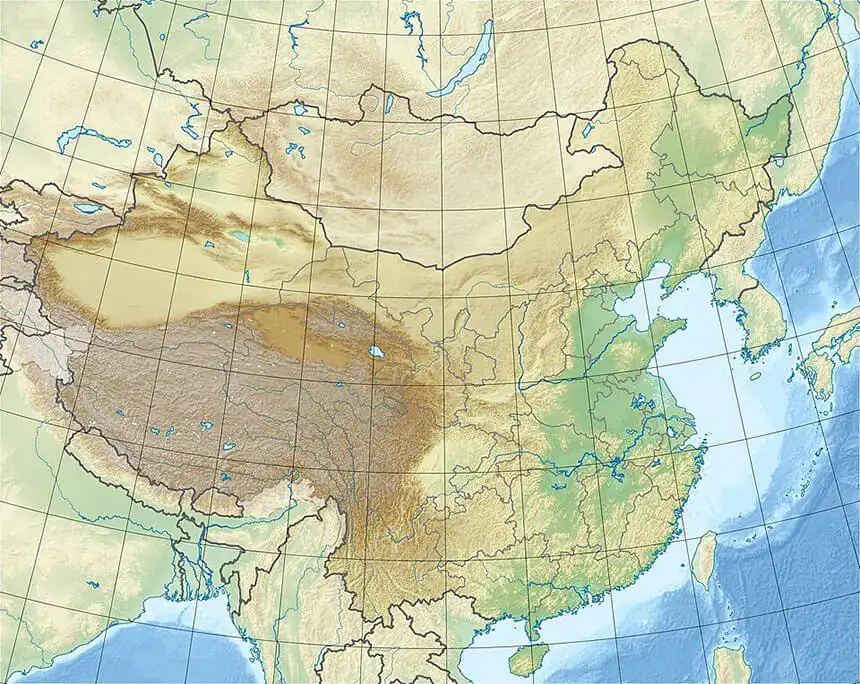
The Yellow Sea is the marginal sea between the Chinese mainland and the Korean Peninsula, named for the golden-yellow silt poured into it by the Yellow River and other great rivers of the north. For the Tang dynasty its coasts were a maritime frontier: the sea roads from the Yangzi delta to Korea and Japan ran across it, its bays held the empire's northern ports, and its waters carried the diplomacy, the monks and the armies that bound Tang China to the Korean world.
The Sea of Silt
The Yellow Sea takes its name from its color: the Yellow River, the Hai River and the Liao River together discharge so much sediment that the coastal waters run ochre for tens of kilometers out. One of the four seas of the world named for a color — with the Black, Red and White Seas — it is shallow, tide-swept and seasonally stormy, and its broad, muddy continental shelf has made it, from antiquity, more a zone of passage than of settlement. The Bohai, its innermost gulf, receives the Yellow River; Korea Bay, at its northeastern reach, receives the Yalu and Taedong rivers and fronts the Korean Peninsula.
The Sea Roads of the Tang
For the Tang, the Yellow Sea coast was the doorstep of the northeast. The great ports stood on it or just inside it: Dengzhou (modern Penglai, on the Shandong promontory), the traditional departure point for Korea and Japan; and, further south, the Yangzi ports of Yangzhou and Mingzhou (Ningbo), which handled the southern sea trade; and, across the water, the Korean ports that received the Tang embassies. The sea road from the Yangzi to Korea and Japan — out through the Yangzi estuary, north along the coast, across the eastern end of the sea to the Korean ports of the Taedong delta — was one of the busiest sea lanes of the early medieval world. It carried the Japanese kentōshi embassies to Tang and home again, the returning monks like Kūkai and Saichō with their boatloads of scriptures, and, in 838, the outbound voyage of the monk Ennin, whose diary of the crossing and the years in Tang remains the most detailed eyewitness account of the age. The seas were dangerous — the kentōshi logs record wrecks, drownings and driftings to distant shores — and the crossing of the eastern Yellow Sea remained, for every traveler, the supreme adventure of the journey.
War on the Water
The Yellow Sea’s greatest hour under the Tang came in 663, at the far end of the Korea wars: the Battle of Baekgang (白江口), at the mouth of the Geum River on the Korean coast, where the Tang–Silla fleet under Liu Rengui destroyed the combined fleet of Baekje restorationists and the Yamato Japanese state — hundreds of ships burned in a single day. It was the largest naval battle in East Asian history to that date, and it ended, permanently, Japanese ambitions on the peninsula for nine centuries. The Tang never again had to fight for the Yellow Sea.
Pirates, Salt and the Maritime Economy
The northern coasts of the sea were the empire’s salt country — the great salt pans of the Huai and Shandong coasts supplied the state monopoly’s richest revenues, and the coastline’s innumerable bays and estuaries sheltered the smugglers who fought the monopoly through every decade of the dynasty. From the ninth century, as the land order decayed, the sea lanes also bred the pirate fleets that raided the coasts of Zhejiang and Fujian — the maritime underside of the Huang Chao age. The dynasty that had ruled the Yellow Sea in 663 was, by 900, bargaining with the men who sailed it.
Today
The Yellow Sea remains one of the busiest and most contested stretches of water in East Asia — ringed by the ports of Tianjin, Qingdao, Dalian, Incheon and Pyongyang, and divided between the exclusive economic zones of China, North Korea and South Korea. The silt still colors its waters gold; the ferries still run the ancient crossings; and the sea roads the Tang envoys sailed are, in outline, the shipping lanes of the present.