Woodblock Printing
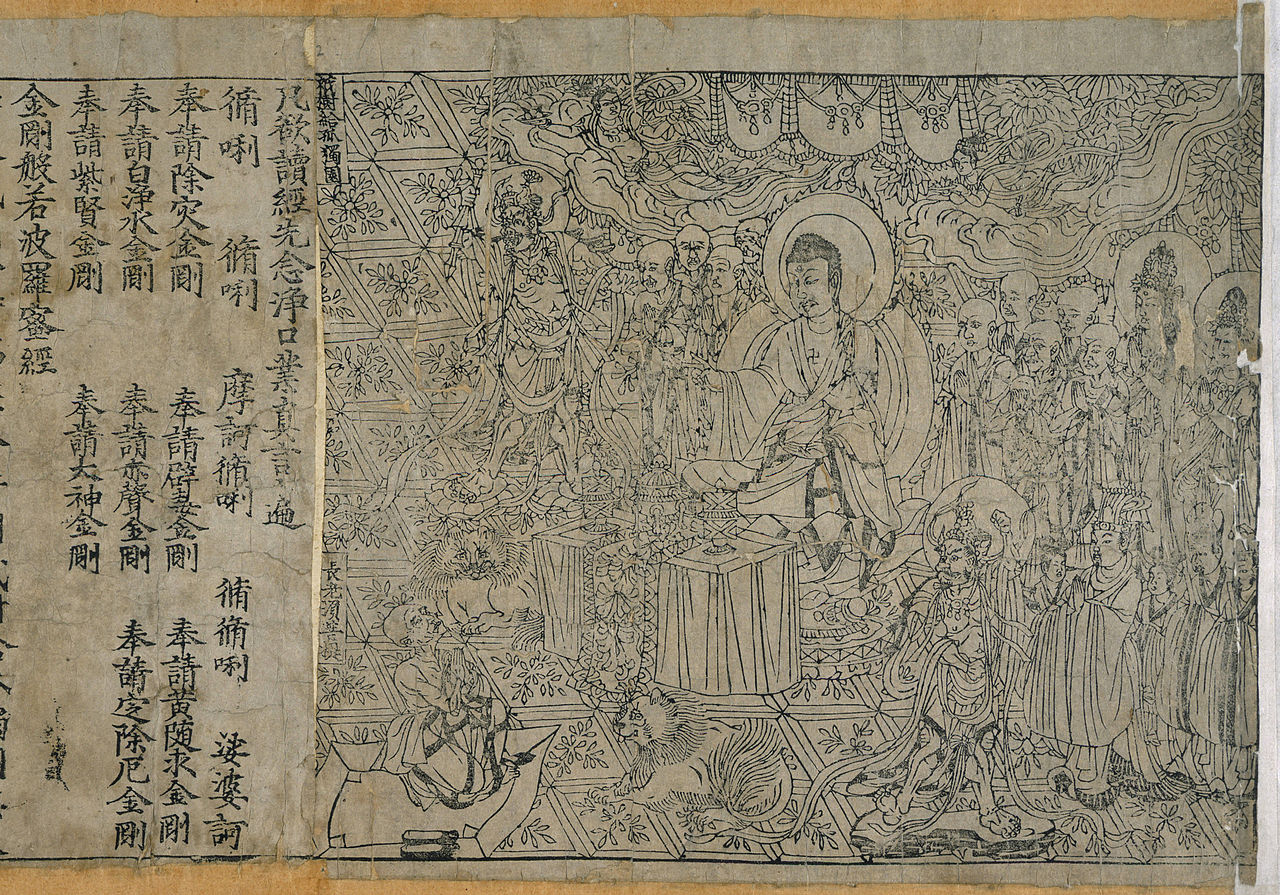
Woodblock printing — carving a page of text or image in relief on a wooden board, inking the raised surface and pressing it to paper — was the technology that made books affordable, and China invented it. The technique existed under the Tang dynasty by the seventh century; by 868 the Tang had produced the Diamond Sutra, the oldest dated printed book in the world. For the next thousand years, block printing remained the principal means of multiplying texts and images across East Asia, and its Japanese descendant flowered in the ukiyo-e prints of the Edo period.
The Technique
A woodblock is a mirror-image carving: the craftsman pastes a sheet of the text, written in reverse, face-down onto a seasoned plank — pear wood was favored — and cuts away everything except the characters, leaving the text standing in relief. Ink the block, lay paper over it, rub the back, and lift: one printed page per impression. A skilled shop could print thousands of clean copies of a sutra or almanac in the time a copyist needed for a handful, at a fraction of the cost. The economics were revolutionary: for the first time in history, a text could be owned by people who could not afford a scribe.
Printing under the Tang
The technique’s origins are older than the dynasty — textile printing on cloth is documented in Han times — but paper printing comes of age under the Tang. The earliest physical witnesses are Buddhist: a tiny printed dhāraṇī charm, the Unblemished Pure Light Dharani, excavated in Korea from a pagoda sealed between 704 and 751, carries the oldest known printed text; by the ninth century, printed matter was a commonplace of Tang urban life. The Japanese monk Ennin, traveling in China in the 840s, records printed sutras and calendars sold in the markets of the Yangzi ports — cheap, popular, mass-produced. The state itself used the technology, and the demand for printed almanacs was so great that in 835 the government banned private printing of calendars to protect its own monopoly — a prohibition that is itself the best evidence of a thriving commercial printing industry.
The Diamond Sutra of 868
The supreme monument of Tang printing was sealed into a cave library at Dunhuang around 1000 and rediscovered in 1900: a scroll over five meters long, the complete Diamond Sutra in seven panels of text framed by an opening illustration of the Buddha preaching — the frontispiece of Sakyamuni surrounded by disciples and bodhisattvas. The colophon reads: “Reverently made for universal free distribution by Wang Jie on behalf of his two parents on the 15th day of the fourth month of the ninth year of Xiantong [11 May 868].” It is the oldest dated printed book in the world, a century and a half before Korea’s Jikji and nearly six centuries before Gutenberg — and it was already a mature, beautiful product of a mature industry: Wang Jie commissioned it; he did not invent it.
From Sutras to the Book of Everything
The dynastic wars of the late ninth century scattered the trade, but the habit of print had been established. Under the Five Dynasties, the chancellor Feng Dao (882–954) undertook the first great state printing program — the Confucian classics in 130 volumes — explicitly to end the errors of hand-copying and to put the canon within reach of every school; the project took twenty years and set the template for the Song printing boom that followed. Buddhist monasteries printed canons; commercial shops printed poetry collections, dictionaries, medical manuals, examination primers and — always — calendars. Paper money, printed in Sichuan under the Song, completed the technology’s conquest of daily life.
The World After
Block printing spread with Chinese paper and Buddhism to Korea — which printed the world’s oldest extant metal-type book in 1377 — and to Japan, where the woodblock tradition, never displaced by movable type for artistic printing, produced the floating-world color prints of Hokusai and Hiroshige. In Europe, where block-printed images and playing cards preceded Gutenberg by decades, the Chinese priority is no longer seriously disputed: the printed book was a Tang invention, and the 868 Diamond Sutra, now in the British Library, remains its oldest dated birth certificate.