Pipa
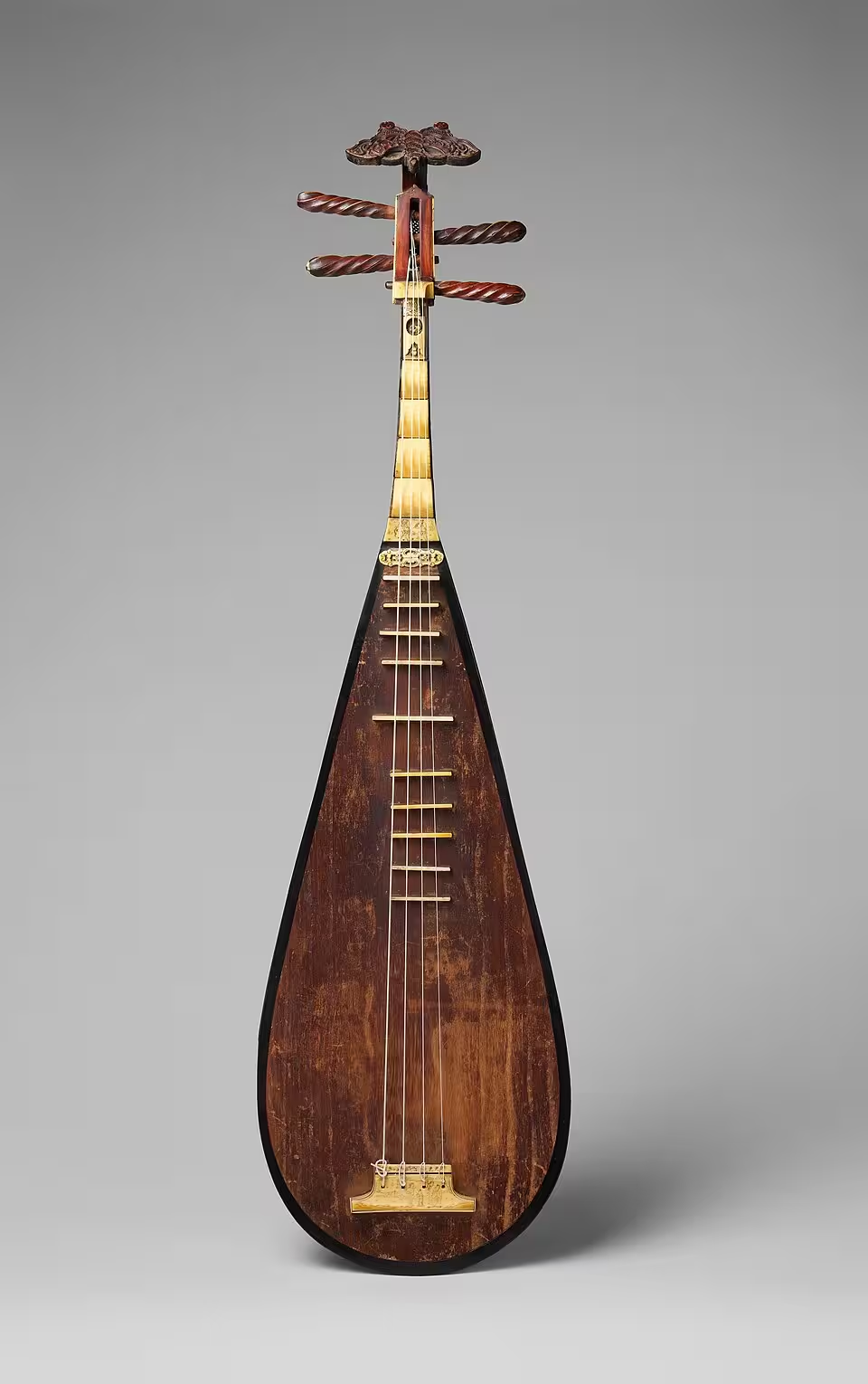
The pipa is the great lute of China — a pear-bodied, four-stringed instrument whose modern form was fixed under the Tang dynasty. Imported in its medieval shape from Central Asia, where it was played horizontally with a plectrum, it became the signature instrument of the Tang court and the Tang repertory, and remains today one of the most popular and technically demanding of all Chinese instruments. Its children — the Japanese biwa, Korean bipa and Vietnamese đàn tỳ bà — still carry its name.
From the Western Regions
The pipa’s ancestry is foreign, and the Tang knew it. The word itself is generally taken as transliteration — possibly from the Persian barbat — and the medieval instrument arrived from the oasis cities of the Silk Road in the centuries of division before the Sui. Two ancient forms shared the name: the round-bodied, straight-necked ruan-type of native Chinese antiquity, and the pear-shaped, bent-neck lute of Central Asia, played held horizontally across the knees and struck with a large plectrum. The Tang stage belonged overwhelmingly to the second: the lute of the Sogdian and Kuchean orchestras, louder, brighter and faster than anything native.
Under the Tang the pipa became the instrument against which the age’s music was measured. The ten repertory orchestras of the court included Kucha and Kashgar ensembles whose pipa virtuosi were celebrities; the scholar of music Sujiva (Su Zhiba), a Kuchean, re-founded Chinese tuning theory at the dynasty’s very beginning. In the ninth century the court still kept a hereditary guild of pipa masters — the Cao family of Chang’an, descended from Kuchean players, whose technique other lutenists imitated for generations.
The Sound of the Golden Age
The pipa’s Tang repertory was the soundtrack of the dynasty’s cosmopolitanism — dance suites from the western regions, banquet pieces of the Seated Repertory, and the great narrative medleys of the late Tang. When Bai Juyi wrote his Song of the Pipa Player in 816 — the most famous poem ever addressed to a musical instrument — it was a pipa he heard on a night river boat: a former court musician, married to a merchant, playing the repertory of her lost world. The poem’s technical passages — “the thick strings clattered like sudden rain, the fine strings whispered like secrets; clatter and whisper interweaving, like great and small pearls cascading onto a jade plate” — remain the standard Chinese description of the instrument’s dual voice. The pipa in Bai Juyi’s poem is played in the older manner — held horizontally, driven by the plectrum — and the poem is precise enough that scholars still use it to date the instrument’s transformation toward modern technique.
From Plectrum to Fingertips
Sometime between Tang and Song, Chinese players revolutionized the technique: the plectrum was discarded, the pipa raised to the chest and eventually held nearly vertically, and the right hand’s five fingers took over the plucking — enabling the tremolo, the harmonics and the furious left-hand slides that define the instrument’s modern virtuosity. The frets multiplied and the range widened. By the Ming, the pipa had a solo concert repertory of great suites — the Ambush from All Sides (十面埋伏), depicting the battle of Gaixia, and the Spring Moon on the Han River — that are still the summit of the repertory and a staple of conservatory training.
The Pipa Today
The modern pipa has four strings, two dozen or more frets spanning more than three octaves, and a technique of left-hand bends and right-hand rolls capable of everything from whispered melody to machine-gun percussion. It crossed back west in the twentieth century — it is now a standard instrument of the Western contemporary music scene, played by soloists who commission concertos for it — and east it never left: the Japanese biwa, guardian of the Tale of the Heike, and its Korean and Vietnamese cousins preserve the horizontal, plectrum-playing medieval form that the Tang knew. Two millennia after its arrival from the Silk Road, the pipa remains what the Tang made it: China’s voice.