Luoyang
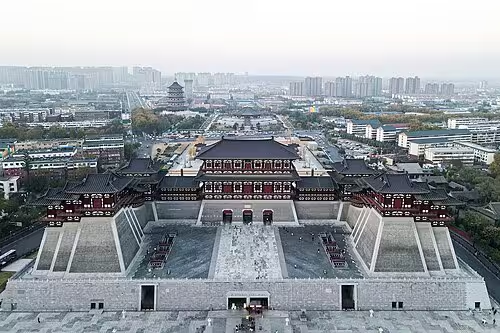
Luoyang, the Tang dynasty's eastern capital on the middle Yellow River, was the second city of the empire and, under Wu Zetian, briefly its only one — the Divine Capital from which she ruled her Zhou dynasty. Rebuilt by the Sui and perfected by the Tang, it was the eastern terminus of the Grand Canal, the empire's grain insurance policy, and the site of two of China's greatest works of religious art: the Longmen Grottoes, whose colossal Vairocana Buddha was funded by Wu Zetian's court, and the White Horse tradition that made it Buddhism's Chinese cradle. When Chang'an fell, Luoyang fell first; the two capitals' fates were one.
The Second Capital
Luoyang’s claim on the imperial imagination was older than the Tang and deeper than convenience. The city stood where the Luo River meets the Yellow River plain, in the cradle-land of the earliest Chinese dynasties, on ground the classical geographers had sanctified as the center of the world. Every unified dynasty had weighed it against the Guanzhong plain to the west; the Sui had settled the question practically by building both, and the Tang formalized the arrangement in 657, designating Luoyang the Eastern Capital and Chang’an the Western — the “two capitals” (liangjing) system that structured the dynasty’s life. The arrangement was fiscal as much as ceremonial. Chang’an sat at the dead end of the empire’s transport geography, fed by a canal whose last stretch climbed difficult country; Luoyang sat on the canal’s good side, where the grain flotillas arrived fresh from the Yangzi. When the capital’s food ran short — as it regularly did — the court moved east and ate. Nearly every Tang emperor spent long periods ruling from Luoyang, and the histories treat the eastward progress of the whole court, thousands strong, as a normal fact of government rather than an evacuation.
The city the Tang ruled from was a planned masterpiece. Its grid — palace city against the northern wall, imperial city below it, and a hundred-odd walled wards laid out across the plain south of the Luo River — followed Chang’an’s design in gentler form, but with a character the capital lacked: the Luo ran through it, crossed by famous bridges, and the western hills beyond it were parkland, temple land, and retreat. The Shangyang Palace complex on the riverbank, rebuilt by the early Tang, was the most beautiful in the empire, its gardens the setting for Xuanzong’s later years and, by the poetry they provoked, for the dynasty’s whole memory of pleasure and loss.
The Divine Capital
Luoyang’s one moment of sole supremacy belonged to Wu Zetian. The empress had personal and political reasons to leave Chang’an — the western capital was the fortress of the Li clan, the Tang aristocracy, and the memory of everything her usurpation had to overcome — and Luoyang, with its older, more neutral prestige and its eastern support, became in 684 the seat of her power and in 690 the capital of her Zhou dynasty, renamed the Divine Capital (Shendu). She rebuilt its heart on a scale meant to overawe: the Bright Hall (Mingtang), a three-hundred-foot wooden rotunda she commissioned in 688 as the ritual center of her state and the architectural proclamation of a new cosmic order; and the Tower of Paradise beside it, taller still. A fire destroyed both in 695, and she had them rebuilt — the histories preserve her court’s awe and its bankers’ arithmetic in equal measure. From this city she held her examinations on a scale Chang’an had never seen, promoted a generation of eastern and southern talent against the western clans, received the embassies of Asia, and — by the Buddhist monks she patronized there, from the Huayan master Fazang to the translators of her own Great Cloud Sutra — dressed her rule in the newest and most splendid theology on the continent. When her dynasty ended in 705, the Divine Capital reverted at once to being the Eastern Capital; but the fourteen years had permanently shifted the empire’s center of gravity east and south, in a direction the dynasty never afterward reversed.
Longmen and the Arts of the Riverbank
Two miles south of the city, where the Yi River cuts between the Xiang and Longmen hills, the cliff faces are honeycombed with the Longmen Grottoes — more than a hundred thousand carved niches and figures, the single densest concentration of Buddhist stone sculpture in China. Work there had begun under the Northern Wei, whose slender, archaic saints still line the oldest caves; but the Tang gave the site its masterpieces and its scale, carving through the seventh and eighth centuries with an imperial confidence the earlier age had lacked. The summit of the whole complex is the Fengxian Temple cliff, completed in 675: a colossal seated Vairocana Buddha some seventeen meters high, ringed by disciples, bodhisattvas, and guardians, cut from the living rock under the patronage of Wu Zetian’s court. The tradition, first recorded long after, holds that the empress contributed twenty thousand strings of her own rouge-money to the project and that the great Buddha’s face was modeled on hers; the donation is plausible, the portrait impossible to prove, and the result — serene, massive, faintly smiling — indifferent to the question, having outlasted every argument about it. Nearby stood the Xiangshan temple, whose memory belongs to the city’s secular afterlife: it was there that the poet Bai Juyi, retired and old, styled himself the Lay Buddhist of Xiangshan, wrote his best late verse, and asked to be buried at Longmen — a wish his executors honored, and where the modern Poet’s Park (Bai Yuan) still keeps his grave.
Grain, Peonies, and Catastrophe
Luoyang ran on the canal and celebrated with flowers. Its northern suburbs held the imperial granary complexes — the Sui-built Hanjia granary, excavated by modern archaeologists, could hold a million tons of grain behind its ringed walls, the largest storage installation in the pre-modern world — and through them passed every year the flotilla that kept both capitals alive. And each spring the city gave itself over to peonies. The flower that became China’s queen of blooms was a Luoyang specialty, bred to extravagance in the city’s nurseries, and the Tang poets who praised it — none more enthusiastically than Bai Juyi, who described the whole town emptying into the gardens for the twenty days of bloom — fixed the association that Chinese culture has never relinquished: Luoyang, the city of peonies, wealth, and melancholy pleasure.
The catastrophes came as they did to Chang’an, one war earlier. An Lushan’s rebels took Luoyang in January 756 and made it the capital of his new Yan dynasty, and the city changed hands in blood four times in the next seven years; the Tang armies that retook it in 757, by the chronicles’ grim count, massacred tens of thousands whose loyalty was doubted. The city recovered, as both capitals always did — but each recovery was thinner than the last, and after the Huang Chao wars of the 880s the east was ruined beyond the dynasty’s power to restore. The Tang fell in 907; Luoyang’s next age of glory was still two centuries away, when the Northern Song, finding Kaifeng close at hand, remembered the old eastern capital as the image of everything a city should be.
References & Historical Sources
- Old Book of Tang and New Book of Tang, treatise on geography (Dili zhi), for the two-capitals system and the eastern capital’s administration.
- Zizhi Tongjian, annals of the Gaozong, Wu Zetian, Xuanzong, and Suzong periods (657 designation, 684–705 Divine Capital, the wars of 756–763).
- The later gazetteer tradition, especially Xu Song’s Liangjing Chengfang Kao (Study of the Two Capitals’ Wards), for the city’s physical layout.
- Bai Juyi and the Tang poets on the peonies and gardens of Luoyang, in the Quantangshi.
- Longmen Grottoes archaeological reports, for the Fengxian Temple colossus and its date of 675.