Leshan Giant Buddha
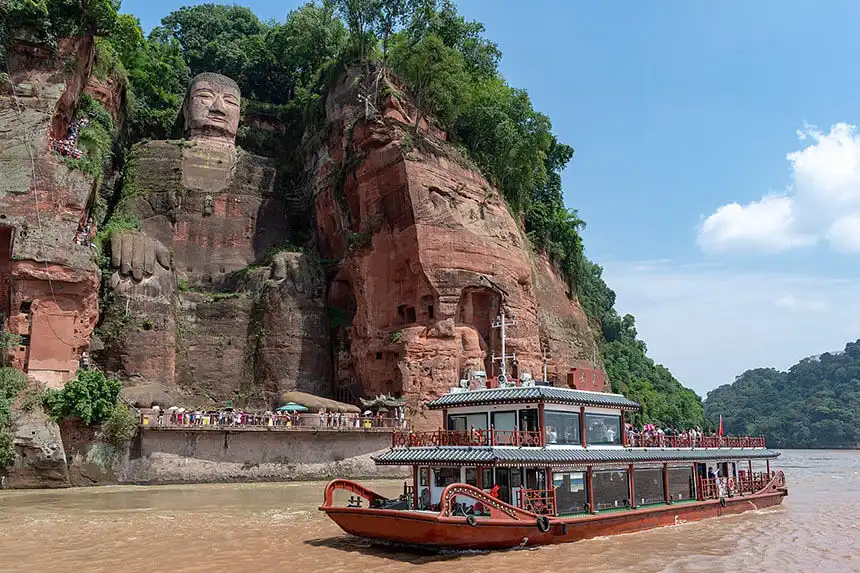
The Leshan Giant Buddha is a 71-meter-tall stone statue of Maitreya carved directly into a red sandstone cliff between 713 and 803, in the high Tang. Standing at the confluence of the Min, Dadu and Qingyi rivers in Sichuan, it remains the largest and tallest stone Buddha in the world and the tallest pre-modern statue ever made. Together with the sacred mountain of Emei facing it across the river, it has been a UNESCO World Heritage Site since 1996.
A Miracle of Engineering and Faith
The Buddha sits where three rivers meet — a stretch of water so treacherous, with whirlpools fed by the confluence’s currents, that boats were wrecked there by the score. The solution, conceived by the Tang monk Haitong (海通), was characteristically Buddhist and characteristically practical at once: a Buddha massive enough to calm the waters, both by his presence and, less mystically, by the mountain of excavated rock his carving would dump into the riverbed, breaking the currents. Haitong began the work in 713, begging alms and rallying believers across the region; legend — recorded in later local gazetteers — holds that when a corrupt official tried to extort the construction funds, the monk answered that he had given his eyes to the Buddha, and would offer them if the money must be had. The frightened official fled, and the work continued.
Haitong died with the project barely begun, and the carving passed through generations of patrons and engineers, pausing for decades when funds ran out. The official Wei Gao of Jiannan renewed it in the 780s, and the work was finally completed in 803, ninety years after its beginning — under the supervision of the monk? the final push is credited to Haitong’s disciples and local donors. The result: a seated Maitreya 71 meters from coiled hair to lotus throne, shoulders 28 meters wide, ears seven meters long, with a coiled-hair head and downcast eyes engineered to look proportionate from the boats below — an early masterpiece of deliberate perspective distortion.
How It Works
The statue is not merely carved but plumbed. An ingenious hidden system of gutters and channels woven through the hair, collar and sleeves drains rainwater away from the face and body, protecting the soft Cretaceous sandstone from the erosion that has consumed so much of the cliff around it. These drainage galleries, rediscovered and studied by modern conservators, are among the reasons the Buddha has survived twelve centuries of subtropical rain. Even so, the statue has been scoured, patched and repeatedly restored — most recently in a major twenty-first-century conservation project that also addressed the acid-rain damage of the industrial age.
Setting and Significance
The Buddha faces Mount Emei, one of the four sacred Buddhist mountains of China and, since 1996, its twin in the UNESCO listing. The cliffs of Lingyun Mountain preserve a whole palimpsest of the region’s history: the Mahao cliff tombs of the Han dynasty, carved burial chambers that speak of a far older sacred geography, and the temples of Wuyou and Lingyun that made the site a pilgrimage destination long before the statue and long after. The Tang state that built it was then at the height of its wealth and confidence; the Buddha’s serene, half-smiling face — one of the earliest great images of Maitreya, the Buddha of the future — has watched the rivers ever since, through the dynasty’s fall and a millennium of successors.
Visiting and Legacy
Today the site receives millions of visitors annually, viewed either from the water — the angle the Tang engineers designed for — or by descending the narrow plank path along the cliff at the statue’s side. Its scale record has never been surpassed by any stone sculpture; only modern engineering, with dynamite and reinforced concrete, could exceed what chisels, faith and ninety years achieved.