Chang'an
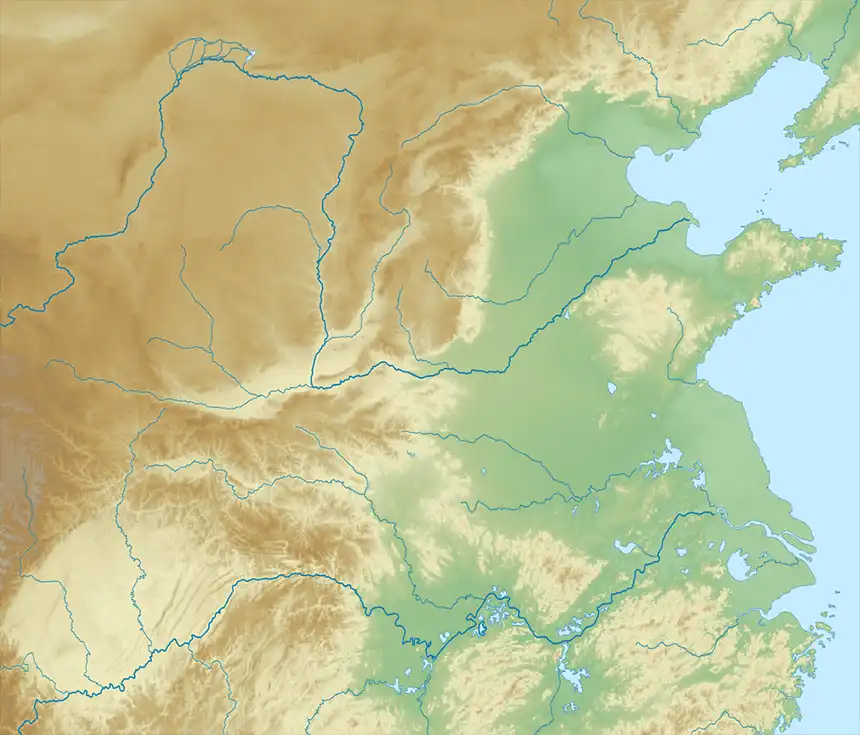
Chang'an was the principal capital of the Tang dynasty and, at its height, the largest, richest and most cosmopolitan city on earth. Laid out on a strict grid within vast rammed-earth walls, it held nearly a million residents, received embassies from three continents, and set the pattern of urban planning for all of East Asia. Its ruins lie beneath the modern city of Xi'an, in Shaanxi Province.
The City on the Grid
Chang’an had served as a capital since the Han dynasty, but the city the Tang inherited was almost entirely a Sui foundation: in 582 the Sui emperor Wen had ordered a new city built southeast of the ruined Han capital, and the Tang simply moved in and enlarged the inheritance. What resulted was urban planning as political philosophy. The city was a rectangle of some 84 square kilometers — roughly six times the area of contemporary Constantinople — enclosed by walls twelve meters high, pierced by gates that closed at night and opened at dawn with the drum roll that governed a million lives.
Within, geometry ruled. A central axis, the Vermilion Bird Avenue (朱雀大街) more than 150 meters wide, ran from the main southern gate straight to the imperial precincts in the north. Eleven north-south and fourteen east-west avenues divided the city into 108 walled wards (坊) — self-contained neighborhoods, each gated, each closing at curfew, each a small city of lanes, courtyard houses, temples and wells. At the ward crossroads stood the city’s two great markets, East and West, where, by official regulation and unquenchable demand, every commodity on earth changed hands.
The Imperial Quarter
The northern center of the city held the palace complexes: the Taiji Palace of the early Tang; the colossal Daming Palace east of it, seat of the court from Gaozong’s reign onward, whose Hanyuan Hall hosted the great New Year audiences before embassies from Persia, Arabia, Japan, Silla and Tibet; and, from Xuanzong’s time, the Xingqing Palace around the emperor’s former princely residence. South of these lay the Imperial City — the ministries, chancelleries and academies — arranged so that the entire apparatus of state stood physically between the emperor and his people, on the axis of the world.
A Million People, Three Continents
The Tang census of 742 recorded more than 500,000 residents within the walls, and the true figure, swollen by monks, students, merchants, soldiers and the unregistered, probably approached a million — with the suburban sprawl beyond the walls adding hundreds of thousands more. It was the most cosmopolitan city in world history to that date. Arab and Persian merchants kept their warehouses, inns and places of worship in the quarters along the West Market; Sogdian wine-shops with western singing-girls lined the avenues — Bai Juyi’s and Li Bai’s poems are set in them; Japanese monks studied at the state academy; Korean, Arab and Southeast Asian envoys cycled through the hostels of the official quarter. The city’s cuisine, its fashions, its music and its slang absorbed everything and sold it back transformed.
Literature’s Capital
Chang’an was, in a real sense, the subject of Tang poetry itself: the examinations that every ambitious young man took were held there; the Apricot Garden banquets of the successful, the lantern nights when Zhongzong threw open the palace gates, the ruined palaces of the emperors’ exiles — all are Chang’an scenes. Du Fu’s great lament for the city after the An Lushan rebellion, “The nation’s hills and rivers remain, in the city the spring grass grows deep,” is the single most quoted line about any Chinese city.
Destruction and Survival
The city burned and was rebuilt, time and again: in the An Lushan war of 756, the Tibetan occupation of 763, the Huang Chao cataclysm of 881–883. The end came in 904, when the warlord Zhu Wen forced the court east to Luoyang and, in the Zizhi Tongjian’s haunting sentence, demolished the palaces and ministries and the houses of the people, floating the timber down the Wei River — “and from that day Chang’an became a wasteland.” The Tang capital was never rebuilt; the Ming walls of Xi’an enclose barely a seventh of the Tang city’s footprint. But the grid survives beneath the modern streets, the great avenues still run where the Vermilion Bird Avenue ran, and the Giant and Small Wild Goose Pagodas still stand — the skyline of the greatest city of the medieval world.