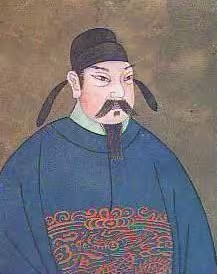
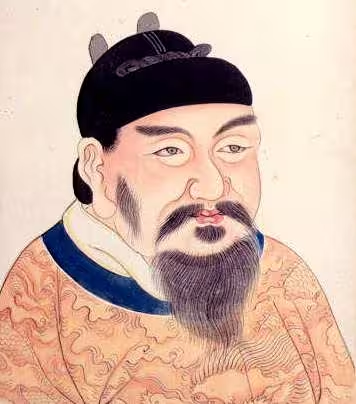
Personal Name:
Li Ye 李晔
Reign: 888 - 904 (Longji, Dashun, Jingfu, Qianning, Guanghua, Tianfu, Tianyou)
Zhaozong 昭宗
Temple name
Emperor Shengmu 圣穆皇帝
Posthumous name
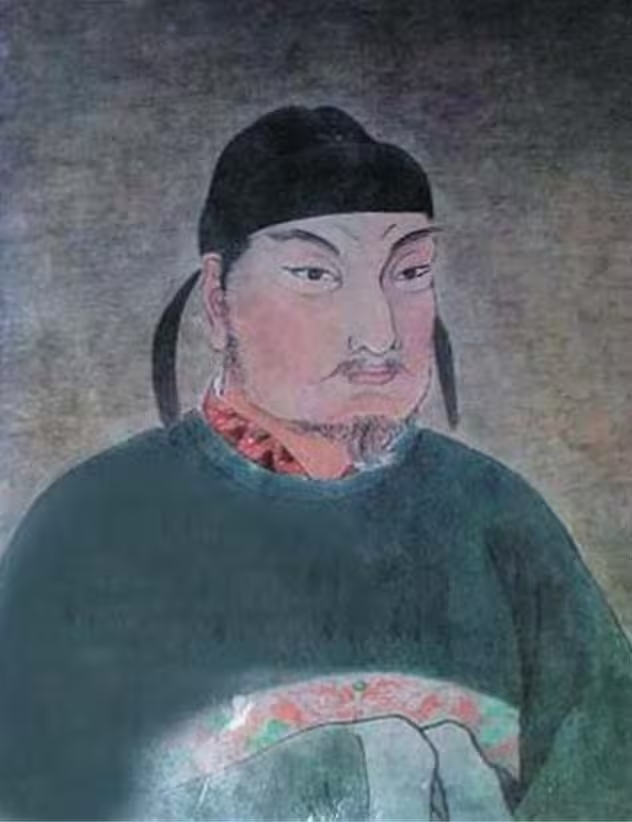
The Legacy
Emperor Zhaozong of Tang (31 March 867 – 22 September 904), personal name Li Ye, born Li Jie, was the nineteenth emperor of the Tang dynasty and its last to die with the crown actually on his head. He was a startling figure amid the wreckage: vigorous, literate, ambitious, personally brave — a ruler of the old type, with “the intent of a restorer,” as the historians put it, born forty years too late and armed with nothing but intent.
His sixteen years are a study in the economics of powerlessness. Every lever he pulled was attached to someone else’s machine: the eunuchs who chose him, the warlords who used him, the one warlord who finally decided the machine was cheaper without him. He was deposed once, abducted twice, driven from his capital three times, and made to watch the massacre of his own ministers; he answered with plots, prayers, poems and an endurance that bordered on the heroic. In September 904, at thirty-seven, Zhu Wen’s officers murdered him in his bedchamber at Luoyang. Three years later the dynasty itself followed.
Reign & Achievements
The last restoration attempt (890). The new reign began, uncommonly, with hope. The young emperor — he was twenty-one — read history with the appetite of a man looking for precedents, kept the examination system functioning, and in 890 committed the dynasty’s last great military gamble: a national campaign against the Shatuo lord Li Keyong, the strongest subject in the empire. It failed within months, and the failed commander Zhang Jun was exiled; but the attempt itself — an emperor trying to be Xianzong with Xizong’s treasury — tells everything about the man.
The coalition years (893–898). When the eunuch dictator Yang Fugong turned against the throne in 893, and the western warlords Li Maozhen of Fengxiang and Han Jian of Huazhou filled the capital’s power vacuum, Zhaozong improvised like a juggler with knives: he set the warlords against each other, married his daughter into Li Maozhen’s house, and in 895 accepted rescue from Li Keyong — the very man he had attacked in 890 — whose loyalist campaign destroyed one of the three warlords besieging the capital and humbled the other two. For a season, the court breathed. In 896, cornered by Li Maozhen, he took the extraordinary step of moving his government bodily to Han Jian’s Huazhou — and paid for the shelter with two years of captivity, during which Han Jian massacred eleven imperial princes in a single valley to teach the throne its place.
The reckoning with the eunuchs (901–903). The emperor’s last and nearly successful maneuver was his alliance with Chancellor Cui Yin against the eunuch establishment: when the eunuch Han Quanhui abducted him to Fengxiang in the winter of 901, Cui Yin summoned Zhu Wen of Bianzhou — the rising master of the east — and Zhu Wen besieged Fengxiang until Li Maozhen surrendered the emperor in 903. What followed was the emperor’s grim triumph: the eunuch leadership, some seventy men, was executed and their hold on the Shence Armies abolished at a stroke. The institution that had chosen and discarded emperors for eighty years was dead. The emperor had mortgaged the house to pay the executioner — and the executioner now owned it.
controversies & Failures
Every alliance was a loan. Each rescue had a price measured in sovereignty: Li Keyong’s help in 895 legitimized the Shatuo in Guanzhong; Han Jian’s shelter cost eleven princes; Cui Yin’s partnership delivered the capital’s defenses to Zhu Wen. Zhaozong’s defenders answer that an emperor without armies buys time with whatever currency he has — and that he nearly, twice, converted time into victory.
The coup of 900. In December 900 the eunuch Liu Jishu, concluding that the emperor was unreliable, simply imprisoned him in the Shaoyang Courtyard — doors sealed with molten iron, a hole knocked through the wall for food — and enthroned the crown prince. The coup collapsed in six weeks when officers loyal to the emperor struck back; but the lesson was absorbed by every observer: the crown itself was now a factional office. Zhaozong had stopped believing in his own safety long before; afterward, no one else believed in it either.
The Defining Trait: The Captive Fighter
Zhaozong’s defining trait was refusal. With less means than any emperor since the dynasty’s founding, he kept acting as if the means mattered less than the will — studying, scheming, remarrying his family into warlord alliances, outliving two abductions and one deposition, and forcing history to murder him outright rather than let it retire him. The Jiu Tang Shu closes his annals with a sentence of unmistakable respect for a failure.
Anecdotes & Folklore
- “The mountains and rivers remain.” Zhaozong was the most genuinely literary emperor of the late Tang, and his attributed lyrics — the Bodhisattva Man on ascending a tower, “Gazing from the tower at the palaces of Qin, all I see in the boundless distance are paired swallows” — read like the reign in miniature: an eye, a height, and the view empty of everything but flight.
- The whip at thirteen (880). During the flight from Huang Chao, the boy prince Li Jie, exhausted, begged the eunuch Tian Lingzi for a horse; Tian refused and had the prince’s attendant whipped for asking. The prince, the story goes, said nothing — and remembered. The histories do not claim the memory governed his later policy; they note, with the dryness that is their own comment, that the eunuch’s whole house fell in the purges the emperor eventually blessed.
- The eleven princes (897). Han Jian of Huazhou, holding the court hostage, assembled eleven imperial princes at the Stone Embankment Valley and killed them to eliminate alternatives to his control. Zhaozong, a prisoner in the same compound, was not told until it was done. The Tongjian enters the massacre in a single pitiless sentence; later writers have never forgiven Han Jian, and the emperor’s silence, enforced by chains of protocol and arms, became the emblem of his reign.
- The last night (904). In September 904, with the court forcibly relocated to Luoyang and his own guards replaced by Zhu Wen’s men, the emperor’s household noticed that the night patrols had doubled. On the night of the 22nd, soldiers led by Zhu Wen’s officer Jiang Xuanhui entered the palace; by morning the emperor was dead, officially of sudden illness, and his eldest son passed over in favor of a thirteen-year-old. The eunuch who announced the succession had helped arrange the murder; the historians, Sima Guang among them, recorded the arrangement with open contempt.
References & Historical Sources
- Jiu Tang Shu (旧唐书), juan 20 (Annals of Zhaozong).
- Xin Tang Shu (新唐书), juan 10.
- Zizhi Tongjian (资治通鉴), juan 257–264 (Longji 1 through Tianyou 1).
- Cefu Yuangui (册府元龟), relevant juan — the campaigns of 890 and 895.
- Robert M. Somers, “The End of the T’ang,” in Cambridge History of China, vol. 3 — the standard narrative of the warlord endgame.
- 岑仲勉 (Cen Zhongmian), 隋唐史 — on the final decades.
- The biographical notices of Zhu Wen’s rise in the dynastic histories of the Five Dynasties (旧五代史 / 新五代史).