Personal Name:
Li Longji 李隆基
Reign: 712 - 756 (Xiantian, Kaiyuan, Tianbao)
Xuanzong 玄宗
Temple name
Emperor Minghuang 明皇皇帝
Posthumous name
The Legacy
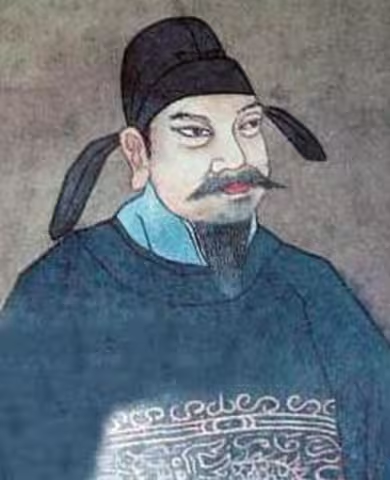
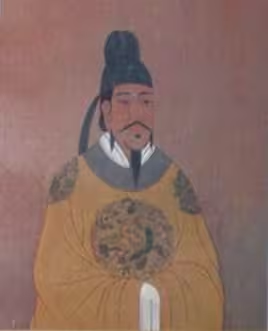
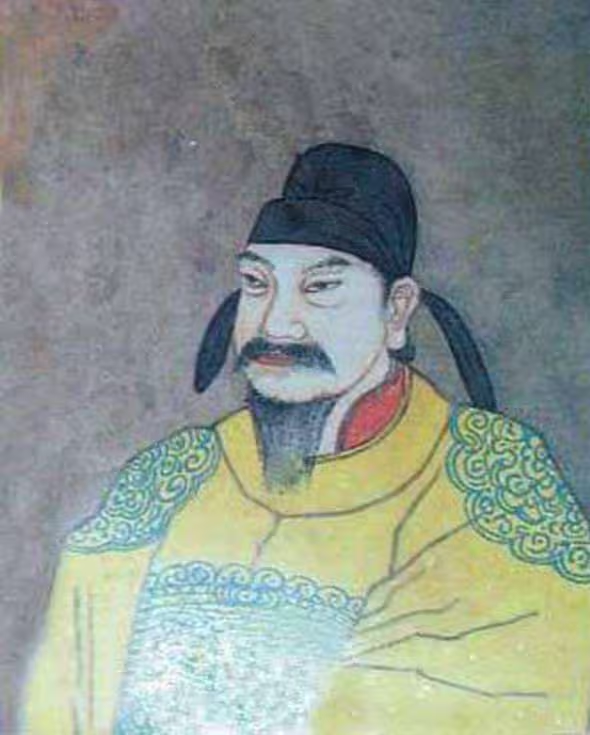
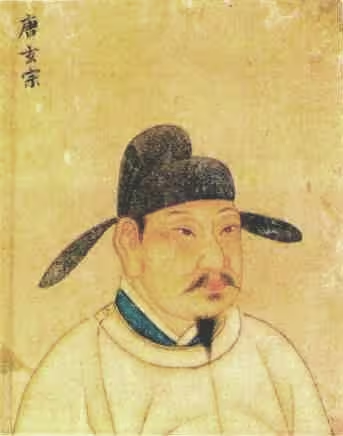
Emperor Xuanzong of Tang (8 September 685 – 3 May 762), personal name Li Longji, known to a millennium of literature as Tang Minghuang (唐明皇), was the sixth emperor of the Tang dynasty and its longest-reigning sovereign, holding the throne for forty-four years from 712 to 756. No reign in Chinese history presents so theatrical an arc: he inherited a court still vibrating from palace coups and ended by presiding over the empire’s most celebrated golden age; he then let that age rot from within until it detonated in the catastrophe that nearly destroyed the dynasty.
The verdict of the Xin Tang Shu became the standard frame: “When he devoted himself to government, the Kaiyuan era came near to perfect peace — how splendid it was! But once the heart of extravagance was stirred, he believed flattery, opened the door to favorites, and let great ministers be destroyed” — and so a reign that had ascended highest ended in flight and abdication. The Kaiyuan era (713–741) stands as the classical definition of 盛世, the “Flourishing Age”; the Tianbao era (742–756) stands as the classical definition of its collapse. Du Fu, who lived through both, set the template for all later memory in his “Reminiscences” (忆昔): “Rice flowed like fat, millet like snow; the granaries of court and household alike overflowed” — and then the music stopped.
Reign & Achievements
The coups that made an emperor. Li Longji was Ruizong’s third son, born while his grandmother Wu Zetian still ruled as emperor and his mother Consort Dou lay secretly murdered in the Zhou terror. In 710 the twenty-five-year-old prince, with his aunt Princess Taiping, orchestrated the Tanglong Coup that annihilated Empress Wei’s faction and put Ruizong back on the throne; passed over by his elder brother, he became crown prince. In 713, with the faction of the now-rival Taiping poised to strike, he preempted her in the Xiantian Coup: her chancellor allies were executed in a dawn sweep and Taiping herself was ordered to suicide. The Kaiyuan era was proclaimed on the blood of his last enemy — and there were no more coups for the rest of the reign.
The Kaiyuan golden age. Xuanzong’s first quarter-century is the most scrutinized success story in Chinese governance. He opened by accepting Yao Chong’s “Ten Articles” (十事要说) as the program of the new reign, then worked through a sequence of chancellors of the first rank — Yao Chong, Song Jing, Zhang Shuo, Han Xiu, and the poet-statesman Zhang Jiuling — who lectured him to his face and were rewarded for it. The results, documented in the registers and the Zizhi Tongjian with undisguised pride: by the Kaiyuan years rice in the capitals cost twenty cash a dou or less, the 725 imperial progress through the east was paid for out of surplus rather than levies, and the census of 754 recorded over 8.9 million households — some fifty-three million people, a population China would not match again for centuries. Granaries overflowed; the currency was sound; the roads were safe; and the empire’s frontiers, not its interior, absorbed its armies.
Institutional engineering. Xuanzong’s government did not merely enjoy prosperity; it rebuilt the machine. The chancellery was re-founded as the Secretariat-Chancellery (中书门下) with its own seal; a uniform ritual code, the Kaiyuan Rituals (大唐开元礼, 732), standardized state ceremony; Yuwen Rong’s great registration drive of 722 brought nearly a million tax-evading households back onto the rolls. As the old fubing militia decayed, long-service volunteers (彍骑) replaced it — an efficient solution that quietly transferred the empire’s sword to professional, long-tenured regional commanders, the jiedushi. Under Xuanzong the jinshi degree, with its poetry composition, became the prestige track of the examinations, and the literary culture of the bureaucracy reached its zenith.
The empire of the arts. Xuanzong was himself a working artist — calligrapher, composer, and director. He founded the Pear Garden (梨园) conservatory in 714 to train court musicians, giving Chinese opera its eternal name for its own profession (梨园子弟). He composed or completed the Robe of Rainbow and Feathers (霓裳羽衣曲), the supreme set piece of the age. Around him gathered Li Bai, summoned to court in 742 and celebrated as an exiled immortal; Du Fu, who failed the examinations and never stopped believing in the Kaiyuan he had glimpsed as a boy; Wang Wei, Meng Haoran, He Zhizhang; the painters Wu Daozi and the wild-cursive calligraphers Zhang Xu and Huai Su. The Japanese envoy Abe no Nakamaro passed the jinshi examination in 717 and never went home; the monk Jianzhen made six attempts to carry Tang Buddhism to Japan, succeeding in 754. Chang’an was, by every contemporary account, the largest, richest, and most cosmopolitan city on earth.
The frontier record. Tang arms under Xuanzong pushed in every direction: the Eastern Turkic revival was crushed in 744 with Uyghur alliance; the Khitan and Xi were broken in 734; Gao Xianzhi stormed over the Pamirs to seize Little Balur in 747 — among the most astonishing mountain campaigns ever recorded. The check came at Talas in 751, where an Arab-Abbasid army defeated Gao Xianzhi’s far-eastern flank corps, halting Tang expansion at the Syr Darya. In the south, two massive invasions of Nanzhao (751, 754) were annihilated in the mountain jungles of Yunnan — casualties the empire could not replace.
controversies & Failures
The destruction of the crown princes. In 737, on a frame-up engineered by Consort Wu and her ally Li Linfu, three imperial sons — Crown Prince Li Ying and Princes Li Yao and Li Ju — were deposed and forced to suicide on the same day. “The realm held it a grave injustice,” records the Zizhi Tongjian. The purge cleared the way for Li Heng (Suzong) and poisoned the politics of succession for the rest of the dynasty.
The long night of Li Linfu. From 736 to 752 the chancellorship belonged to Li Linfu, the “honey on the lips, sword in the belly” (口蜜腹剑) minister of the histories — the archetype of the evil chancellor in the Chinese tradition. Xuanzong, aging and increasingly weary of administration, let him run the empire and eliminate rivals: Chancellor Li Shizhi was hounded to suicide in 747; in 746 the Wei Jian case nearly unmade the heir apparent; the great frontier general Wang Zhongsi was broken in the same year. The 747 special examinations at which no candidate passed — Li Linfu reporting smugly that “there were no more talents left in the wilds” (野无遗贤) — became the age’s bitterest joke; among the rejected was Du Fu.
The frontier policy that armed the rebellion. It was Li Linfu who argued for entrusting border commands to non-Han generals of humble origin — men without scholarly credentials who could never threaten the chancellorship. Xuanzong agreed, and by the 740s ten military governors commanded professional long-service armies. An Lushan, an obese Sogdian-Turkic officer of dazzling charm and no visible loyalty, accumulated three commands — Pinglu, Fanyang, Hedong — with perhaps 200,000 of the empire’s best troops, while the interior garrisons starved and the emperor dismissed every warning, including Zhang Jiuling’s decades-old plea to execute him.
The Tianbao court. In 745 Yang Yuhuan, once the consort of his own son, was installed as Precious Consort Yang Guifei; her cousin Yang Guozhong, a croupier of no ability, became chancellor in 752. The clan’s villas at Huaqing Palace consumed the imperial winters; seven hundred craftsmen worked exclusively for the consort’s wardrobe, and courier horses galloped a thousand li to deliver fresh lychees. The emperor was sixty and did not wish to be argued with.
The fall. On 16 December 755 An Lushan rose at Fanyang with some 150,000 troops. The passes fell like shutters; Luoyang was lost within a month; and in July 756, against the desperate advice of the garrison commander Geshu Han, Yang Guozhong ordered the last army out of Tong Pass — where it was destroyed in a day. On 14 July 756 Xuanzong fled Chang’an at dawn. At Mawei Station his own guards mutinied, butchered Yang Guozhong, and demanded the consort’s life; the emperor watched from his palanquin as Yang Guifei was led away and strangled at the shrine. He went on into exile in Shu, while his son Li Heng, turning north at the parting of the roads, was acclaimed emperor at Lingwu as Suzong on 12 July 756. Xuanzong, informed weeks later in Chengdu, endorsed the fait accompli with grace: “My son has answered the will of Heaven and of men.”
The last years. Restored to Chang’an in late 757, the retired emperor lived at Xingqing Palace, a melancholy relic courted and feared by Suzong’s eunuchs. In 760 the eunuch Li Fuguo forced his removal to the desolate Ganlu Hall, exiled his loyal Gao Lishi, and dispersed his remaining household. He died there on 3 May 762, aged seventy-six, and was buried at Tailing — the last Tang emperor to die in his capital until the dynasty’s end.
The Defining Trait: The Talent-Spotter Who Stopped Seeing
Xuanzong’s defining gift was judgment of men — and its defining failure was its loss. In the Kaiyuan years he sought out, appointed, and endured the frankness of the very best administrators of the age; in the Tianbao years he anointed, protected, and would not hear a word against the very worst. The same eye that chose Yao Chong and Zhang Jiuling embraced Li Linfu, Yang Guozhong, and An Lushan. The arc is so clean — talent, then flattery; diligence, then fatigue; the mirror held up, then the mirror banned — that later moralists used his life as a demonstration that empires rarely fall; they are first simply stopped being looked at.
Anecdotes & Folklore
- The Pear Garden. In 714 Xuanzong selected three hundred musicians from the court ensembles and drilled them personally at the Pear Garden; an error in the imperial ensemble, the histories say, was corrected on the spot by the emperor-conductor. Chinese opera performers have called themselves “disciples of the Pear Garden” (梨园子弟) for twelve centuries.
- Zhang Jiuling’s refused prophecy (736). When the frontier general Zhang Shougui sent the captive An Lushan to Chang’an for execution, Chancellor Zhang Jiuling endorsed the death warrant in writing: “Lushan has the heart of a wolf cub… he will surely bring calamity.” Xuanzong spared him for his dash and charm. Nineteen years later the prophecy was quoted back at the fleeing court; the Zizhi Tongjian keeps the document on record.
- Li Bai at court. The poet arrived in 742 and was appointed Hanlin academician; the notebook tradition (preserved in Duan Chengshi’s Youyang Miscellany and other Tang anecdotes) has the great eunuch Gao Lishi pulling off the poet’s boots and the consort grinding ink while Xuanzong composed with him; the three “Qingping Diao” songs (“Clouds remind me of her dress, flowers of her face”) survive as the collaboration. Scholars treat the stage business as embroidery on a real favor.
- The lychee riders. Consort Yang loved fresh lychees; courier stations were ordered to relay them from the far south at gallop, the fruit still on the branch when it reached Huaqing Palace. Du Mu’s quatrain on the pass at Huaqing — “A rider comes, raising red dust; the consort smiles; no one knows it is lychees arriving” — fixed the image forever; the histories confirm the relay, if not the smile.
- The vow at Changsheng Hall. When Bai Juyi wrote The Song of Everlasting Regret (长恨歌) in 806, he fused rumor and tragedy into the empire’s favorite love story: the autumn vow of 7 July at Changsheng Hall, the Mawei death, and the shaman’s journey to the Isles of the Blest where the consort, “though not among the living,” sends her hairpin back. It is poetry, not record — and it is how China has chosen to remember him.
- A name written to avoid. Under the Qing, the temple name 玄宗 was written 元宗 to dodge the naming taboo of the Kangxi Emperor (Xuanye) — one reason Western older sources sometimes call him “Yuanzong.” The taboo also renamed Xuanwu Gate to Shenwu? (元武门 during Qing). A footnote of empire-wide resonance for a single character.
References & Historical Sources
- Jiu Tang Shu (旧唐书), juan 8–9 (Annals of Xuanzong).
- Xin Tang Shu (新唐书), juan 5.
- Zizhi Tongjian (资治通鉴), juan 210–218 (Xiantian 2 through Tianbao 15).
- Du You, Tongdian (通典) — the census, fiscal and frontier data of the Tianbao registers.
- Bai Juyi, Changhen Ge (长恨歌, 806) — the literary afterlife; Du Fu, Yixi (忆昔) — the contemporary memory of Kaiyuan.
- Denis Twitchett, “Hsuang-tsung (reign 712–56),” in The Cambridge History of China, vol. 3 — the standard English account.
- 陈寅恪 (Chen Yinke), 唐代政治史述论稿 — on the aristocracy, the jiedushi, and the An Lushan catastrophe.
- Edwin G. Pulleyblank, The Background of the Rebellion of An Lu-shan — the frontier policy dissected.
- Paul W. Kroll, Essays in Medieval Chinese Literature and Cultural History — on High Tang court culture.
- Stephen Owen, The Great Age of Chinese Poetry: The High T’ang — on the literary world of the Kaiyuan and Tianbao courts.