Personal Name:
Li Yan 李炎
Reign: 840 - 846 (Huichang)
Wuzong 武宗
Temple name
Emperor Zhidao 至道皇帝
Posthumous name
The Legacy
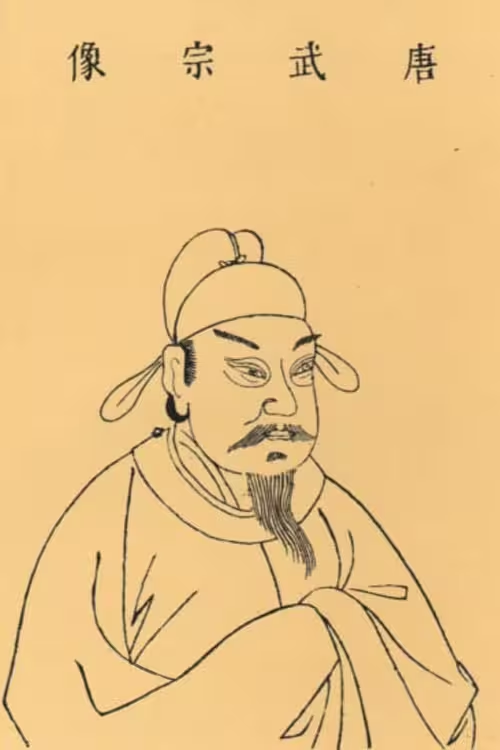
Emperor Wuzong of Tang (2 July 814 – 22 April 846), personal name Li Yan, born Li Chan, was the fifteenth emperor of the Tang dynasty and the last vigorous one. Placed on the throne in February 840 by the eunuchs Qiu Shiliang and Yu Hongzhi in defiance of his dying brother’s testament, he spent six years proving that a ruler chosen by the palace could still rule it: the age is remembered as the Huichang Restoration, the final brief assertion of the throne’s authority over the twin cancers of the late dynasty — the warlords and the great monasteries — before the eunuchs closed their hand again.
His legacy is deliberately double-edged, and the historians sharpened both edges. To admirers he was the strong emperor the dynasty had lacked since Xianzong: decisive, served by the last great aristocratic chancellor, Li Deyu, and unafraid of the tax-exempt wealth of the church. To his detractors he was a bigot with a match: the Huichang Persecution of 845, which destroyed 4,600 monasteries and laicized a quarter-million monks and nuns, remains the largest single act of religious destruction in Chinese history. He ended, like Xianzong, on an elixir — dead at thirty-two, and replaced, as the court watched with open mouths, by an uncle the whole palace had agreed was a fool.
Reign & Achievements
The last great chancellorship. Wuzong’s reign was, in effect, the six-year premiership of Li Deyu — the aristocratic master-politician whom the Niu faction had blocked and exiled for two decades. Recalled at the accession, Li Deyu ran the empire with a discipline the court had not felt since Yuanhe: the Niu faction’s patrons were systematically demoted to the far south, appointments were made on capacity rather than connection, and the memoranda of the Huichang years have the snap of a reformed court.
The Uyghur emergency (840–843). The year of Wuzong’s accession brought the collapse of the steppe: the Kyrgyz destroyed the Uyghur Khaganate in 840, and its refugee khans, starving and armed, raided the Tang’s northern frontier for three years. Li Deyu managed the crisis with a characteristic mixture of subsidy and war — buying off one claimant while General Shi Xiong annihilated the main refugee horde at the Mountain of the Slain Hu (杀胡山) in 843, capturing khans and hostage princes by the cartload. The forty-year Uyghur problem ended on schedule and within budget, and the northern horse-traders henceforward came to market, not to war.
The destruction of Zhaoyi (844–845). When Liu Congjian, the warlord of Zhaoyi commanding the passes between the capitals and Hebei, died in 844 leaving a nephew as heir, Wuzong refused — the first such refusal since Xianzong — and for once the war did not spiral: Liu Zhen’s own subordinates murdered him and surrendered, and the great Zhaoyi command was carved into three obedient prefectures. It was the last unambiguous victory the dynasty would ever win over a military governor, and it was won with an economy of force that Xianzong’s generation would have envied.
The Huichang persecution (845). The reign’s signature act was fiscal and ideological at once. The Buddhist church had grown, across two centuries of imperial favor, into the empire’s largest owner of tax-exempt land and bronze, its monasteries sheltering hundreds of thousands of registered-or-unregistered men and women outside the tax rolls. In 845, advised by the Daoist clergy and by Li Deyu’s hard arithmetic, Wuzong ordered the suppression: the official returns — preserved in the edicts and the Tongjian — count 4,600 monasteries and 40,000 shrines destroyed, 260,500 monks and nuns returned to lay life, 150,000 temple dependants re-registered as taxpayers, and millions of acres of land and vast hoards of bronze and coin back on the state’s books; the great bells and statues went into the mints. The “three barbarian religions” — Manichaeism, Zoroastrianism and the Nestorian church — were suppressed in the same sweep, extinguishing organized Christianity in China for three centuries. Famine refugees were forbidden to take refuge in what no longer existed; it was, by the standards of the age, a successful fiscal revolution with a body count history has never settled.
controversies & Failures
The persecution’s shadow. Even in a dynasty that would end in massacres, the Huichang suppression stood apart: monks were beaten to force laicization, sacred images were melted before their congregations, and the edicts rang with a contempt for the religion that later Buddhists — who wrote most of the surviving narrative — never forgave. Modern historians split between those who see a necessary demolition of a fiscal state-within-a-state and those who see the largest act of religious vandalism of the medieval world; the reign’s own arithmetic — millions in new revenue, a quarter-million new taxpayers — suggests the emperor’s motives were exactly what he said they were.
The Daoist death. Wuzong’s devotion to the Daoist adepts around his throne — above all the physician-alchemist Zhao Guizhen — became fatal in the spring of 846. His last months show the classic signature of heavy-metal poisoning: rage, tremor, skin lesions; he died on 22 April 846 at thirty-two, having produced no surviving heir. The court, by one of the strangest ironies of the dynasty, then passed the throne to an uncle who had spent thirty years feigning simplicity to survive the very faction the dead emperor had just destroyed.
The Defining Trait: The Last Strong Hand
Wuzong’s defining trait was appetite for decision — the willingness, unique among the emperors of his generation, to say no to warlords, no to factions, no to the church, and to enforce the no with armies, edicts and accounting. That every one of his victories was personal rather than institutional is the tragedy beneath them: six years of strength, followed by two decades in which everything he built was dismantled by the men he had spared.
Anecdotes & Folklore
- The Weizhou debt (831). Li Deyu’s chancellorship rested partly on a grievance a decade old: in 831, as governor of the west, he had accepted the surrender of Weizhou, a strategic fortress the Tibetans had held for a generation — and the court, on Chancellor Niu Sengru’s advice, had handed the city and its defecting garrison back to the Tibetans, who executed them to a man. For fifteen years Li Deyu called it murder by faction, and the Tongjian keeps both sides of the argument as the founding text of the Niu–Li feud.
- The captive khans at New Year. After the victory of 843, the Uyghur hostages were paraded at the court’s New Year audience before being pensioned off with titles and rice. The emperor reportedly remarked that he had been shown, in one morning, the exact difference between tribute and tribute in the other direction. Court diarists marked the day as the first since Yuanhe that the northern question had an answer.
- “Burn the bronze.” The destruction of the great temple bells was opposed even within the cabinet on the ground that the Buddha had brought the dynasty luck; Wuzong’s answer, in the preserved edict, was arithmetic: the empire’s coinage was short, the church’s bronze was long, and “Buddha, if he has power, has no use for metal.” The coins cast from temple bronze circulated for the rest of the dynasty — a small, jingling memorial.
- The fool who watched. His successor-to-be, Prince Guang (the future Xuanzong), had spent decades perfecting the manner of an amiable simpleton at exactly the courts Wuzong was purging; the palace jest that “Prince Guang is good for laughing at” was, within months of the Huichang emperor’s death, revealed as the longest audition in the dynasty’s history. The eunuchs chose him for malleability; they had chosen, as it turned out, the last capable emperor of the Tang.
References & Historical Sources
- Jiu Tang Shu (旧唐书), juan 18 (Annals of Wuzong).
- Xin Tang Shu (新唐书), juan 8.
- Zizhi Tongjian (资治通鉴), juan 246–248 (the Huichang reign and the persecution edicts).
- Buddhist and Daoist sources: Zanning (赞宁), Song Gaoseng Zhuan (宋高僧传), and the anti-persecution narratives — essential for the church’s side of 845.
- Cambridge History of China, vol. 3, ch. on the ninth century.
- 岑仲勉 (Cen Zhongmian), 隋唐史 — on the Huichang campaigns and the Niu–Li settlement.
- Stanley Weinstein, Buddhism under the T’ang — the standard study of the suppression and its fiscal logic.