Personal Name:
Li Shimin 李世民
Reign: 626 - 649 (Zhenguan)
Taizong 太宗
Temple name
Emperor Wenwu 文武皇帝
Posthumous name
The Legacy
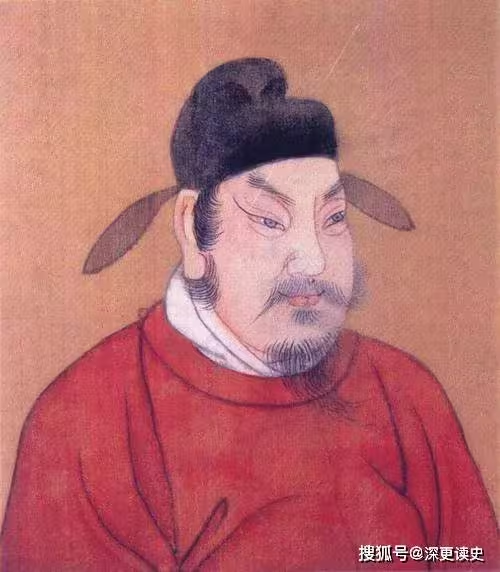
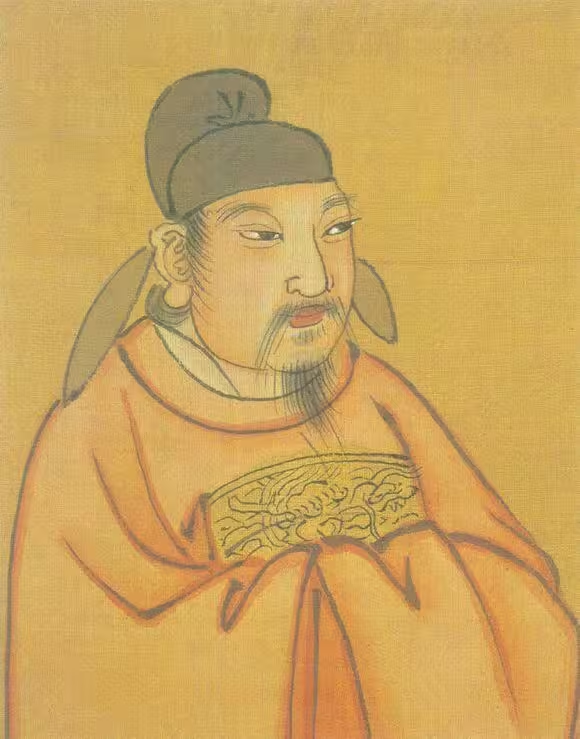
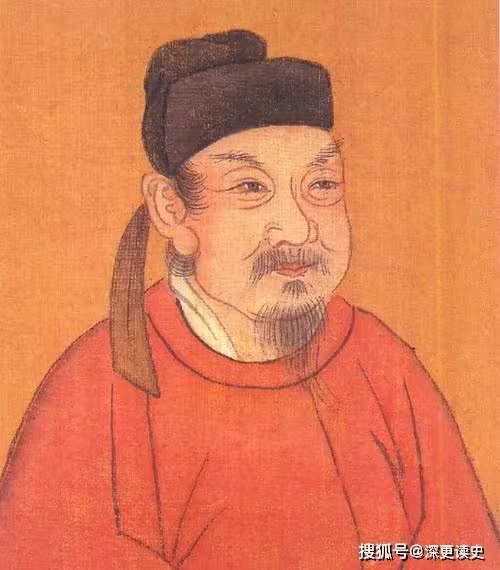
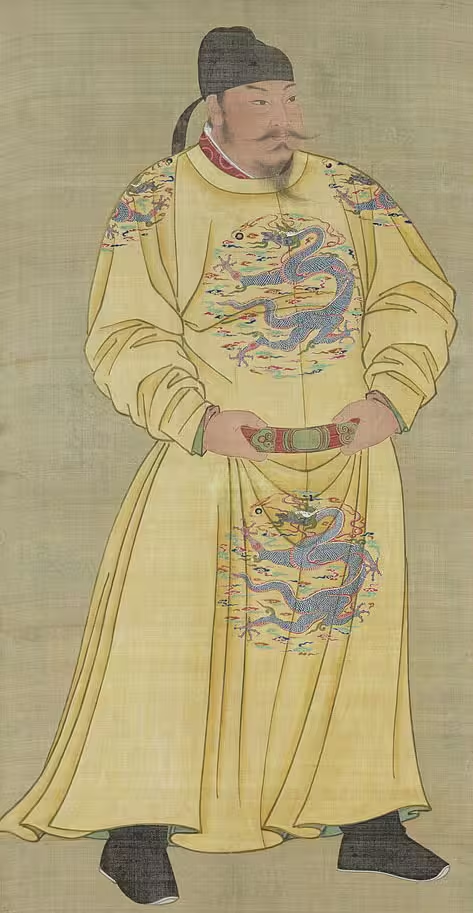
Emperor Taizong of Tang (28 January 598 – 10 July 649), personal name Li Shimin, was the second emperor of the Tang dynasty, reigning from 626 to 649. He is conventionally ranked among the greatest rulers in Chinese history, and his era name, Zhenguan (贞观), became a byword for good government so potent that later statesmen invoked it for a thousand years.
His claim rests on a paradox: he seized the throne by murdering his brothers at the Xuanwu Gate and compelling his father’s abdication, then governed so well that posterity largely forgave the crime. The Zizhi Tongjian’s judgment set the tone — a ruler who “cultivated himself to bring peace to the age” and who, in the verdict of the Jiu Tang Shu, rose above Han’s Wen and Jing emperors and stood comparison with Zhou’s founders. The political culture of the Zhenguan court — remonstrance institutionalized, conquered enemies employed, histories read aloud as mirrors of policy — became the template against which every subsequent Chinese emperor was measured.
Reign & Achievements
Zhenguan governance. Taizong surrounded himself with an extraordinary bench: Fang Xuanling for personnel and planning, Du Ruhui for decisions (“Fang’s plans and Du’s verdicts,” 房谋杜断), and above all Wei Zheng as remonstrating mirror. He regularized the three-chancellery, six-ministry system, codified law in the Zhenguan Code that matured into the Tang Code, and expanded the examination system so that talent slowly diluted aristocratic monopoly. His famous maxim, set down in the Zhenguan Zhengyao (贞观政要), defined the ethic: “The ruler depends on the state; the state depends on its people. Oppress the people to serve the ruler — like cutting one’s own flesh to fill one’s belly.”
The Heavenly Qaghan. In 630 Li Jing and Li Shiji destroyed the Eastern Turkic Khaganate in a winter blitzkrieg; its ruler, the Jiali Qaghan, was captured and brought to Chang’an. Steppe and oasis leaders thereafter acclaimed Taizong as Tian Kehan (天可汗, Heavenly Qaghan) — a supra-imperial title no purely Chinese ruler had held. He used it shrewdly, organizing conquered peoples as protectorates and loose-reign prefectures while resettling tens of thousands of Turks within the Tang military system. The Tuyuhun were crushed in 635, Xueyantuo contained, and Gaochang annexed in 640, paving the way for the Protectorate of the Western Regions.
Culture and empire. In 641 the Wencheng Princess was sent to marry the Tibetan king Songtsen Gampo, seeding a century of Tang–Tibet exchange. The legal reforms, land and tax ordinances, census, and granary system of the Zhenguan years gave the dynasty the fiscal sinews for its coming golden age. Taizong also kept tight personal control of the army, rotating regional commanders so that no general could build an independent power base.
controversies & Failures
Xuanwu Gate and its shadow. Taizong never escaped the manner of his accession: the killing of Li Jiancheng and Li Yuanjing, the coercion of a living father, and the rewriting of the record. Even his admirers concede that the official histories’ unflattering portrait of Gaozu and Jiancheng is political art.
Interference with historiography. Taizong’s demand to read the court diaries (起居注) and the veritable records of his own reign broke a tradition of historian independence stretching back centuries — a breach later emperors learned from all too well.
The Goguryeo failure. In 645 he launched a massive invasion of Goguryeo, took Liaodong city, but failed before the fortress of Ansi through an exceptionally stubborn defense and brutal winter; the withdrawal cost the army dearly. The failure haunted his last years and contributed to his obsessive preparation for a renewed campaign that death cut short.
Late-reign erosion. Biographers note a gradual shift: lavish palace construction at Cuiwei and Yuhua, the traumatic succession crisis of 643 — which saw one crown prince deposed for treasonous conspiracy and a brilliant prince demoted for overreaching — and finally the fatal elixir. In 649 he died at Cuiwei Palace after taking “immortality” pills supplied by an Indian monk — a death his own physicians could not prevent, and one later writers cited as the wages of violating his own sober maxims.
The Defining Trait: The Exemplar Ruler
Taizong’s defining characteristic was his self-conscious construction of rulership as a discipline of listening. He institutionalized remonstrance, rewarded officials who contradicted him, and built the cult of the ruler-as-mirror into Tang political identity. His three-mirror aphorism — bronze to dress, the past to foresee rise and fall, men to know gain and loss — is not merely a bon mot; it was the operating manual of the Zhenguan court, and its authorship by the man who had killed his way to the throne gave it undeniable weight.
Anecdotes & Folklore
- “I have lost a mirror.” On Wei Zheng’s death in 643 Taizong told his ministers: “With bronze as a mirror one can correct one’s dress; with the past as a mirror one can know rise and fall; with men as a mirror one can see gain and loss. Wei Zheng is gone — I have lost a mirror.” Years later, after the Goguryeo failure, he sighed that had Wei Zheng lived, “he would not have let me make this expedition.”
- The falcon in the sleeve. Taizong was playing with a hunting falcon when Wei Zheng arrived to report. He tucked the bird into his sleeve; Wei Zheng, aware of the trick, deliberately prolonged the memorial until the falcon suffocated. The emperor, fond and exasperated, kept the game anyway.
- The death-row promise (632). Taizong released some 390 condemned prisoners to return home for the New Year on their word of honor that they would come back to be executed. All returned. Delighted, he pardoned them. The tale, preserved in the Zizhi Tongjian and Xin Tang Shu, has been questioned by later scholars as exemplary propaganda — but it was told, and retold, as the signature story of Zhenguan.
- The caged locust. During the 628 drought and locust plague, Taizong caught a locust and ate it, declaring: “The people rely on grain to live, and you eat it — I would rather you devour my lungs and bowels.” Courtiers protested against the impropriety; he ate it anyway.
- The Wang Xizhi obsession. Taizong was history’s greatest collector of the calligrapher Wang Xizhi; the story that he had the Orchid Pavilion Preface (兰亭序) buried with him at Zhaoling comes from the account of the tomb robber Wen Tao’s ravaging of the imperial tombs in the Five Dynasties. The six stone relief steeds of his favorite warhorses at Zhaoling remain among the supreme treasures of Tang art.
References & Historical Sources
- Jiu Tang Shu (旧唐书), juan 2–3 (Annals of Taizong).
- Xin Tang Shu (新唐书), juan 2.
- Zizhi Tongjian (资治通鉴), juan 191–199 (Wude 9 through Zhenguan 23).
- Wu Jing (吴兢), Zhenguan Zhengyao (贞观政要) — the canonical compilation of Taizong’s court dialogues.
- Tang Huiyao (唐会要), relevant juan on institutions.
- Denis Twitchett & Howard Wechsler, “Kao-tsung (reign 649–83) and the Empress Wu,” and Wechsler, “The Founding of the T’ang Dynasty,” in The Cambridge History of China, vol. 3.
- David McMullen, State and Scholars in T’ang China — on examinations and the scholar-official ideal.
- Wechsler, Mirror to the Son of Heaven: Wei Cheng at the Court of T’ang T’ai-tsung (Yale, 1974).