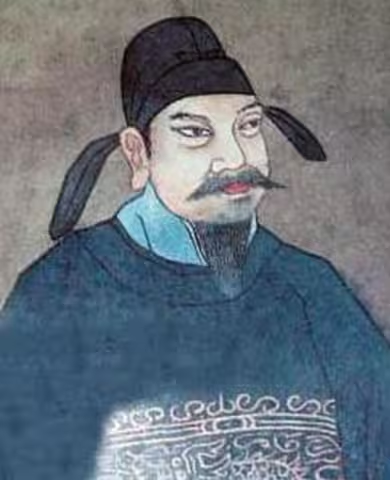
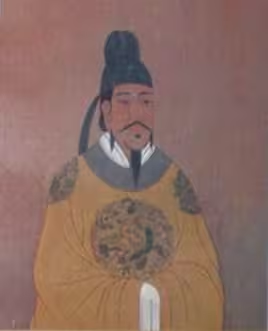
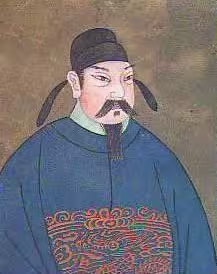
Personal Name:
Li Yuan 李渊
Reign: 618 - 626 (Wude)
Gaozu 高祖
Temple name
Emperor Shenyao 神尧皇帝
Posthumous name
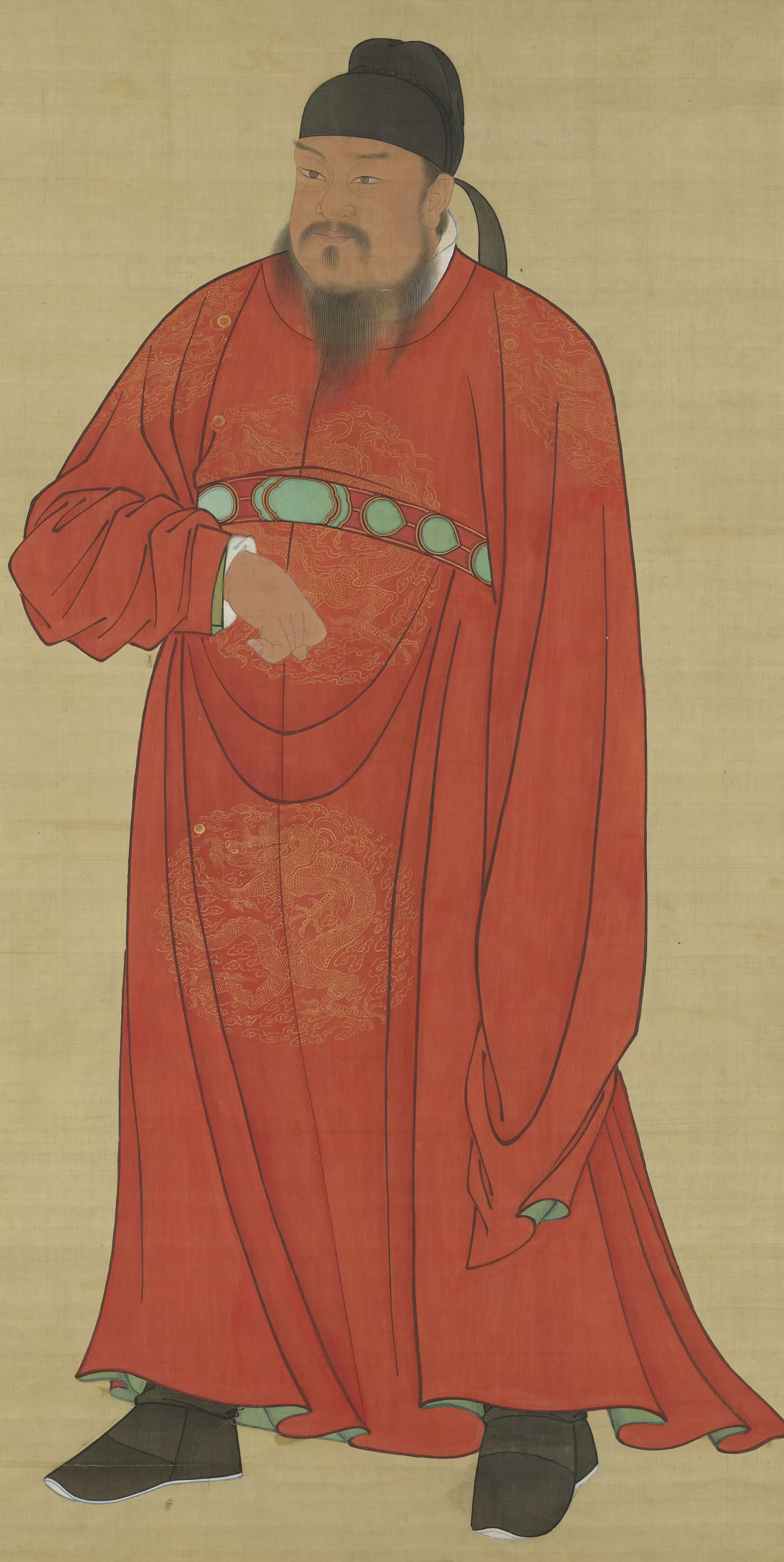
The Legacy
Emperor Gaozu of Tang (7 April 566 – 25 June 635), personal name Li Yuan, was the founding emperor of the Tang dynasty, reigning from 18 June 618 until his forced abdication on 4 September 626. He was the last of the great founders of Chinese imperial dynasties to come from the aristocratic military elite of the northwest — the so-called Guanlong aristocracy (关陇集团) — and his career bridged the fall of the Sui and the reunification of China after nearly three centuries of division.
Traditional historiography, written largely under his son Taizong, portrays Li Yuan as a hesitant figure pushed into rebellion by the impetuous Li Shimin. Modern scholarship, led by historians such as Niu Zhigong, has largely reversed this verdict on the basis of Wen Daya’s Da Tang Chuangye Qiju Zhu (大唐创业起居注), a near-contemporary diary of the uprising. That source shows Li Yuan planning the Taiyuan uprising carefully for years, cultivating allies, and timing his move with cold political calculation. Whatever the later image, the institutional achievement is not in doubt: within seven years of taking Chang’an, Li Yuan and his sons destroyed more than a dozen rival regimes and restored a unified empire.
His posthumous reputation is inseparable from the tragedy of the Xuanwu Gate Incident, in which Li Shimin murdered his brothers and forced his father’s abdication. Yet it was precisely Gaozu’s willingness to delegate real military power to his sons — above all to Li Shimin — that made the rapid reunification possible. The historian’s summary in the Zizhi Tongjian is apt: the Wude era laid every institutional foundation on which the celebrated Zhenguan governance would build.
Reign & Achievements
The Taiyuan uprising (617). Born into the Dukedom of Tang, Li Yuan inherited his title at the age of seven when his father Li Bing died in 572. A cousin of Emperor Yang of Sui through their mothers — both were daughters of the powerful Dugu clan — he served the Sui loyally for decades as prefect, commandery governor, and finally garrison commander (留守) of Taiyuan, the strategic capital of Shanxi. In the summer of 617, with the Sui order collapsing under peasant rebellions, Li Yuan rose. He eliminated the suspicious Sui deputies Wang Wei and Gao Junya, sent for his sons, and — in a masterstroke of pragmatism — wrote in deferential terms to the Eastern Turkic Khagan Shibi, securing cavalry and horse support in exchange for nominal subordination. The rebel army swept through Huoyi, crossed the Yellow River, and entered Chang’an on 9 November 617 with minimal destruction.
Founding the dynasty (618). Rather than declaring himself emperor immediately, Li Yuan displayed characteristic political finesse: he enthroned Yang You, a grandson of Emperor Yang, as the puppet “Emperor Gong of Sui,” styled himself Grand Chancellor and Prince of Tang, and waited. When news arrived that Emperor Yang had been strangled at Jiangdu in April 618, Yang You was made to abdicate, and on 18 June 618 Li Yuan founded the Tang, taking Wude (“Martial Virtue”) as his era name and making Chang’an the capital.
The wars of reunification (618–624). The new regime faced a ring of rivals: Xue Ju’s Qin state in the northwest, Liu Wuzhou — backed by the Turks and holding Taiyuan itself — in the north, Wang Shichong’s Zheng and Dou Jiande’s Xia in the east, Xiao Xian’s Liang in the middle Yangzi, and Du Fuwei and Fu Gongshi in the Huai valley. The campaigns were staggering in their speed. Li Shimin destroyed Xue Rengao at Qianshuiyuan in late 618, drove the Turks out of Shanxi and crushed Liu Wuzhou in 620, and won the decisive Battle of Hulao (虎牢之战) in May 621, capturing Dou Jiande and forcing Wang Shichong’s surrender — one battle that destroyed two empires. Meanwhile Li Xiaogong and Li Jing took Jiangling and captured Xiao Xian in 621. Residual resistance — Liu Heita’s revolt in Hebei (suppressed 623), Fu Gongshi’s rebellion in the south (suppressed 624), and the separatist Liang Shidu in the Ordos (eliminated under Taizong in 628) — was mopped up with a mixture of force and amnesty. Gaozu’s declared policy of “pacifying with pardons wherever possible” (招抚为主) spared the exhausted population from even greater devastation.
Institution building. The Wude government restored the equal-field land system and promulgated the zu-yong-diao (租庸调) tax-and-corvée framework in 624; codified law in the Wude Code, which became the ancestor of the celebrated Tang Code; reorganized the fubing (府兵) militia; and in 621 cast the Kaiyuan Tongbao coin, which standardized currency for the next three centuries. Gaozu also re-established the civil service examinations as a regular channel of recruitment, though aristocratic recommendation still dominated.
controversies & Failures
The succession crisis and Xuanwu Gate. Gaozu’s greatest failure was personal rather than institutional: he never resolved the rivalry between his eldest son Li Jiancheng, the crown prince, and his second son Li Shimin, whose dazzling military prestige had made him a rival center of power, formally ennobled as the “Tiance Generalissimo” in 621. Court politics fractured into princely factions, and the emperor’s indecision ended in blood: on 2 July 626 Li Shimin ambushed and killed both his brothers at Xuanwu Gate, then sent the armor-clad Yuchi Jingde into the palace as, in effect, an ultimatum. Gaozu named Li Shimin crown prince and abdicated two months later, spending the last nine years of his life as retired emperor (太上皇).
Historiographical distortion. Because the official histories of the founding were compiled under Taizong’s supervision, Gaozu’s role was systematically diminished and the founding recast as his son’s achievement. Historians treat the received account with due caution; the Da Tang Chuangye Qiju Zhu is the essential corrective.
The Defining Trait: The Pragmatic Delegator
Li Yuan’s signature talent was the delegation of overwhelming authority to the most capable men available — to Pei Ji and Liu Wenjing at the start, to his sons on campaign, to Li Jing and Li Xiaogong in the south. Contemporaries and historians alike note his magnanimity: he rarely punished surrendered enemies, absorbed defeated armies into his own, and tolerated blunt advice. The Jiu Tang Shu credits him with “valuing talent as his own eyes and ears” — a founder who won an empire less by personal heroics than by assembling the team that could win it for him.
Anecdotes & Folklore
- The prophecy that hunted the Li clan. Court prophecies circulating under the Sui — “The one surnamed Li will gain the empire” (桃李子,得天下) — made Emperor Yang paranoid about his powerful Li cousins. The story that Li Yuan survived only by remaining conspicuously wine-loving and harmless is told in later histories; modern scholarship treats it as a retrospective embellishment, but it reflects a real climate of suspicion in which the Taiyuan uprising had to be disguised as a defensive measure against rebels.
- Pei Ji and the palace ladies. The standard version has Pei Ji, director of the Jinyang Palace, deliberately quartering palace women with the abstinent Li Yuan so as to compromise him and force commitment to rebellion. Wen Daya’s near-contemporary diary, however, records no such episode and depicts Li Yuan as the uprising’s master planner from the outset. The two versions frame the central historiographical debate about the founding.
- “What is so special about an emperor?” When followers first urged him to take the throne in 617, Li Yuan reportedly laughed: “What you say is a one-night affair, but do you think an emperor is something to be grabbed casually?” — a line that captures both his caution and his ambition.
- Princess Pingyang’s army. His third daughter, later Princess Pingyang, raised an army of several thousand in the Guanzhong hills while her father marched on Chang’an, personally recruiting bandit chieftains; her “Army of the Lady” (娘子军) joined him at the Wei River. When she died in 623, Gaozu broke precedent by ordering a military band at a princess’s funeral — declaring that she had personally waged war on his behalf.
References & Historical Sources
- Jiu Tang Shu (旧唐书), juan 1 (Annals of Gaozu); juan 2 (Annals of Taizong).
- Xin Tang Shu (新唐书), juan 1.
- Zizhi Tongjian (资治通鉴), juan 182–191 (the transition from Sui to Tang).
- Wen Daya (温大雅), Da Tang Chuangye Qiju Zhu (大唐创业起居注) — the key near-contemporary source for the 617 uprising.
- Sima Guang’s narrative of the Hulao campaign, Zizhi Tongjian, juan 188–189.
- Denis Twitchett (ed.), The Cambridge History of China, vol. 3, Sui and T’ang China (Cambridge, 1979), ch. 1 and 3.
- Niu Zhigong (牛致功), Tang Gaozu zhuan (唐高祖传) — the leading modern rehabilitation of Li Yuan’s role in the founding.
- Howard J. Wechsler, “The Founding of the T’ang Dynasty: Kao-tsu (reign 618–26),” in Cambridge History of China, vol. 3.